Strength coach Paul O’Neill recently visited Elite FTS headquarters to explore a critical but often overlooked connection in training.
Hip mobility and core strength aren’t separate training goals—they’re intertwined.
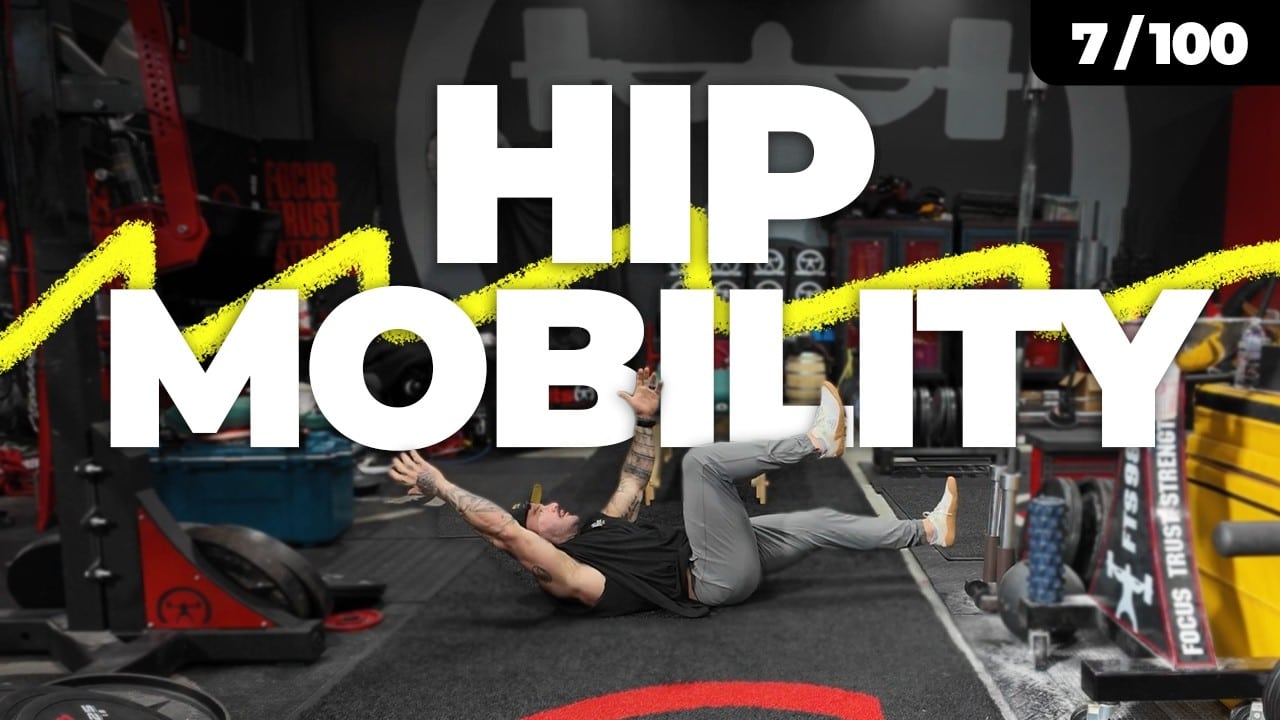
Working alongside legendary powerlifter Dave Tate and Air Force performance coach Sam Brown, O’Neill broke down practical exercises that simultaneously build bulletproof core stability while unlocking restricted hips.
What emerged was a masterclass in functional training that goes far beyond crunches and stretching.
Jump to:
The Bracing Problem Nobody’s Talking About
Dave Tate has spent decades coaching some of the world’s strongest athletes. His perspective on core training might surprise you.
The longer you’re around this, the issues change like in four-year periods, five-year periods. In the last five years, bracing has become a big issue.
According to Tate, most people fundamentally don’t understand how to brace their core properly. They can hold a plank for five minutes, but that doesn’t mean they’re bracing correctly.
If they brace properly, trying to do a plank after they’re really doing it right, four to six seconds, man, is brutal.
The real issue? People cheat planks by relying on their erector muscles instead of creating true trunk stability. This compensation pattern carries over into everyday life with devastating consequences.
When Poor Bracing Leads to Injury
Tate posed a revealing question to lifters everywhere: How many times have you tweaked your back?
Did you do it on a main lift? Very rare. Which means you don’t know how to brace when you pick up a laundry basket. You don’t know how to brace when you’re getting in and out of your car.
This reality check highlights how dedicating three or four minutes to core work before training means nothing if bracing isn’t practiced throughout the entire day.
The solution? Integrate bracing into everything—lat pulldowns, push downs, even accessory movements.
The Dead Bug: Superior to Planks for Real Core Control
Both Tate and O’Neill emphasized the dead bug as the foundational exercise for building authentic core stability while developing hip mobility.
Unlike planks, dead bugs provide immediate feedback. Your lower back either stays pressed against the floor or it doesn’t—there’s no hiding compensation patterns.
How to Execute the Perfect Dead Bug
- Starting position: Lie on your back with arms and knees at 90-degree angles
- Stack your rib cage: Pull your pubic bone toward the top of your rib cage
- Exhale and engage: Pull your ribs down before initiating movement
- Alternating motion: Extend one leg while bringing the opposite arm overhead
- Maintain connection: Keep your lower back pressed into the floor throughout
O’Neill explained that dead bugs train proximal stability with distal mobility—exactly what’s needed for heavy compound lifts.
Progressive Variations to Challenge Every Level
The beauty of dead bugs lies in their scalability:
- Band around feet: Increases hip flexor engagement with each leg extension
- Overhead band pullover: Targets the rib cage-to-pelvis connection
- Front-loaded bands: Forces hip flexor activation as you pull the foot forward
- Weighted variations: Add dumbbells or plates for advanced trainees
- Incline position: Increases difficulty by changing the resistance angle
Choose your variation based on where your weakness lives—weak hip flexors get banded variations, while rib-flaring issues benefit from pullover modifications.
The Hip Airplane: Diagnostic and Corrective in One
Sam Brown works with Air Force pilots—a population that spends countless hours seated in cockpits at 30,000 feet. His go-to assessment and correction tool is the hip airplane.
A lot of the pilots I work with are essentially sitting at a desk that just so happens to be flying at 30,000 feet. They’re in a seated position just like most people for the majority of their day.
Brown discovered that most people are completely unaware of hip positioning and how their core should stabilize pelvic movement.
Why Hip Airplanes Expose Hidden Restrictions
The hip airplane forces you to stabilize your pelvis while rotating your hip through internal and external ranges of motion.
I put them in a hip airplane and they’re like, ‘My core is lighting up.’ And it’s like, yeah, it’s trying to stabilize your pelvis. It’s trying to stabilize your hips.
This exercise immediately reveals restrictions while simultaneously creating the buy-in needed for consistent core work. When someone feels their limitation firsthand, ego disappears.
Executing Hip Airplanes for Maximum Benefit
O’Neill demonstrated multiple progressions:
- Assisted version: Hold a rack or barbell with both hands for stability
- Single-leg stance: Progress to unsupported balance
- Single-leg RDL to airplane: Combine hip hinge with rotation (close-open-close pattern)
- Loaded variations: Loop a kettlebell or dumbbell around your back on the opposite hip
The loaded version is particularly effective. Placing weight on the opposite hip pulls you into internal rotation, forcing your glute and obliques to work overtime to maintain position.
O’Neill has used up to 70 pounds in training sessions, proving this isn’t just a mobility drill—it’s legitimate strength work.
Three Additional Core-Hip Mobility Power Moves
O’Neill rounded out his recommendations with three exercises that train different planes of motion while integrating core stability.
GHD Reverse Leg Raise
Position yourself facing away on a glute-ham developer with hands gripping the foot plate and legs extended forward.
The key is starting with proper breathing mechanics: exhale at the bottom, tuck your pelvis underneath (posterior pelvic tilt), then bring legs up into a reverse crunch.
This trains global hip and thoracic extension while preventing the lower back compensation that plagues most ab exercises.
Copenhagen Plank Variations
This exercise targets the anterior oblique sling—the connection between obliques and adductors that’s often neglected in traditional core training.
Position yourself in a side plank with your top foot elevated on a bench. The further down your leg the contact point, the harder the movement becomes.
Three progression levels:
- Isometric hold: Squeeze top glute, pull with bottom leg adductor, maintain straight alignment
- Active lateral flexion: Drop hip toward floor, then drive back up
- Rotational variation: Add cross-connect arm movements while maintaining hip stack
The Copenhagen plank trains anti-lateral flexion—essential for preventing energy leaks during heavy squats and deadlifts.
Single-Arm Farmer Carry
O’Neill called this his favorite for integrating rotation with natural gait mechanics.
Each step creates a single-leg stance phase where your core must stabilize against an opposite-hand load—exactly the rotational demand your body faces during running, jumping, and athletic movement.
Programming options include heavy loads for short distances or lighter weights for extended duration. O’Neill’s personal favorite: a 20-30 pound kettlebell for a 20-minute walk, switching hands every minute.
Nothing will light up your core more than a walk like that, and your hips will be fantastic because they’re going through that natural lateral sway of your gait cycle.
Advanced variations include front-rack position for different stimulus or overhead carries for anti-extension training combined with shoulder mobility work.
Training Core for Transfer, Not Just Aesthetics
O’Neill emphasized a critical distinction often missed in core training: exercises should be loaded and taken close to failure, not just performed for high reps with minimal resistance.
These movements can and should be progressed aggressively. Train them with the same intensity you’d bring to your main lifts—that’s where true transfer to the big three and athletic performance happens.
Building visible abs requires low body fat, but developing thick, hypertrophied core musculature ensures those abs show through at higher body fat percentages while providing the stability needed for elite performance.
The integration of hip mobility with core strength isn’t just smart programming—it’s essential for longevity in training and life. As Tate pointed out, you can’t compartmentalize bracing to just your training sessions. Master these movement patterns, and you’ll protect your spine whether you’re deadlifting 600 pounds or picking up your child’s toy off the floor.