

Four months of daily effort, zero pull-ups to show for it.
That’s the reality for thousands of people who buy door-frame bars, watch tutorials on repeat, and hang there with shaking arms, wondering why their chin refuses to clear that metal by even half an inch.
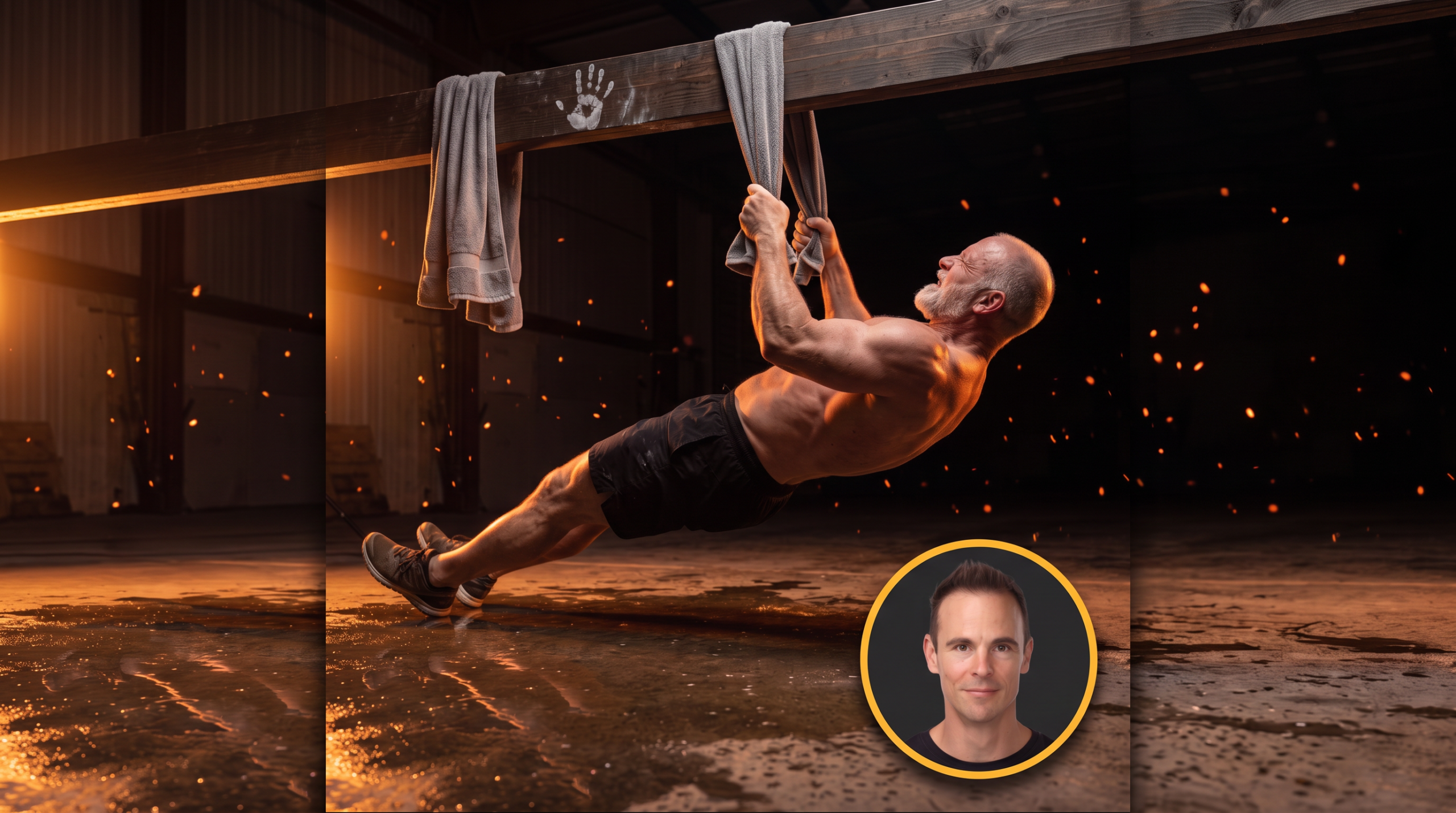
Every fitness influencer online insists pull-ups are the foundation of back strength, yet countless people hit a wall and stay there, no matter how hard they try.
What if the problem isn’t effort, but the exercise itself?
Old-school strongmen built legendary backs without making pull-ups their foundation, and the alternatives they used—three simple exercises involving a table, a towel, and a rope—scale perfectly regardless of starting strength level.
Jump to:
Why Pull-Ups Keep So Many People Stuck
Pull-ups hang the body from an overhead bar and demand vertical pulling strength. At the top of that movement, the shoulder rotates inward, and that internal rotation under load creates a position where impingement can easily occur.
For people whose shoulders have been rolling forward from years of desk work and driving, that position is already compromised before training even begins.
The movement doesn’t scale down smoothly. Either the chin clears the bar, or it doesn’t. There’s no middle ground, no adjustment dial.
That’s why so many people spend months grinding away without progress—the exercise itself is a locked door, and most never find the key.
Exercise One: The Inverted Row
Instead of pulling vertically with the shoulder rotating inward, the inverted row shifts the angle completely. You pull horizontally, and the shoulder stays neutral the entire time.
The lats, rhomboids, and rear deltoids all get loaded, but the shoulder joint never gets forced into the position that produces pain.
Researchers measuring muscle activation during inverted rows found that the movement fires deep stabilizers of the shoulder complex and hits the rear deltoids hard. That matters because rear delt strength is what pulls shoulders back into proper alignment after years of forward collapse.
How to Set Up
- Find a solid table that holds your weight without wobbling
- Lie underneath it
- Grip the edge with hands slightly wider than shoulder width
- Keep body in a straight line from heels to head
- Pull chest all the way up to the underside of the table
- Pinch shoulder blades together hard at the top
- Lower with control
Body angle controls difficulty. Start at 45 degrees with feet tucked in for easier resistance. Move feet out toward horizontal as strength builds.
That’s the progression—infinitely adjustable.
A pull-up is a locked door. The inverted row is a dimmer switch.
The Lowering Phase Builds Strength
Take three full seconds on the way down. That eccentric phase is where strength actually gets built.
When 12 to 15 clean horizontal reps feel easy, elevate feet on a chair to shift more load onto the upper back.
Why Grip Strength Matters More Than Most People Realize
Grip strength predicts overall mortality risk better than almost any other simple test a doctor can perform. Not blood pressure, not resting heart rate. Grip.
A major review published in the British Medical Journal confirmed the correlation. Stronger grip means longer life, fewer hospitalizations, and better functional independence over time.
Old-school strongmen knew this before the research existed. They never isolated forearms with wrist curls. Instead, they made every pulling movement harder to grip by using towels, ropes, and thick bars.
The next exercise takes that philosophy and builds it directly into back training.
Exercise Two: The Towel Row
Same setup as the inverted row, but instead of gripping the table edge, drape a folded bath towel over it. Grab one end in each hand, palms facing each other.
Pull chest up to the towel and crush the towel hard from first rep to last.
When researchers compared muscle activation between standard pulling movements and towel variations, the towel version produced significantly higher activity in forearm and grip muscles. Because the towel is unstable, the back has to recruit more fibers just to keep the movement controlled.
More total muscle work per rep, not because the exercise is more complicated, but because the implement demands more.
Every squeeze of that towel mimics the same finger flexion pattern used to carry groceries, lift a suitcase, or haul a bag across a parking lot. This isn’t grip training tucked onto the side of a back workout—it’s grip training disguised as a back workout, and both are happening simultaneously.
The Mistake That Kills the Point
Relaxing the grip at the top when chest meets towel. That’s where most people let it go slack.
Keep crushing it through the entire range of motion. If forearms aren’t burning by the third rep, the squeeze isn’t honest.
Progress the same way as the inverted row: feet further out, body more horizontal.
Long-term, the full towel pull-up is available—hang the towel over a bar, grip both ends, pull until chin clears hands. But 90% of the benefit lives in the row itself, and you never need to reach the pull-up variation to build a strong back and crushing grip.
Exercise Three: The Rope Pull
This is the exercise that made old-school strongmen question whether pull-ups were necessary at all.
The arm-over-arm rope pull is still contested in strongman competitions today. Competitors pull a heavy rope hand over hand while legs brace and the core fights to prevent them from sliding across the floor.
Lats, rhomboids, traps, biceps, and forearms all fire together—not in sequence, but simultaneously—while the core anchors the entire chain.
Unlike a standard row, resistance never disappears. The moment one hand finishes pulling, the other takes over. That means back and arms stay under tension from first pull to last.
There is no comfortable pause between repetitions, and nowhere for weak grip strength to hide.
How to Set Up
- Attach a thick rope (at least an inch in diameter) to something heavy: a sturdy bag full of books, a weighted gym bag, a securely tied sandbag, or a laundry basket loaded with weights
- Sit on the floor 6 to 8 feet away with rope stretched out in front
- Pull hand over hand, dragging the weighted object toward you until it reaches your hands
- Move object back to starting position, reset, and repeat
Keep chest tall and torso controlled as you pull. Don’t turn it into a frantic tug-of-war.
Each hand should reach forward, clamp down hard, and pull rope toward the body before the opposite hand takes over. The smoother the rhythm becomes, the longer you’ll be able to keep working.
No rope? A folded bed sheet, a heavy towel, or a gym bag strap all work. The equipment isn’t the point. The movement pattern is.
Why This Exercise Builds Endurance
Because you’re seated and pulling in a straight line, there’s no overhead position and no shoulder rotation under load. The joint stays neutral the whole time, making this one of the safest pulling exercises available for shoulders that have accumulated mileage.
The real prize here isn’t strength—it’s endurance. Pulling for 30, 40, or 50 continuous seconds teaches the nervous system to sustain a pulling effort longer than standard sets ever allow.
Rows and any overhead pulling you do will feel easier afterward because the body has learned to keep pulling without quitting.
Start with shorter rounds if necessary. Twenty or thirty seconds of uninterrupted pulling is enough to expose exactly where grip, arms, or back begin to fade.
Add time gradually instead of sacrificing control just to survive a longer set. Build toward five sets of 60 continuous seconds. That’s 5 minutes of total pulling work that develops more functional back strength than most people accumulate in a month of grinding out partial reps.
The Weekly Plan
Monday: Inverted Rows
- Three sets, as many clean reps as possible with a 3-second lowering phase
- 60 seconds rest between sets
Wednesday: Towel Rows
- Three sets of 8 to 10 reps, crushing the towel from start to finish
- 60 to 90 seconds rest so forearms recover between sets
Friday: Rope Pull
- Three sets of 30 to 45 seconds of continuous hand-over-hand pulling
- 60 seconds rest between sets
Optional Finisher: Pick up something heavy in one hand and walk for 30 seconds. Switch hands and repeat. That’s a suitcase carry—grip, traps, and core stability in one simple movement.
Three exercises, three sessions, 15 minutes each.
Why This Approach Works When Pull-Ups Don’t
Pull-ups are a locked door for most people. They demand a baseline of strength that many don’t have yet, and they offer no smooth way to build toward that baseline.
A table, a towel, a rope—that’s all old-school strongmen needed to build backs that lasted decades, grips that didn’t fail, and pulling strength that carried over to every physical thing they encountered in daily life.
These three exercises scale infinitely. They don’t punish shoulders. They build grip strength that predicts longevity. And they develop pulling endurance that translates directly to real-world tasks.
You don’t need to force the locked door anymore. The window has been open the whole time.
Sources
- British Medical Journal – grip strength and mortality review










