Fitness influencer Sam Sulek recently trained arms with podcaster Chris Williamson, and the session revealed more than just workout techniques.
It showcased a training philosophy built on intensity, mental toughness, and a counterintuitive approach to form that challenges modern fitness trends.
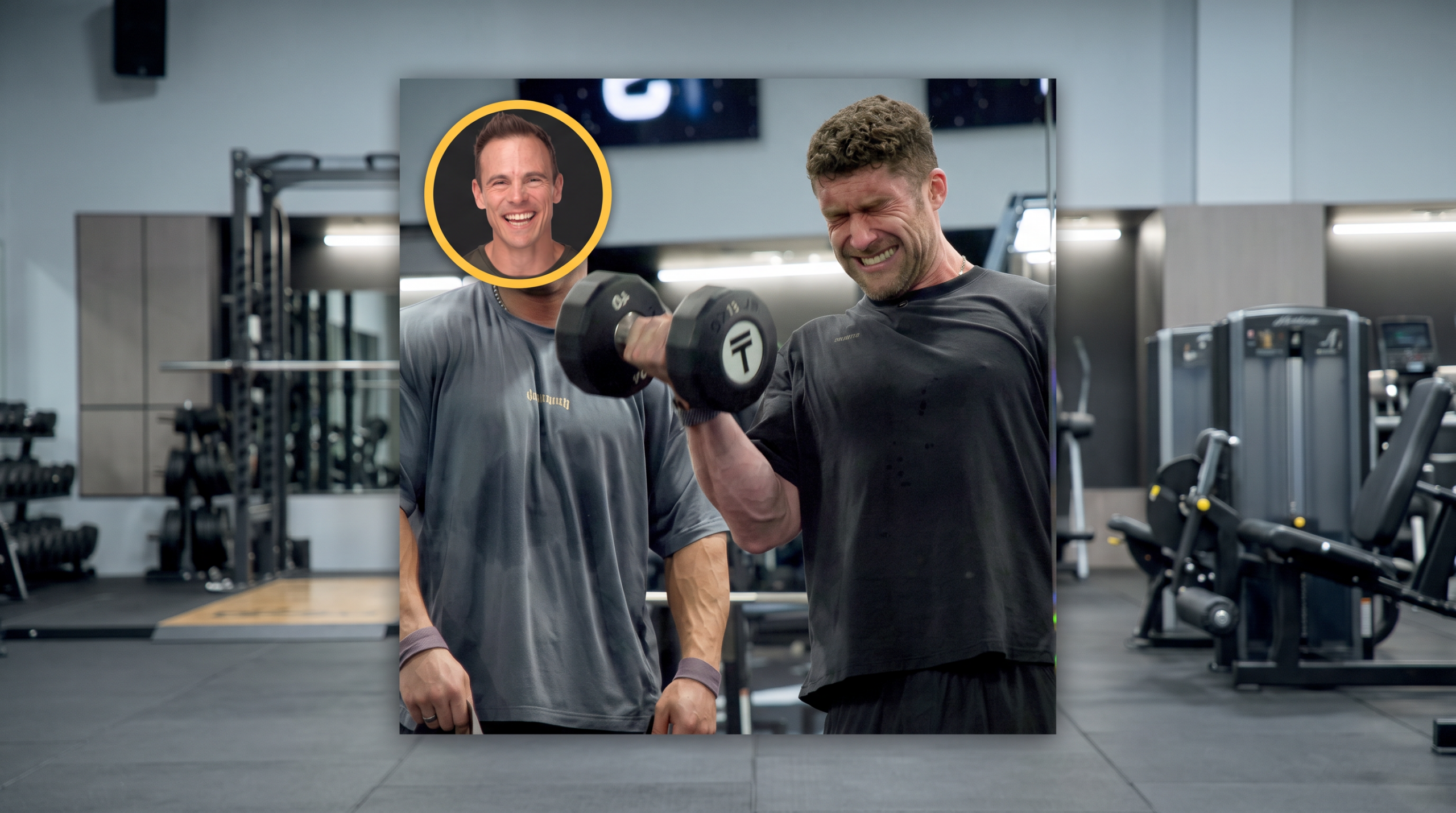
The conversation touched on everything from the psychology of perfect first sets to why big arms without shoulders might be sabotaging your physique.
And yes, there was talk of passing out from squats—on purpose.
Jump to:
- First Set Sets the Tone
- The Form Versus Intensity Debate
- Small Shoulders, Big Arms: A Physique Killer
- Grip Adjustments for Maximum Contraction
- The Mental Bandwidth Theory
- Why Weighted Side Bends May Thicken Your Waist
- Training in Heat Without Water
- The Squat-Induced Pass-Out Fantasy
- Rest-Pause and Myo-Reps for Volume
- Assisted Reps Beyond Failure
- Internal Versus External Motivation
- Gym Environment Philosophy
- Maintaining Muscle on Minimal Volume
- Sources
First Set Sets the Tone
Sulek emphasized a critical training principle: the first set determines everything that follows.
You know, like you if you have a bad January 1st, you might as well just skip the whole year.
He described moments where he’d rack the weight after a half-hearted first set, immediately recognizing the self-sabotage.
I like rack it. Totally could have done five more. And I’m like looking at myself, what the fuck did I just do?
This mental checkpoint prevents the domino effect of mediocre training. A scrappy opening creates permission to coast through remaining sets.
Williamson noted how this approach mirrors broader goal-setting psychology—starting strong builds momentum that carries through entire training blocks.
The Form Versus Intensity Debate
The conversation shifted to bodybuilding legend Dorian Yates’ recent criticism of reps-in-reserve (RIR) training.
Sulek suggested that prioritizing perfect form can inadvertently increase RIR, leaving gains on the table.
If you hold yourself to too high of a standard for form, your reps and reserve inevitably end up ticking up.
He acknowledged context matters—partial reps on heavy barbell incline press without a spotter invite disaster. But strict adherence to textbook form, especially on isolation movements, may limit hypertrophy stimulus.
The key distinction: “nasty” sets work for curls but not squats. Compound movements demand technical precision for safety, while single-joint exercises tolerate controlled deviation when chasing mechanical tension.
Both agreed that appearing perfect while leaving effort in reserve defeats the purpose.
Small Shoulders, Big Arms: A Physique Killer
Sulek dropped a brutally honest physique assessment most lifters miss.
Big arms, small shoulders makes you look like a fat guy. Small arms, big shoulders makes you look like a football player.
He argued that prioritizing arm development without proportional shoulder growth creates an optical illusion of being “chunkier” rather than muscular.
Williamson observed the opposite—oversized shoulders with underdeveloped arms—produces a “funky” look, almost as if wearing shoulder pads.
Sulek’s training reflects this philosophy. He revealed he hasn’t performed dedicated shoulder pressing in three to four years, focusing instead on bringing arm size up to match naturally developed delts.
The roundness of my shoulder is more than my bicep, my tricep. I want this to catch up.
This strategic imbalance correction demonstrates advanced body awareness—identifying weak points and adjusting training volume accordingly rather than following cookie-cutter programs.
Grip Adjustments for Maximum Contraction
During rope pushdowns, Sulek demonstrated a grip modification that enhanced tricep engagement.
Instead of holding rope handles separately, he pressed them together, creating a stability advantage similar to switching from dumbbell curls to hammer curls.
He also addressed hand placement on dumbbells, noting many lifters unknowingly reduce range of motion by gripping near the top of the handle.
I’ll see guy I’ve been seeing a lot where it’s the ego lifter like I’m curling 100 pound dumbbells. When they hold it with their the top of their hand at the top. Since their hand is at the top section of the handle, the weight is actually a little lower.
Gripping at the bottom forces the bicep to lift weight through a longer arc, increasing time under tension without adding load.
These micro-adjustments exemplify Sulek’s obsessive attention to mechanical advantage—extracting maximum stimulus from every rep rather than chasing heavier weights through leverage manipulation.
The Mental Bandwidth Theory
Sulek uses lifting straps on bicep movements, but not for the typical reason.
I feel like you’ve got a certain amount of bandwidth that you can send to really fire. So, if I’m wasting 30% of my bandwidth on forearms, what’s happening with my biceps?
This concept—neural drive allocation—suggests conscious effort has finite capacity. Devoting mental resources to grip security potentially reduces the signal sent to target muscles.
Whether physiologically accurate or placebo, the approach reflects intentional training optimization. By eliminating grip as a limiting factor, he ensures biceps reach mechanical failure before forearms give out.
The strategy also aligns with his broader training philosophy: remove variables that interfere with maximum intensity on target muscles.
Why Weighted Side Bends May Thicken Your Waist
Sulek critiqued a common ab exercise that may work against aesthetic goals.
When I see guys doing like 100 lb side bends, I’m like, dude, why do you want a thicker waist?
Heavy oblique training, particularly weighted side bends, builds lateral core musculature. For athletes requiring rotational strength or stability, this serves functional purposes.
But for physique-focused lifters chasing the V-taper illusion, thickening obliques expands waist circumference—exactly the opposite of bodybuilding’s goal.
He recommended prioritizing weighted crunches that target the rectus abdominis directly, building the “front section” without widening waist measurements.
This nuance—not all ab work supports aesthetic development—gets lost in generic core training advice. Strategic exercise selection based on specific outcomes matters more than volume alone.
Training in Heat Without Water
Perhaps the session’s most controversial element was Sulek’s hydration approach.
He trains in 78–80°F heat wearing long pants, often without drinking water mid-workout if fully hydrated beforehand.
Last summer I could barely do it cuz I was like bulking up. But I’ve been dieting this whole summer. I’m already a little colder, so it made it easier to work out in the hotter temperature.
Williamson responded with disbelief at the combination of environmental and self-imposed stressors.
This practice warrants caution. While pre-workout hyperhydration can sustain performance for 60–90 minutes, heat stress accelerates fluid loss through sweating. Individual tolerance varies dramatically based on acclimatization, body composition, and cardiovascular health.
Sulek’s leaner physique during his cut may improve thermoregulation compared to higher body fat percentages, but the approach isn’t universally advisable—especially for those unaccustomed to heat training.
The Squat-Induced Pass-Out Fantasy
One of the conversation’s most revealing moments came when Sulek described his ultimate intensity benchmark.
Sometimes I like to imagine myself doing a set of squats so good that at the end after I fail like I don’t hurt myself but I put it down on the safeties and I just actually pass out for real because I went so hard.
Williamson jokingly asked if Sulek might be a masochist. But the motivation isn’t suffering for its own sake—it’s validation of absolute effort.
This mentality echoes old-school bodybuilding ethos, exemplified by Tom Platz’s legendary leg training intensity. Sulek wants spectators at public gyms to witness sets so brutal they provoke genuine concern.
While extreme, the psychology reveals intrinsic motivation divorced from external validation. The goal isn’t applause—it’s knowing nothing remained in reserve.
Rest-Pause and Myo-Reps for Volume
Both Sulek and Williamson praised rest-pause techniques for accumulating volume when time or frequency is limited.
I love Myo reps. Like a rest pause, like just a rest pause, but the final like four. 3 seconds, go again. 3 seconds, go again. I can like do 10.
Williamson noted this approach compensates for reduced weekly training frequency during travel, allowing single sessions to pack additional effective reps beyond initial failure.
The strategy aligns with emerging research showing that total hard sets per muscle group per week drives hypertrophy more than specific set-rep schemes. Rest-pause extends a single set’s stimulus, potentially replacing an entire additional working set.
Sulek emphasized this isn’t necessary for every set—but when volume needs boosting, brief intra-set rest periods maximize mechanical tension without excessive systemic fatigue.
Assisted Reps Beyond Failure
During leg presses, Sulek employed partner-assisted forced reps, continuing past technical failure with help lowering and lifting weight eccentrically.
Williamson observed the utility but cautioned against overuse.
There’s something to the assisted reps beyond failure. Maybe not every set.
The technique amplifies metabolic stress and recruits additional motor units as fatigue accumulates. But recovery cost increases dramatically—frequent use risks exceeding adaptive capacity, particularly on compound movements.
Strategic application on final sets of isolation exercises balances additional stimulus against systemic taxation, squeezing extra growth without compromising subsequent workouts.
Internal Versus External Motivation
Williamson asked whether Sulek had always been internally driven, prompting reflection on competitive bodybuilding’s role in his training.
Even winning the first two, like it was awesome. It’s like sweet. Like proof of like I’m doing all this stuff. But if I never did the show, I would still be me.
He acknowledged social validation provides a “performance booster” but insisted satisfaction comes from the process itself—getting bigger, stronger, and mastering training variables.
This autonomy shapes his competitive approach. Rather than chasing qualifications or stage validation, he’ll compete again only when preparation aligns with personal goals—potentially rolling existing leanness into prep rather than forcing a timeline.
The mindset represents mature self-awareness often missing in fitness culture, where external metrics—followers, trophies, PRs—become primary drivers rather than byproducts of genuine passion.
Gym Environment Philosophy
Both discussed how various gym atmospheres—from basement dungeons to multi-million-dollar facilities—can foster great training.
There’s lots of ways to get a gym wrong. But there’s also lots of ways to get it right. I don’t think oh this is there’s too many windows or it’s too bright and airy or it’s too high ceiling or too low ceiling or too like if the vibe’s right, the vibes right.
Williamson mentioned a Michigan gym with a commercial first floor and dungeon basement featuring a vault with squat rack—formerly a bank.
Sulek’s perspective reflects training maturity: equipment quality and atmosphere matter less than mindset and consistency. The best gym is the one you’ll use intensely and regularly, regardless of aesthetics or amenities.
Maintaining Muscle on Minimal Volume
Sulek pondered maintenance requirements—how little training would preserve size if growth wasn’t the goal.
If I wanted to what could I get away with in terms of minimizing my training volume like what would it really be? What would really be required to maintain?
Williamson suggested two brutal full-body sessions weekly might suffice, noting maintenance demands dramatically less stimulus than growth.
Research supports this: maintaining strength preserves cross-sectional area with as little as one-third the volume required for hypertrophy, provided intensity remains high. Frequency can drop to once weekly per muscle group without significant atrophy in trained individuals.
The conversation highlighted an underappreciated training reality—muscle is relatively easy to maintain once built, making aggressive accumulation phases followed by strategic maintenance periods viable for long-term development.
Sources
- Bickel CS, Cross JM, Bamman MM. Exercise dosing to retain resistance training adaptations in young and older adults. Med Sci Sports Exerc. 2011;43(7):1177-1187. https://pubmed.ncbi.nlm.nih.gov/21131862/
- Schoenfeld BJ, Grgic J, Ogborn D, Krieger JW. Strength and hypertrophy adaptations between low- vs. high-load resistance training: a systematic review and meta-analysis. J Strength Cond Res. 2017;31(12):3508-3523. https://pubmed.ncbi.nlm.nih.gov/28834797/
- Burd NA, West DW, Staples AW, et al. Low-load high volume resistance exercise stimulates muscle protein synthesis more than high-load low volume resistance exercise in young men. PLoS One. 2010;5(8):e12033. https://pubmed.ncbi.nlm.nih.gov/20711498/