Collagen is everywhere right now, promising glowing skin, bulletproof tendons, and happy joints.
But does powder in a tub deliver?
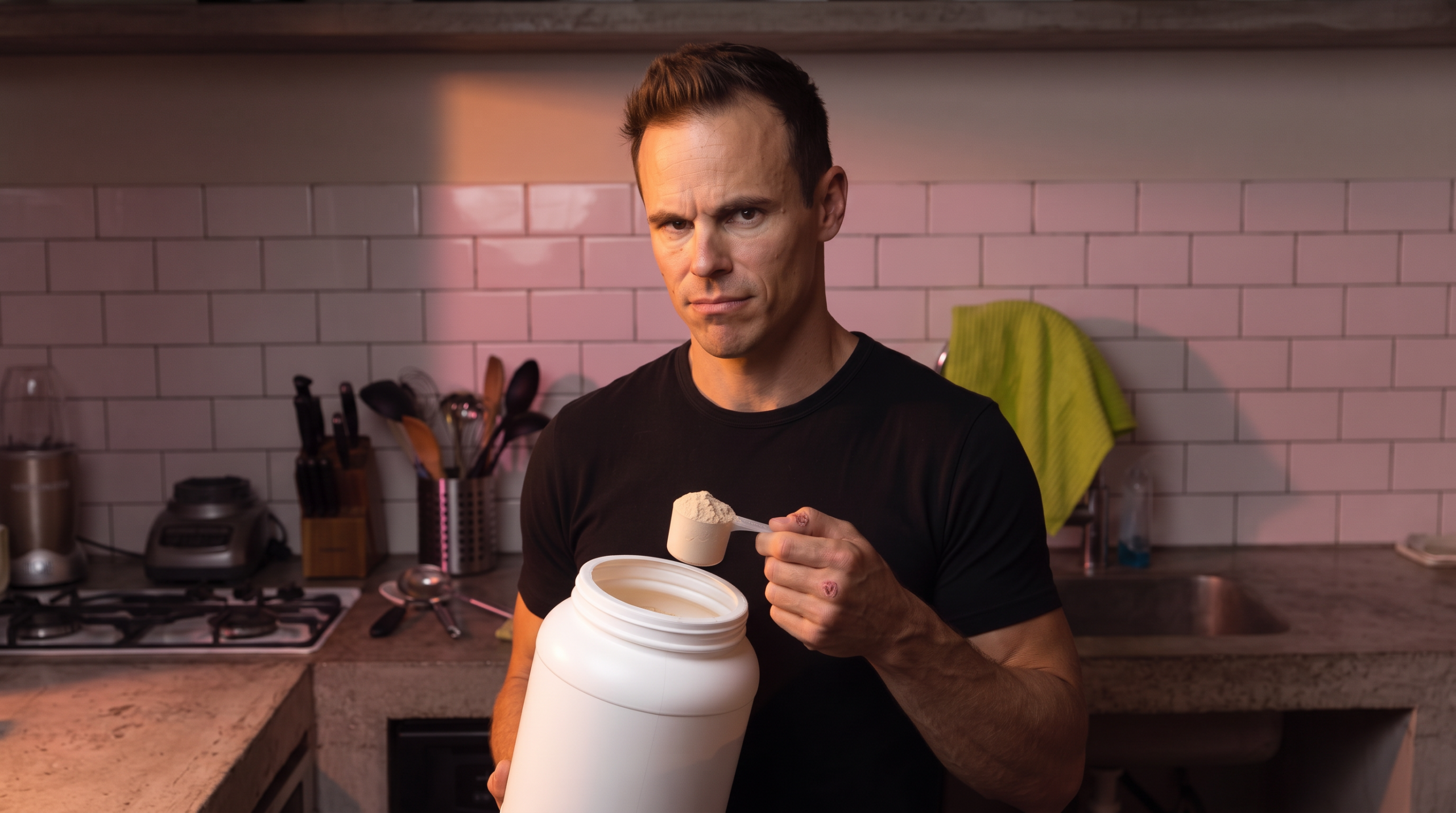
In a recent article, Physiqonomics writer Aadam dug through research on muscle, tendons, joints, and skin.
His verdict? Messier than the marketing suggests.
One set of charts reveals why skin studies deserve a serious squint.
Here’s what the evidence shows.

If you want something simple that actually works, this is one of the most effective tools I’ve used to build strength, conditioning, and endurance without needing a full gym setup.
- Full-body training with one weight using swings, squats, and presses
- Solid cast iron build that feels stable and lasts for years
- Comfortable grip that makes high-rep workouts easier to handle
Jump to:
What Collagen Actually Is
Collagen isn’t one protein but a family of proteins making up roughly 25–30% of total body protein. Two types matter most here:
- Type I: found mainly in skin, tendons, and bones
- Type II: found mainly in cartilage
Aadam’s favorite way to picture it:
One way to think of collagen is like the biological glue that holds your body together so you don’t collapse into a big ol’ human puddle.
Supplement labels often say hydrolysed collagen or collagen peptides. Translation: long amino acid chains have been chopped into shorter pieces.
Some peptides do reach your bloodstream. Absorption, though, doesn’t prove benefit.
Muscle Growth: Whey Wins
Collagen is rich in proline and glycine but low in essential amino acids like leucine and methionine, and tryptophan is missing entirely. On protein-quality scoring (DIAAS), collagen lands at zero while whey scores 1.09.
Some studies show collagen beating placebo for muscle, which shouldn’t surprise anyone. Give protein to people undereating it, and muscle tends to follow. One study even suggested gains in fat-free mass came from connective tissue, not muscle.
If you want something simple that actually works, this is one of the most effective tools I’ve used to build strength, conditioning, and endurance without needing a full gym setup.
- Full-body training with one weight using swings, squats, and presses
- Solid cast iron build that feels stable and lasts for years
- Comfortable grip that makes high-rep workouts easier to handle
Head-to-head trials tell the real story:
- 2022 trial (22 participants, 10 weeks): whey beat leucine-fortified collagen for thigh thickness (8.4% versus 5.6%) and biceps thickness (10.1% versus 6%).
- 2023 trial (45 athletes): after squats, whey boosted muscle protein synthesis over five hours, while collagen failed to outperform placebo.
If you want to gain (or retain) muscle, there’s no reason to use collagen over a higher-quality protein source like whey.
Tendons: Hype Outpaces Evidence
Tendons are roughly 60–85% collagen by dry mass, so supplement logic seems sensible. Researchers typically track two outcomes: thickness and stiffness.
A 2024 meta-analysis found collagen might improve thickness alongside training, with no clear stiffness benefit. Researchers rated certainty as very low.
A 2026 review, meanwhile, declared “strong evidence” for both. Aadam isn’t buying it.
- Only four of eight included studies fed the tendon analysis.
- Just two of those four found stiffness benefits.
- A relevant trial by Balshaw and colleagues was left out.
That trial put 39 men through 15 weeks of resistance training with either 15g of daily collagen or placebo. Patellar tendon stiffness rose roughly 17% with collagen and 21% with placebo, so training did the heavy lifting.
Injury research looks equally murky. Studies mixed injections, multi-ingredient products, and different injuries, and some lacked placebo groups.
If you want something simple that actually works, this is one of the most effective tools I’ve used to build strength, conditioning, and endurance without needing a full gym setup.
- Full-body training with one weight using swings, squats, and presses
- Solid cast iron build that feels stable and lasts for years
- Comfortable grip that makes high-rep workouts easier to handle
So, could collagen improve certain tendon adaptations? Possibly. But I wouldn’t feel confident recommending collagen for the ostensible tendon benefits based on the research that’s currently available.
Joint Pain: The Most Promising Territory
Evidence gets stronger here, particularly for knee osteoarthritis.
- 2025 meta-analysis (five trials): collagen delivered 13.6 extra points of pain relief on a 100-point scale. Results swung wildly, from about 30 points in two small comparisons to under 5 in a larger study.
- 2024 meta-analysis: average reduction of 8.5 points, holding up even among lower-bias studies.
- 2021 review: five small trials, all reporting some benefit, though types and doses varied.
Collagen is generally well tolerated, so it may be worth trying beside physiotherapy and smart training-load management. Small benefit? Yes. Potentially meaningful for persistent pain? Also yes.
Skin: Where Funding Changes Everything
Plenty of studies report better hydration, elasticity, and wrinkles. One 2024 trial showed exactly that, but the manufacturer funded it and four of five authors worked there.
Nothing shady necessarily happened. Still, manufacturer-sponsored research is more likely to report positive outcomes.
A 2025 meta-analysis shows the pattern. Industry-funded studies hit significance across all three outcomes, while independent studies didn’t. Higher-quality studies also fell short.
Look closer, though. Independent results leaned toward collagen, yet every confidence interval crossed the “no difference” line.
If you want something simple that actually works, this is one of the most effective tools I’ve used to build strength, conditioning, and endurance without needing a full gym setup.
- Full-body training with one weight using swings, squats, and presses
- Solid cast iron build that feels stable and lasts for years
- Comfortable grip that makes high-rep workouts easier to handle
The industry-funded research seems to strongly favour collagen, while the independent studies boil down to, “Eh, collagen might help, but we can’t say for sure and we need more independent research.”
Statistically Significant Isn’t Always Visible
One trial measured elasticity with a Cutometer, scoring from 0 to 1. Collagen drifted from 0.69 to 0.74, placebo from 0.69 to 0.70.
That 0.04-point edge counted as statistically significant. Even the researchers admitted results weren’t “translatable to clinical appearance.”
The Placebo Plot Twist
A 2026 trial gave 140 adults with crow’s feet either a collagen, vitamin E, and glutathione drink or placebo for 12 weeks. Five blinded evaluators graded photos and found no clear difference.
Here’s the kicker: both groups reported improved skin, even though half drank a dummy product. Measured hydration also rose equally in both.
So if you start supplementing with collagen and your skin starts looking better, maybe it was the collagen. Or, maybe, you just placeboed yourself.
Smarter Moves Than Collagen
Better-supported options exist for every goal:
- Muscle: choose higher-quality protein like whey.
- Tendons: prioritize resistance training.
- Joint pain: try strengthening exercises and modify aggravating activities. For osteoarthritis, add regular exercise and weight loss when relevant.
- Skin: use sunscreen regularly while awaiting independent research.
Aadam isn’t calling collagen useless. Better research could prove it as impressive as the internet claims, but today’s decisions shouldn’t hinge on a hypothetical future.
If you want something simple that actually works, this is one of the most effective tools I’ve used to build strength, conditioning, and endurance without needing a full gym setup.
- Full-body training with one weight using swings, squats, and presses
- Solid cast iron build that feels stable and lasts for years
- Comfortable grip that makes high-rep workouts easier to handle
Take it if you want. It’s generally safe and may offer some benefits. But if you’re worried you’re missing out on something by not taking collagen, you probably aren’t.