Isometric training might be the missing piece in your strength routine that strengthens tendons and connective tissue better than traditional dynamic exercises.
Movement coach and fitness expert Mark Wildman recently broke down exactly how to integrate isometrics into any training program—and why cutting back on some dynamic work might actually accelerate your progress.
The approach isn’t about abandoning what’s working.
It’s about strategically replacing volume to build bulletproof connective tissue while recovering faster.
Jump to:
- Why Connective Tissue Needs Different Stimulus
- Rethinking Your Training Split
- Understanding Yielding vs. Overcoming Isometrics
- The 3LD Protocol: Long Duration, Low Intensity
- Practical Applications for Different Goals
- Programming Isometrics Into Your Week
- Safety and Accessibility Advantages
- What Isometrics Don’t Replace
Why Connective Tissue Needs Different Stimulus
Wildman explains that isometric holds target tendons and ligaments more effectively than standard repetition-based training. The difference comes down to sustained tension versus intermittent stress.
Instead of doing bicep curls, if you have an isometric where you’re holding your hand out and you’re getting direct stress on the bicep tendon, that bicep tendon is going to respond much better to the isometrics versus doing the dynamic bicep curls.
While dynamic movements certainly strengthen tendons, they don’t maintain constant tension on connective tissue throughout the entire range. Isometrics fill that gap by creating prolonged stress at specific joint angles.

If you want something simple that actually works, this is one of the most effective tools I’ve used to build strength, conditioning, and endurance without needing a full gym setup.
- Full-body training with one weight using swings, squats, and presses
- Solid cast iron build that feels stable and lasts for years
- Comfortable grip that makes high-rep workouts easier to handle
Another advantage? Recovery happens significantly faster with isometric work—sometimes within 6 to 8 hours compared to the typical 48-hour window needed after heavy dynamic training.
Rethinking Your Training Split
For lifters currently training dynamically four to five days weekly, Wildman suggests a strategic redistribution of training volume.
If you’re somebody who’s doing dynamic strength training five days a week, four or five days a week, there could be some benefit for you, your body, and your structure to decreasing your overall training volume of dynamic training to potentially two to three times a week and replacing some of those sessions with more isometric training volume.
This doesn’t mean abandoning traditional strength work. Dynamic training remains essential for building muscle and developing power through full ranges of motion.
But balancing both methods creates comprehensive development—muscles get stimulated through dynamic work while connective tissue receives targeted strengthening through sustained holds.
Understanding Yielding vs. Overcoming Isometrics
Wildman identifies two fundamental types of isometric contractions that create different training effects.
Yielding Isometrics: Fighting Gravity
Yielding isometrics involve holding a position against an external load, whether that’s gravity, weights, or resistance bands. The goal centers on maintaining position without movement.
If you want something simple that actually works, this is one of the most effective tools I’ve used to build strength, conditioning, and endurance without needing a full gym setup.
- Full-body training with one weight using swings, squats, and presses
- Solid cast iron build that feels stable and lasts for years
- Comfortable grip that makes high-rep workouts easier to handle
A classic horse stance demonstrates this perfectly. Standing with bent knees and wide feet, the objective becomes preventing gravity from pushing the body lower.
Wall sits represent another common yielding isometric. Holding that 90-degree knee angle while pressing your back against a wall creates sustained tension throughout the quadriceps and surrounding connective tissue.
Overcoming Isometrics: Creating Maximum Tension
Overcoming isometrics change the game entirely by introducing intent to move an immovable object.
We’d make it an overcoming isometric by changing the intent of my feet. You see the ground won’t move. And right now in this horse stance, I’m just keeping my feet in place. But if my intent now is to push the ground together in this horse stance, immediately now this becomes an overcoming isometric on the tissues of the adductor.
That same horse stance transforms when actively attempting to push both feet together. The ground doesn’t budge, but adductor tension skyrockets as muscles fire maximally against immovable resistance.
Wall sits can similarly shift from yielding to overcoming. Rather than simply holding position, actively driving feet into the floor while pushing the back into the wall recruits entirely different muscle fibers and creates dramatically increased tension around knee joints.
The 3LD Protocol: Long Duration, Low Intensity
Most strength coaches program isometrics as maximal-effort holds lasting just seconds. While effective for neural drive, Wildman advocates a different approach inspired by researcher Dr. Keith Baar.
If you want something simple that actually works, this is one of the most effective tools I’ve used to build strength, conditioning, and endurance without needing a full gym setup.
- Full-body training with one weight using swings, squats, and presses
- Solid cast iron build that feels stable and lasts for years
- Comfortable grip that makes high-rep workouts easier to handle
The 3LD method—long duration, low intensity isometrics—offers broader benefits including connective tissue adaptation, blood pressure reduction, and dramatically improved safety profiles.
When I do this isometric, whatever I choose to do, I’m going to have the intent of putting in 50% force. 50% force for 30 or so seconds.
Instead of grinding through maximum effort for brief periods, maintaining moderate tension for extended durations creates different physiological adaptations.
Why Lower Intensity Works Better
Prolonged tension at submaximal intensities allows something called “creep” to occur within tendons. Stronger portions of connective tissue fatigue first during extended holds.
As the set progresses, weaker areas that typically don’t receive adequate stimulus finally get stressed. This comprehensive loading strengthens tendons more completely than brief maximal efforts.
Blood pressure benefits also emerge from moderate-intensity isometrics. Research shows isometric training effectively lowers blood pressure—but maximal efforts spike cardiovascular stress dangerously, especially for older adults or those with existing hypertension.
Breathing throughout the hold remains absolutely critical. Holding breath during isometrics creates dangerous pressure spikes that negate cardiovascular benefits.
If you want something simple that actually works, this is one of the most effective tools I’ve used to build strength, conditioning, and endurance without needing a full gym setup.
- Full-body training with one weight using swings, squats, and presses
- Solid cast iron build that feels stable and lasts for years
- Comfortable grip that makes high-rep workouts easier to handle
Practical Applications for Different Goals
Wildman provides several examples showing how to transform familiar movements into targeted isometric exercises.
Lunge Hold with Overcoming Intent
A standard lunge position creates yielding tension against gravity. Adding directional intent completely changes which tissues receive primary stress.
As I push that front leg forward, my hip flexor begins to fire. I feel that through my transverse abs. I’m getting tension. Now, as I try to pull this front leg back, I’m now getting tension through my hamstring and my hamstring tendon while trying to breathe.
This dual intent—simultaneously pushing the front foot forward while pulling it back—creates massive tension throughout hip flexors, hamstrings, and core stabilizers without any visible movement.
Kick Holds for Martial Artists
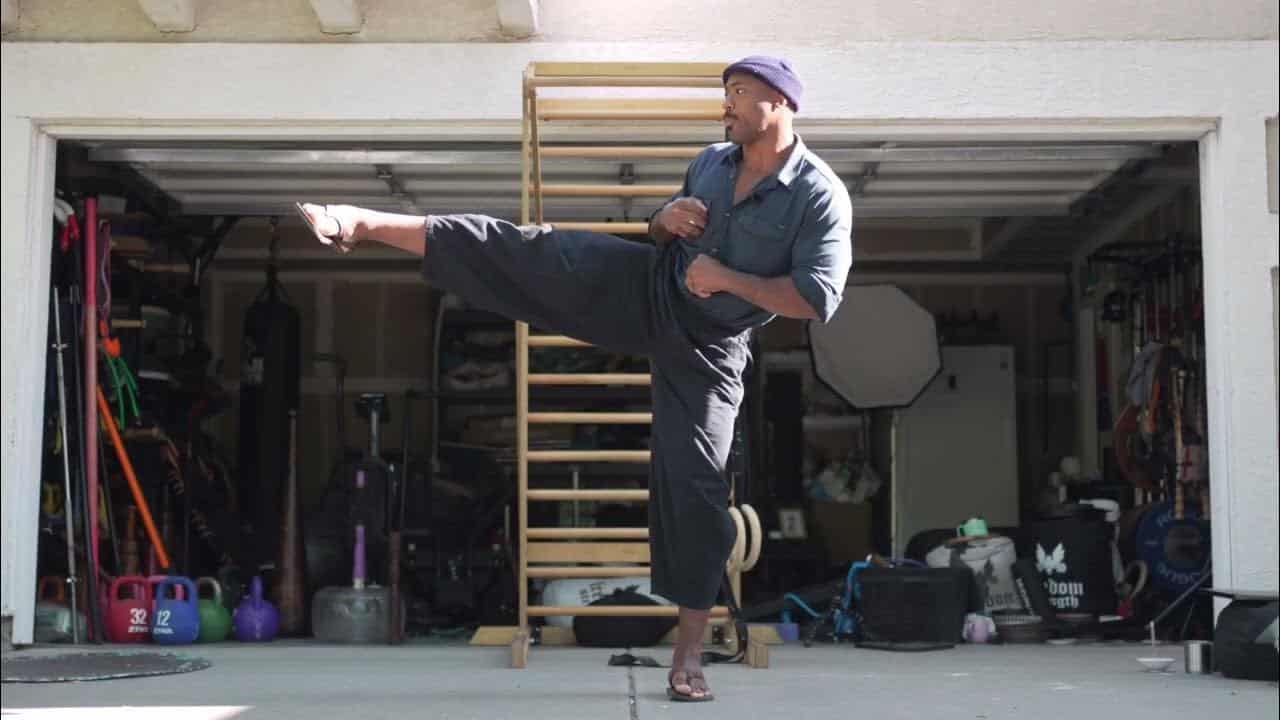
Athletes practicing kicks benefit enormously from isometric holds at various kicking angles. Rather than only performing dynamic kicks, holding the extended position builds positional strength and connective tissue resilience.
Wildman periodically practices raising his knee high, extending into kick position, then maintaining that pose against gravity. This yielding isometric strengthens stabilizers throughout the entire kinetic chain involved in kicking.
Gi Grip Training for Grapplers
Brazilian jiu-jitsu practitioners face unique grip demands that often lead to inflamed, bulbous knuckles from constant jerking forces on finger joints.
If you want something simple that actually works, this is one of the most effective tools I’ve used to build strength, conditioning, and endurance without needing a full gym setup.
- Full-body training with one weight using swings, squats, and presses
- Solid cast iron build that feels stable and lasts for years
- Comfortable grip that makes high-rep workouts easier to handle
A simple drill addresses this: step on your gi with one foot, grab the collar as you would during training, then pull upward with 50% intensity for extended periods.
My hands have never felt better or stronger because of the grip isometrics that I’ve been doing here.
This approach helps collagen form in more uniform patterns around hand structures while reducing inflammation. Over time, grip strength increases while joint stress decreases.
Programming Isometrics Into Your Week
Integration doesn’t require overhauling your entire program. Strategic placement maximizes benefits while preserving recovery capacity.
One effective approach: perform isometrics on opposite muscle groups from your dynamic training days. Upper body dynamic work pairs with lower body isometrics. Lower body training days incorporate upper body isometric holds.
This allows frequent training stimulus without compromising recovery, since fast-twitch muscle recovery from isometrics happens much quicker than from traditional strength work.
Volume Recommendations
Dr. Keith Baar suggests accumulating approximately 10 minutes of total time under tension per tissue. That might break down as:
If you want something simple that actually works, this is one of the most effective tools I’ve used to build strength, conditioning, and endurance without needing a full gym setup.
- Full-body training with one weight using swings, squats, and presses
- Solid cast iron build that feels stable and lasts for years
- Comfortable grip that makes high-rep workouts easier to handle
- Five sets of two-minute holds at 50% intensity
- Ten sets of one-minute holds
- Twenty sets of 30-second holds
Rest intervals between sets can remain short—30 to 60 seconds—since metabolic fatigue stays minimal with submaximal efforts.
“Microdosing” isometrics throughout the day also works beautifully. Brief 30-second holds during work breaks accumulate significant volume without formal training sessions.
Safety and Accessibility Advantages
Isometric training might represent the safest form of resistance training available, making it ideal for populations often excluded from intense strength programs.
Elderly individuals, those recovering from injury, or people with movement restrictions can all perform isometrics with minimal risk. No momentum, no eccentric loading, no coordination demands beyond maintaining position.
Equipment requirements essentially don’t exist. Walls, floors, and bodyweight provide all necessary resistance. Even advanced practitioners using specialized tools like the IsoFit device can replicate most benefits with creative positioning and household objects.
What Isometrics Don’t Replace
Wildman emphasizes throughout his explanation that isometrics complement rather than replace dynamic training.
If you want something simple that actually works, this is one of the most effective tools I’ve used to build strength, conditioning, and endurance without needing a full gym setup.
- Full-body training with one weight using swings, squats, and presses
- Solid cast iron build that feels stable and lasts for years
- Comfortable grip that makes high-rep workouts easier to handle
Full range-of-motion strength work develops different qualities—power production, coordination, muscle hypertrophy across varied lengths. Athletic performance requires movement through space, not just static holds.
The goal centers on strategic balance. Dynamic training builds muscle and develops force through ranges of motion. Isometric work bulletproofs connective tissue and fills recovery gaps between heavy sessions.
Combined intelligently, both methods create more complete physical development than either approach alone—stronger muscles and resilient joints capable of handling whatever demands training or life presents.