What happens when a world-famous lifting scientist trains his arms every single day for a month?
In a recent YouTube video, popular fitness creator Jeff Nippard answered that question while dragging a fellow creator through a full upper body session.
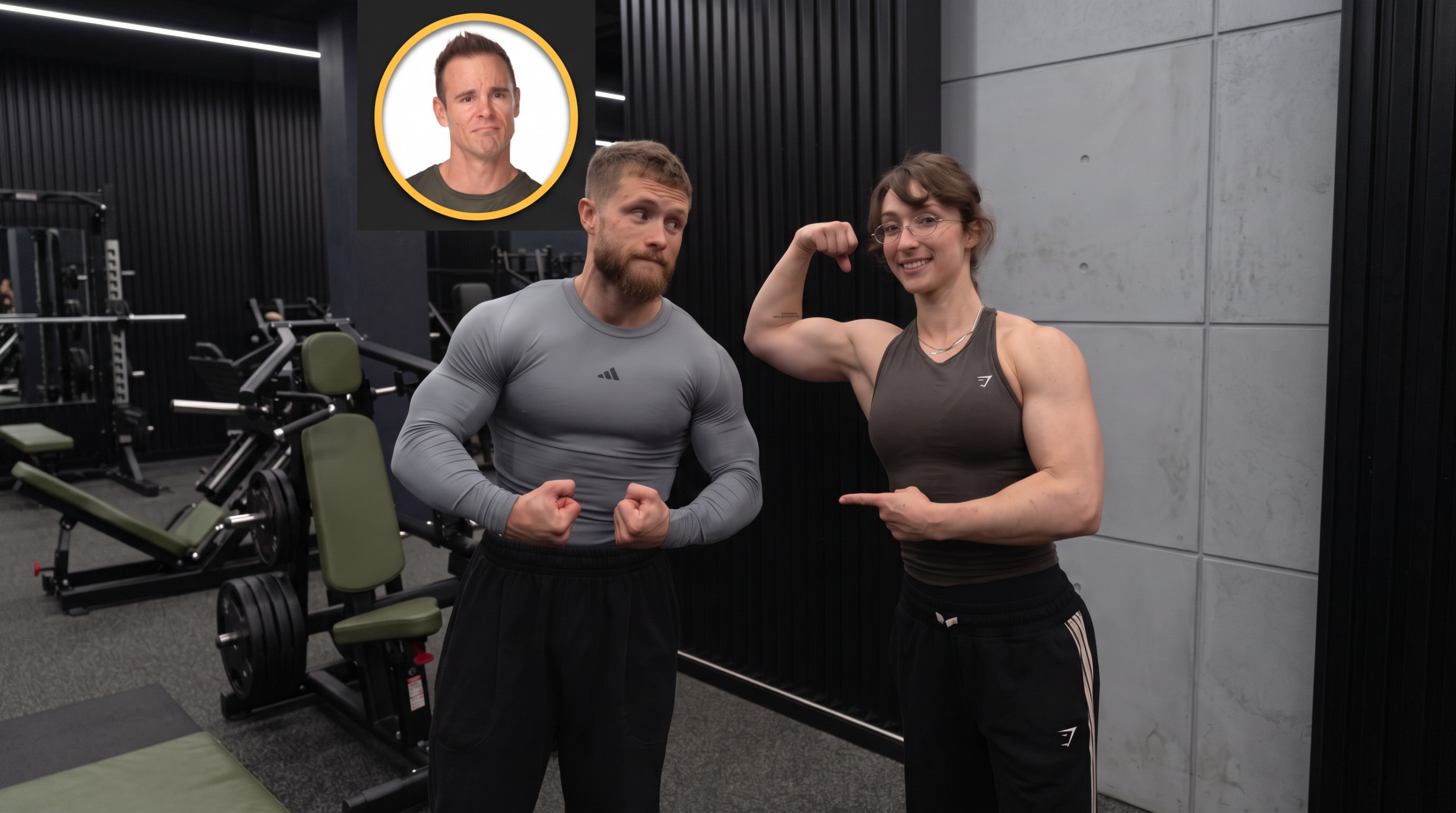
Along the way, he handed out technique cues that can instantly sharpen your own training.
One exercise even got called “underrated” by Nippard himself.
Ready to steal the whole playbook?
Jump to:
The 30-Day Arm Experiment
I’m doing an experiment where I train my biceps and my triceps every day for 30 days to see if they’ll grow.
Each day features one biceps movement and one triceps movement, with a different exercise every session. Nippard admitted he was running low on biceps options, which explains why chin-ups made today’s cut.

If you want something simple that actually works, this is one of the most effective tools I’ve used to build strength, conditioning, and endurance without needing a full gym setup.
- Full-body training with one weight using swings, squats, and presses
- Solid cast iron build that feels stable and lasts for years
- Comfortable grip that makes high-rep workouts easier to handle
His arms already look bigger. Still, he’s refreshingly skeptical of his own mirror.
What I don’t know is if it’s actual muscle tissue growth or if it’s just like pump, swelling, edema, that kind of thing.
His plan: ultrasound check-ins for two weeks after returning to a normal arm routine, to see whether the size sticks around. Until then, treat daily arm training as an open question, not a proven shortcut.
Chin-Ups: Curl Your Body Up
Chin-ups also recruit the back, so Nippard shifts emphasis toward his arms.
I try to focus on like using my biceps as much as possible instead of my back.
His trick? Treat the rep like a curl for your whole body.
- Keep legs slightly out in front
- Think about curling your body upward
- Control every descent
His partner cranked out 10 clean bodyweight chin-ups, earning praise for “technique” and “control.” Nippard chased 16 reps after hitting 15 the previous week.
Why Adding a Rep Matters
Nippard counts even a single extra rep as progress. His reasoning goes deeper than “numbers go up.”
If you want something simple that actually works, this is one of the most effective tools I’ve used to build strength, conditioning, and endurance without needing a full gym setup.
- Full-body training with one weight using swings, squats, and presses
- Solid cast iron build that feels stable and lasts for years
- Comfortable grip that makes high-rep workouts easier to handle
You need to be sufficiently close to failure to maximize hypertrophy.
As you get stronger, a fixed weight and rep target drifts further from failure. His fix:
You need to keep adding something to stay sufficiently close to failure.
Close-Grip Push-Ups: A Bodyweight JM Press
Standard push-ups hammer chest and front delts. Narrow the grip, and triceps take over.
I kind of think of it like a body weight JM press.
Nippard lets elbows collapse back rather than flaring wide, which helps him connect with the triceps. Wrist-sensitive lifters can angle hands slightly, as he does.
Mid-set, he coached his partner to shift feet back and rock the torso rearward, “like you’re lowering this barbell to your neck.” The result: instantly harder reps and a visible triceps burn.
Rows and Kelso Shrugs
Elbow angle decides which back muscles do the work. Flared elbows favor mid traps, tucked elbows favor lats.
For an even blend, Nippard suggests roughly 45 degrees.
If you want something simple that actually works, this is one of the most effective tools I’ve used to build strength, conditioning, and endurance without needing a full gym setup.
- Full-body training with one weight using swings, squats, and presses
- Solid cast iron build that feels stable and lasts for years
- Comfortable grip that makes high-rep workouts easier to handle
Once full rows become impossible, he switches to Kelso shrugs: elbows locked, shrugging backward rather than up. His critique of a common error was sharp.
What a lot of people have a tendency to do is turn it into like a spinal flexion and extension thing.
Rounding then unrounding shifts work toward the spinal erectors instead of traps. Keep the spine tall and the elbows straight.
Nippard usually prefers overloading the stretched position, though very heavy weights can make that bottom range hard to move. Lately, he’s settled for the middle ground.
The Vintage Lat Pullover Machine
Next came a retro, chain-driven pullover machine. Nippard described the movement as pure shoulder extension, the opposite of a front raise.
Biceps drop out entirely, so lats and a bit of triceps long head do the work. Compared with cables, the machine offers a big advantage.
With this one you’re completely locked. So like it’s just lats.
Biomechanically, he likens it to a neutral-grip pulldown with a slightly wider grip, minus any arm involvement.
If you want something simple that actually works, this is one of the most effective tools I’ve used to build strength, conditioning, and endurance without needing a full gym setup.
- Full-body training with one weight using swings, squats, and presses
- Solid cast iron build that feels stable and lasts for years
- Comfortable grip that makes high-rep workouts easier to handle
Cable Lateral Raises: Dig the Shovel
Nippard slightly prefers cables over dumbbells for side delts, citing smoother tension through the range.
You get maximum tension on the side delt when there’s a 90° angle between the path of resistance and your arm.
Does the choice matter for growth? Nippard recalled an eight-week study where cable and dumbbell groups, both training to failure, grew similarly. He noted that the cable group there used a restricted range, so deeper-range tension went unused.
His honest conclusion: small advantages could add up over time, but a meaningful difference after a couple of months? “I really doubt it.”
Stop Shrugging Your Way Through
Near failure, many lifters let traps hijack the rep. His cue helps keep delts in charge.
Like pressing down and then sweeping out.
Picture pushing a shovel down, then scooping sand to the side. Merely thinking about “lifting” tends to recruit more traps.
Finish with partials once full reps stall, keeping a fist down and sweeping out.
If you want something simple that actually works, this is one of the most effective tools I’ve used to build strength, conditioning, and endurance without needing a full gym setup.
- Full-body training with one weight using swings, squats, and presses
- Solid cast iron build that feels stable and lasts for years
- Comfortable grip that makes high-rep workouts easier to handle
The Grand Finale: Ab Wheel Rollouts
After tallying muscles hit so far, lats and shoulders were covered. Chest and abs lagged behind, so abs got the final slot.
Actually, like I think one of the more underrated exercises, to be honest with you.
Rollouts also train the serratus anterior, according to Nippard. Beginners can shorten the range, then lengthen it gradually for overload.
One more pro tip: no need to return all the way up, since tension disappears near the top.
Your Quick-Start Checklist
- Chin-ups: curl your body up, legs slightly forward
- Close-grip push-ups: let elbows travel back, rock torso rearward
- Rows: aim for roughly 45-degree elbows
- Kelso shrugs: locked elbows, tall spine, shrug backward
- Lateral raises: press down, then sweep out
- Ab wheel: start short, extend gradually
Whether daily arm work truly builds extra muscle remains unanswered. Nippard’s ultrasound follow-up should reveal how much of the gain was real tissue and how much was temporary swelling.