Eleven weeks after foot surgery, a elite ultrarunner stepped onto a treadmill at 6:00 a.m. with a workout he calls “so good for everybody.”
In a recent YouTube video, the popular ultrarunner and coach filmed the entire session.
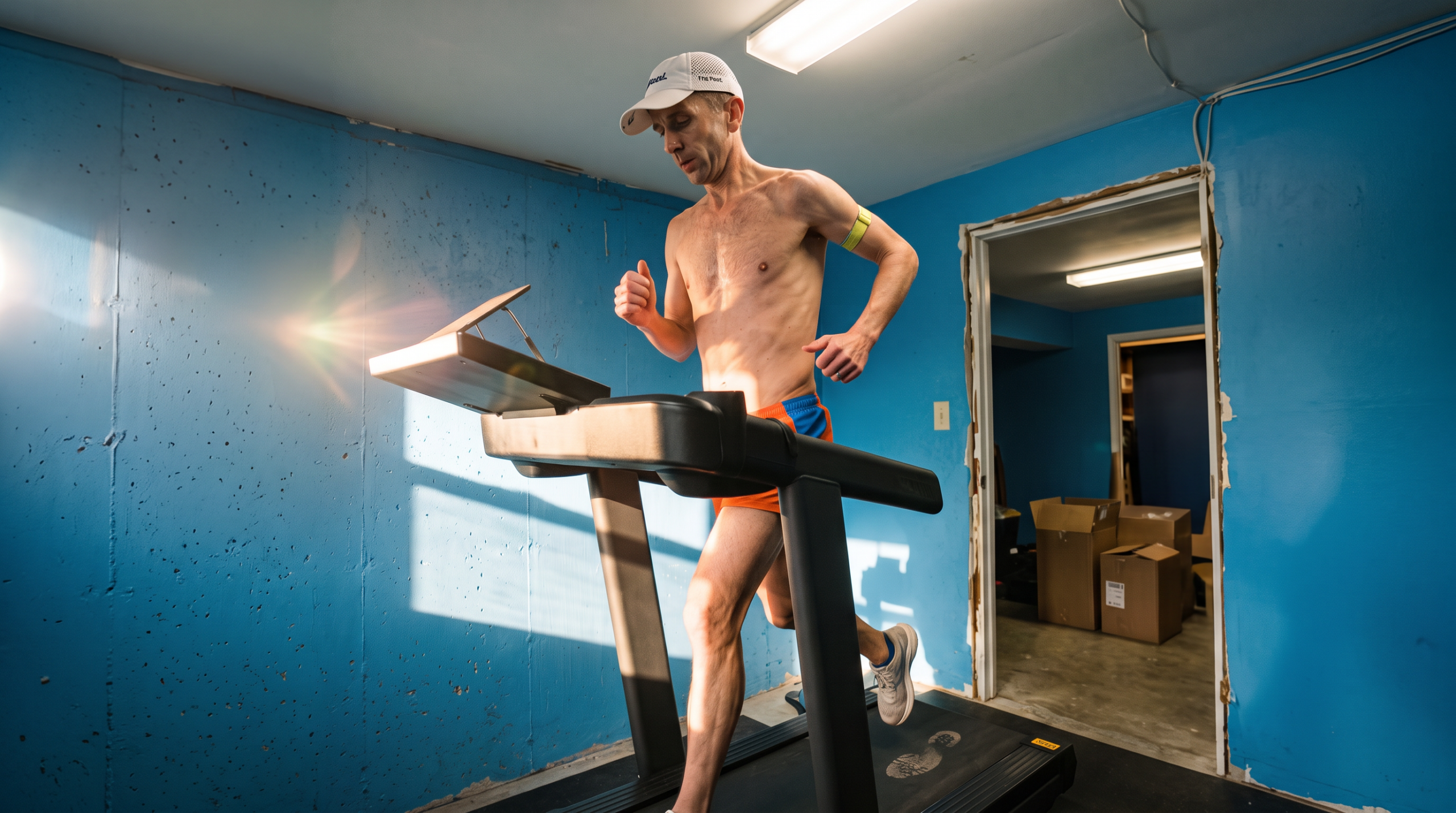
His claim: uphill zone two work sparked his biggest aerobic breakthroughs.
Why does a pace that feels like barely moving deliver such a payoff?
A brand-new running-form study may hold a clue.
Jump to:
The Big Idea: Aerobic Gains Without the Pounding
Uphill treadmill running lets you load your aerobic system hard while sparing your joints, bones and tendons. That matters most for athletes who cannot absorb heavy mileage.

If you want something simple that actually works, this is one of the most effective tools I’ve used to build strength, conditioning, and endurance without needing a full gym setup.
- Full-body training with one weight using swings, squats, and presses
- Solid cast iron build that feels stable and lasts for years
- Comfortable grip that makes high-rep workouts easier to handle
Because it’s uphill, you don’t have to go very fast to get your heart rate up into zone two.
Target intensity sits near LT1, the top end of zone two. He describes it as the point where “so much magic happens aerobically.”
How the Workout Works, Step by Step
- Pick a grade. He suggests 8% as a baseline.
- Hike first. Around 4 mph gets you comfortable on the belt.
- Move to a run. He began at 6 mph, with heart rate in the low 130s.
- Nudge speed every 10 minutes or so. Continue until heart rate settles near the top of zone two.
- Finish with fast hiking. He used 4 mph at 15% to extend aerobic work without pounding the foot.
His session plan: 45 to 75 minutes of running, depending on how the foot felt. Longer sessions, up to two hours, come later.
Which Grade Is Best?
Grades range from 4% for fast road runners, whose heart rates climb quickly, up to 15% for climbing specialists.
His own thinking shifted over time. He began at 15% but now calls it excessive for most athletes.
I think 8 to 10% is probably the sweetest of spots at this stage.
Easy-Feeling, Surprisingly Hard
Consider his numbers. At 8% grade, a 10-minute mile is, by his estimate, a bit faster than 7:30 pace on flat ground.
Cycling comparisons drove the point home. Matching that heart rate on a bike would take roughly 250 watts, which he called “quite challenging.”
If you want something simple that actually works, this is one of the most effective tools I’ve used to build strength, conditioning, and endurance without needing a full gym setup.
- Full-body training with one weight using swings, squats, and presses
- Solid cast iron build that feels stable and lasts for years
- Comfortable grip that makes high-rep workouts easier to handle
Pros benefit too. His top-of-zone-two pace before races might be around 5:30 per mile, a speed that would break down his body if repeated daily.
It’s just such a wonderful way to get aerobic volume, but without mechanical breakdown while still getting muscular endurance benefits.
Zone Two Is Not Always Gentle
Plenty of online voices paint zone two as a leisurely effort. He disagrees for anyone beyond beginner level.
For most slightly more advanced athletes, zone two ends up being quite hard. Not like, you know, a workout sense, but in a you have to push yourself to get there.
After roughly 30 minutes, expect some heart rate drift. His advice: stay put, since the muscular endurance benefits keep stacking.
The “Duty Factor” Theory
Here comes the open loop. He pointed to a study published just days earlier on fatigue resistance, the ability to hold performance as fatigue builds.
Athletes, as he described it, completed three rounds of one hour steady running plus a 12-minute uphill time trial. Foot pods tracked running form throughout.
One variable lined up with performance decline: duty factor, essentially the share of each stride spent on the ground.
If you want something simple that actually works, this is one of the most effective tools I’ve used to build strength, conditioning, and endurance without needing a full gym setup.
- Full-body training with one weight using swings, squats, and presses
- Solid cast iron build that feels stable and lasts for years
- Comfortable grip that makes high-rep workouts easier to handle
My theory is that the uphill treadmill directly improves the amount of time the in your ground contact time and so on.
Worth noting: theory is his word. A correlation between duty factor and fatigue is one claim, while uphill treadmill training reshaping that metric remains his hypothesis, not a proven result.
Still, his experience feels real to him. Longer uphill sessions force quick, light steps, “otherwise, you’re going to fall off the back.”
Who Should Try It?
He sees the workout as especially valuable for:
- Injury-prone athletes who cannot tolerate much impact
- Runners with low bone mineral density
- Beginners struggling to build mileage
- Aging athletes who struggle to run more than two or three times weekly
- Athletes returning from injury, like himself
It’s a mix between running and cross-training with insane aerobic benefits. So, harness it.
Short on time? He insists “10 minutes counts.” Slot it in before a sauna session or after an outdoor run.
A Caution on Returning From Surgery
He felt comfortable loading his foot at 11 weeks, noting that a couple of studies place full bone union around 12 weeks. Healing timelines vary, so follow your surgeon’s or physical therapist’s guidance before copying any comeback plan.
His caffeine-and-carbohydrate strategy, taken about 20 minutes into sessions, also rests on his own reasoning that low blood glucose may speed caffeine uptake. Treat that as one athlete’s experiment rather than settled science.
If you want something simple that actually works, this is one of the most effective tools I’ve used to build strength, conditioning, and endurance without needing a full gym setup.
- Full-body training with one weight using swings, squats, and presses
- Solid cast iron build that feels stable and lasts for years
- Comfortable grip that makes high-rep workouts easier to handle
More Than a Workout
Almost a year after tearing his plantar fascia at a 100-mile race, he admitted to a loss of confidence. At 38, he also feels the clock ticking.
I’m not giving up. I’m going to be a try-hard forever.
Looking back, he recalled that in 2022 he had never finished an ultra beyond 50K. Two years later, results he once considered impossible arrived.
Athletics for any level, you know, even if it’s one 5-minute uphill treadmill is magical because you can learn that on the other side of failure or success you can love yourself just as much.
Takeaway: grab a treadmill, set an 8% incline, hike, then run until effort settles near the top of zone two. Your joints may thank you.