Jessica Biel walked onto the set of her latest action-comedy with more than just acting chops—she brought a body primed for stunts, built through smart, strategic strength work.
The 44-year-old star recently shared a glimpse into the training that prepared her for Matchbox: The Movie, and it’s a masterclass in adapting workouts to real-world challenges.
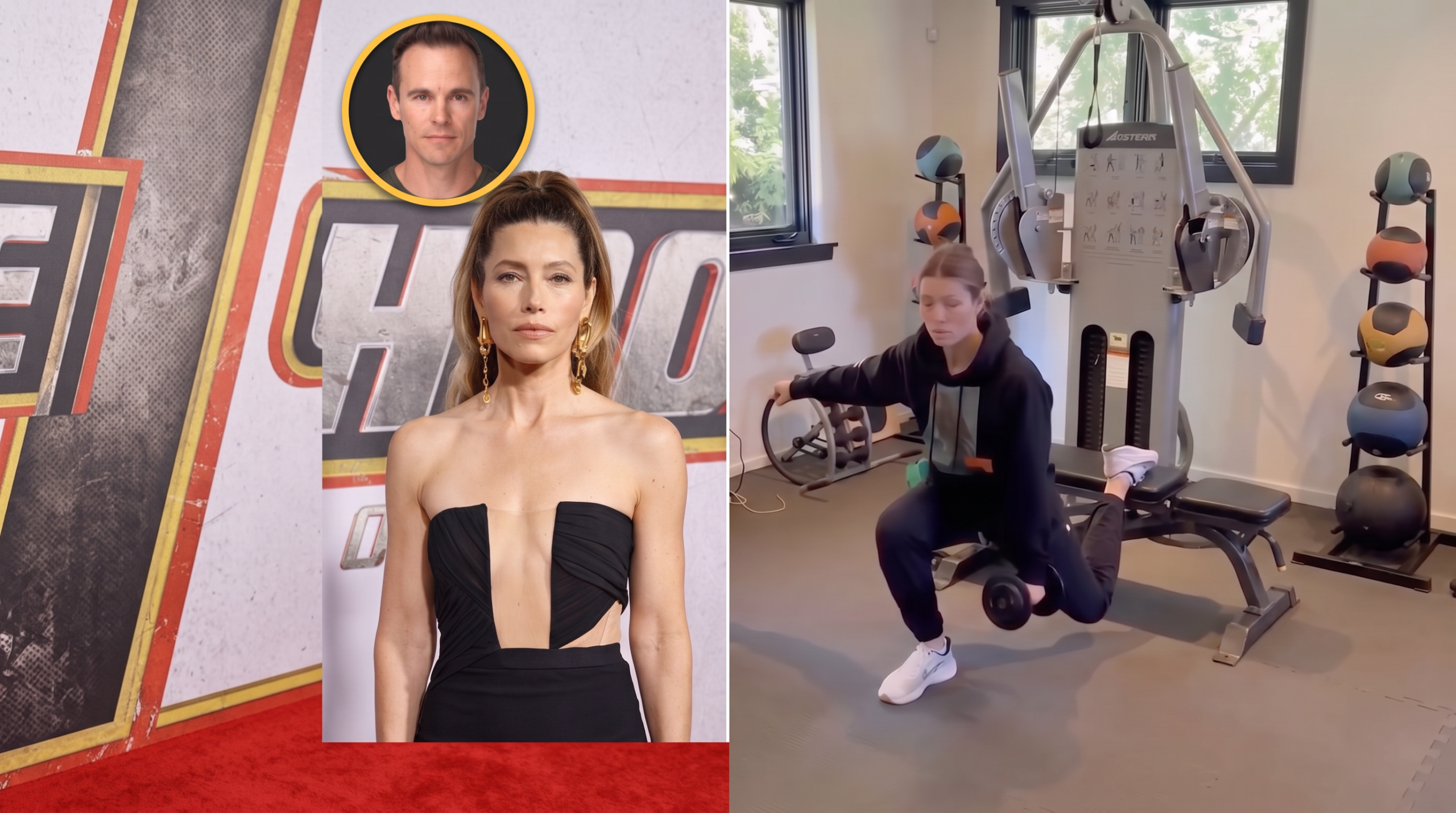
Her longtime personal trainer Ben Bruno revealed that Biel’s preparation wasn’t about chasing personal records or maxing out weights.
Instead, it was about building resilient, functional strength while navigating a lower back injury—and juggling family life in the gym.
Jump to:
- Training Through Injury: The Smart Approach
- Full-Body Focus With a Lower-Body Bias
- Training With Kids in Tow
- 9 Exercises From Jessica Biel’s Matchbox Training
- 1. Inverted Row to Hamstring Curl
- 2. Foam-Roller Wall Goblet Squat
- 3. Foam-Roller Wall Squat
- 4. Wall-Supported Bulgarian Split Squat
- 5. Resistance-Band Side-Plank Crunch
- 6. Resistance-Band Side Lunge With Reach
- 7. Bulgarian Split-Squat Dumbbell Lateral Raise
- 8. Side-Sitting GHD Weighted-Plate Raise
- 9. Kneeling Side Plank With Leg Raise
- Key Takeaways From Biel’s Training Philosophy
Training Through Injury: The Smart Approach
Bruno explained on Instagram that Biel had tweaked her lower back badly just months before filming began, forcing them to rethink her entire programme.
I just want to give some context, because Jess tweaked her lower back pretty badly a few months prior to getting ready for the movie, so we had to find creative ways to challenge her without re-aggravating that.
Rather than loading her spine with heavy barbells, Bruno leaned into exercise variations that delivered strength gains without compromising recovery.
Wall-supported squats, foam-roller-assisted movements and single-leg exercises became staples—proof that progression doesn’t always mean adding weight.
Full-Body Focus With a Lower-Body Bias
Biel’s routine prioritises compound movements that recruit multiple muscle groups at once, making every rep count.
Jess does full-body workouts and focuses a bit more on legs and glutes than upper body.
This approach maximises efficiency and mirrors the demands of action sequences, where strength, stability and coordination must work together.
Her sessions blend upper-body pulling (inverted rows), lower-body strength (Bulgarian split squats, goblet squats) and core stability (side planks with leg raises).
The result? A balanced physique capable of handling the unpredictable.
Training With Kids in Tow
Bruno also gave fans a reality check about what Biel’s training sessions actually look like.
When you watch Jess work out, you might think she’s this hardcore gym rat who’s super intense in the gym, but truthfully, most of the time she’s working out while playing with her kids or even getting straight up tackled by them.
Her children and husband Justin Timberlake are often present during sessions, adding a layer of chaos that many parents will recognise.
It’s a reminder that consistency beats perfection—and that fitting in movement around family life is not only possible, but often necessary.
9 Exercises From Jessica Biel’s Matchbox Training
Here’s a breakdown of the moves Biel used to build full-body strength while protecting her lower back.
1. Inverted Row to Hamstring Curl
This movement targets the posterior chain—back, glutes and hamstrings—in one fluid sequence.
This is from our last workout before the movie started filming, and it’s a black belt manoeuvre that incorporates the whole backside of the body.
- Set gymnastic rings at a comfortable height and lie underneath them
- Grip the rings with palms facing each other, heels elevated on a bench
- Pull your chest towards the rings, hold, then curl your heels towards your glutes
- Reverse the movement with control
2. Foam-Roller Wall Goblet Squat
The foam roller provides spinal support and feedback, reducing compressive load on the lower back.
- Place a foam roller between your lower back and a wall
- Hold a dumbbell vertically at chest height
- Squat down, letting the roller glide up your spine
- Push through your feet to return to standing
3. Foam-Roller Wall Squat
A variation of the goblet squat, this version uses dumbbells at the sides for a slightly different loading pattern.
- Same setup as above, but hold dumbbells at your sides
- Descend into a squat, maintaining contact with the roller
- Drive through your feet to stand
4. Wall-Supported Bulgarian Split Squat
This clever modification removes the need for a bench and increases glute activation through the stabilising demands of the wall.
- Stand a few feet from a wall, press your rear foot against it at knee height
- Lower into a split squat on your front leg
- Push through your front foot to return to the start
5. Resistance-Band Side-Plank Crunch
This anti-rotation exercise challenges the obliques and deep core stabilisers.
- Anchor a resistance band low and assume a high side plank
- Pull the band down with your top hand while driving your bottom knee up
- Return to the plank position with control
6. Resistance-Band Side Lunge With Reach
This lateral movement pattern strengthens the adductors and glutes while adding a dynamic stretch.
- Anchor a band around one leg at a low height
- Step the banded leg out to the side, bending the opposite knee
- Reach a dumbbell towards the floor, then push back to standing
7. Bulgarian Split-Squat Dumbbell Lateral Raise
Combining a unilateral leg movement with a shoulder raise forces the body to stabilise under load—a functional carryover to real-world demands.
- Assume a Bulgarian split squat position, holding a dumbbell in one hand
- As you lower into the squat, raise the dumbbell out to the side
- Lower the weight as you stand
8. Side-Sitting GHD Weighted-Plate Raise
This advanced movement challenges core stability and shoulder strength simultaneously.
- Position yourself sideways on a GHD machine
- Hold a weight plate at your chest, press it forwards, then raise it overhead
- Lower with control
9. Kneeling Side Plank With Leg Raise
A regression of the traditional side plank, this version reduces wrist and shoulder load while still targeting the obliques and glute medius.
- Assume a side plank on your forearm and bottom knee
- Straighten and lift your top leg, raising your top arm towards the ceiling
- Hold the position, engaging your core and glutes
Key Takeaways From Biel’s Training Philosophy
Biel’s approach to strength training offers several lessons for anyone looking to build resilience and functionality.
- Adaptation trumps intensity: When injury or life circumstances demand it, intelligent exercise swaps can maintain progress without setbacks
- Compound movements are king: Multi-joint exercises deliver more bang for your buck, especially when time is tight
- Consistency over perfection: Training with interruptions—whether from kids or other life demands—is still effective training
- Full-body work builds balance: Prioritising movement patterns over isolated muscles creates a more robust, capable physique
Whether you’re preparing for an action role or simply trying to stay strong through midlife, Biel’s routine proves that smart programming—not just hard work—makes all the difference.