Something extraordinary just happened on the streets of Buenos Aires — and the athletics world is still catching its breath.
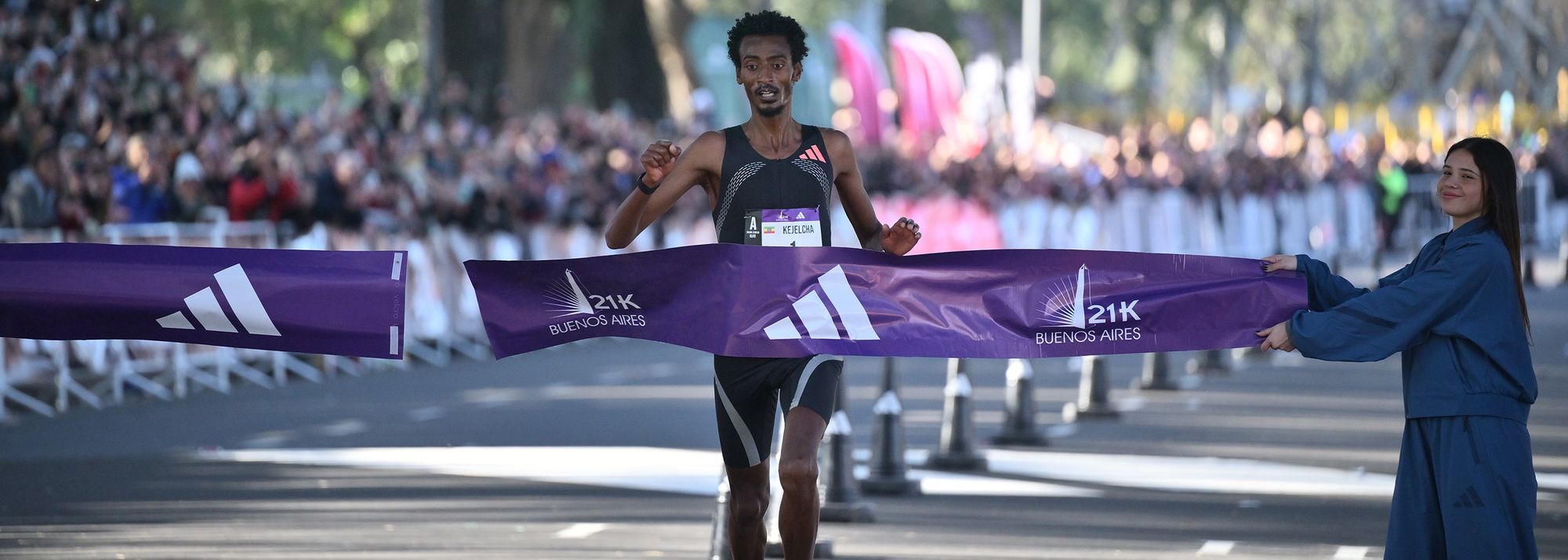
Ethiopian distance runner Yomif Kejelcha shattered the half marathon world record at the Media Maratón Ciudad de Buenos Aires on Sunday, clocking a jaw-dropping 56:51 to slice 29 seconds off the previous mark.
But here’s where the story gets complicated — and honestly, a little bittersweet.
Uganda’s Jacob Kiplimo had already run nine seconds faster than Kejelcha’s new record, and the reason his time doesn’t officially count will leave you shaking your head.
Jump to:
A Record That Almost Wasn’t
Kiplimo blazed through Barcelona last year with a stunning 56:42 — faster than anything Kejelcha ran in Argentina — but World Athletics could not ratify it as an official world record because the race conditions fell short of compliance requirements.
The rulebook, it seems, cares little for greatness if the paperwork isn’t in order.
Kiplimo had also set a 57:20 mark in Lisbon in March, a performance currently pending ratification, which had temporarily held the official record before Kejelcha’s Buenos Aires performance wiped it from the books.
How Kejelcha Dismantled the Record Kilometre by Kilometre
Heading into Sunday’s race, Kejelcha’s stated ambition was modest — simply get inside 58 minutes.
What actually unfolded was something else entirely.
Pacemakers Uganda’s Dillon Kipyeko and Kenya’s Brian Kipmwetich Kipkore set the early tempo at 2:45 per kilometre, rolling through the opening 5km in 13:45. Kejelcha sat right on their heels, clearly comfortable, clearly watching.
By the 10km mark, he had clocked 27:19 — fast, but still 19 seconds behind Kiplimo’s equivalent split from Lisbon. Anyone watching must have thought the record was safe.
They were wrong.
Kejelcha then produced a 13:22 split between 10km and 15km, arriving at the halfway stage in 40:41 — suddenly 11 seconds ahead of Kiplimo’s Lisbon pace. The momentum had completely shifted, and the 29-year-old wasn’t done accelerating.
Aided by a favourable tailwind section, Kejelcha pushed through the next five kilometres at a relentless 2:40 per kilometre pace, reaching the 20km marker in 54:04. His 10km-to-20km split of 26:45 was simply breathtaking.
Then came the closing kilometre — an almost incomprehensible 2:32 surge to the line.
The final time of 56:51 not only shattered the world record by 29 seconds but also obliterated Kejelcha’s own personal best by 39 seconds.
The Man Who Ran 1:59 at His Marathon Debut Is Just Getting Started
Context matters here, because Kejelcha’s Buenos Aires run didn’t arrive in isolation.
Just weeks earlier, in April, the Ethiopian made his marathon debut in London — and promptly posted a 1:59:40, making him the fastest first-time marathoner in history. That performance sent shockwaves through distance running, and now this.
Kejelcha had previously held the half marathon world record himself, setting a 57:30 in Valencia back in October 2024, before Kiplimo’s Lisbon run temporarily claimed the crown. Reclaiming it in such dramatic fashion feels entirely on brand for an athlete who appears to be operating in a different stratosphere right now.
After crossing the finish line, Kejelcha was understandably euphoric.
I’m over the moon. I’m super happy and right now I don’t feel any tiredness. The travel from Ethiopia was too long and I was tired the first days here, but later I felt better and today I was full of beans.
He also revealed that his race strategy had evolved mid-run.
I had planned to run conservatively over the early stages, but I felt good and decided to give it my all. This time is unbelievable; I can’t describe it with words.
And in true fashion for a man who had just rewritten the record books, Kejelcha’s post-race priorities were wonderfully grounded.
I now hope to try the Argentinean meat, which has a very good reputation! And this afternoon I have been invited to watch the River Plate-Velez football match. I’m very grateful.
Ethiopia Owns the Podium — Both of Them
Kejelcha wasn’t the only Ethiopian making headlines in Buenos Aires.
His compatriots swept the men’s podium entirely, with Tadese Worku finishing second in 59:20 and Bereket Nega rounding out the top three in 1:00:20.
On the women’s side, Fotyen Tesfay delivered a commanding wire-to-wire victory, winning in 1:03:57 — the third-fastest time of her career. The 28-year-old broke clear of her rivals around the ninth kilometre and never looked back, ultimately finishing over a minute ahead of Kenya’s Nelvin Jepkemboi in second place.
Tesfay, who made headlines in March by becoming the fastest marathon debutant in Barcelona history with a 2:10:51, was still pushing for more despite the dominant display.
I’m satisfied with my performance. I aimed to run a bit faster, but I felt some discomfort in my leg and I couldn’t run as quick as I wanted.
Satisfied, and still dissatisfied at the same time — that is the mindset of a champion.
The Asterisk That Won’t Go Away
As remarkable as Kejelcha’s 56:51 genuinely is, the conversation surrounding this record will inevitably circle back to Kiplimo’s 56:42 — a faster time sitting in statistical limbo, unratifiable due to race compliance issues.
The fastest half marathon ever run by a human being does not officially exist.
Athletics fans will wrestle with that reality for some time. For now, though, Kejelcha holds the mark — and based on his current form, the question isn’t whether someone will challenge his record.
The real question is whether Kejelcha himself will be the one to break it.