Eleven-time world champion Dennis Vasilev recently spent an entire weekend at Liberish, celebrating the gym’s 10-year milestone with a masterclass in kettlebell sport preparation.
The legendary athlete didn’t just show up—he trained alongside the team, sharing decades of hard-earned wisdom about mobility, pacing, and recovery.
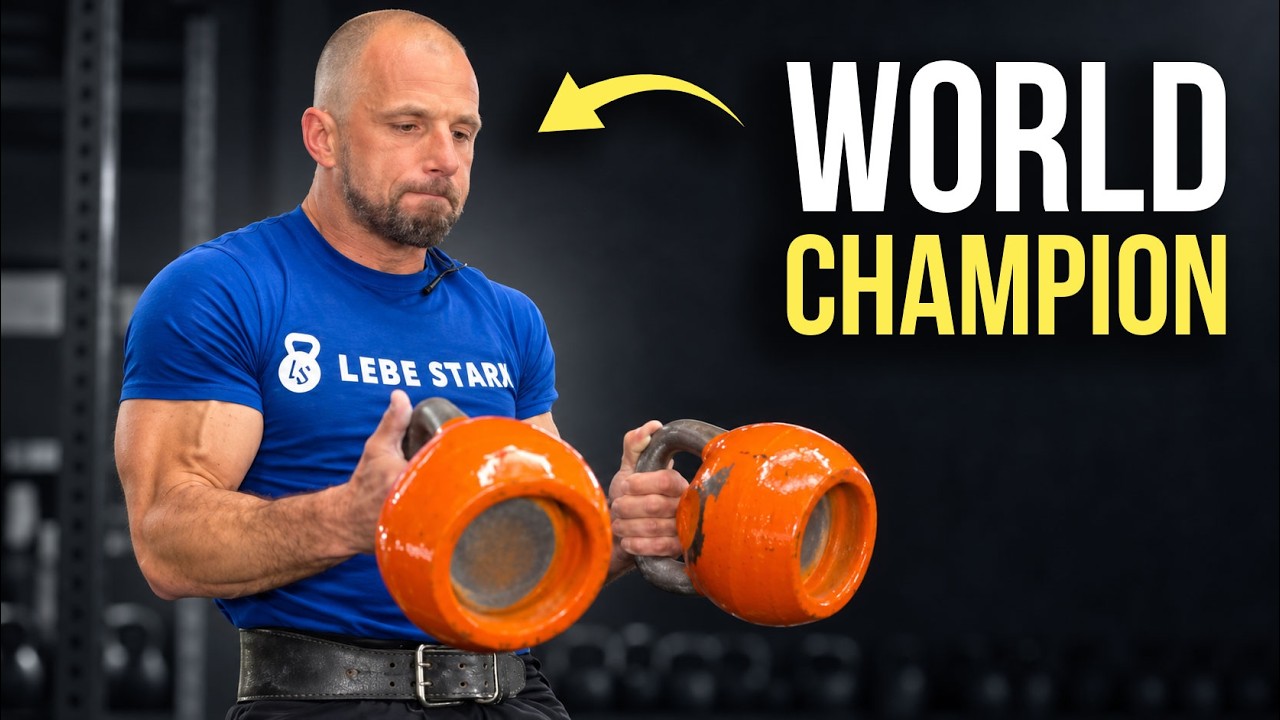
What emerged was a two-hour window into how elite kettlebell sport athletes actually prepare their bodies for competition-level training with 32-kilogram bells.
Every detail matters when you’re moving that kind of weight for minutes at a time.
Jump to:
- The Warm-Up Nobody Skips—If They Want to Stay Healthy
- Earning Your Way to Heavy Bells
- Water Spray, Chalk, and Competition Mindset
- The Two-Minute Work Sets
- GPP Circuit: The Unsexy Foundation
- The Stretching Protocol Nobody Wants to Skip
- Hamstrings, Hip Flexors, and the Seated Sequence
- The Relaxation Principle
- Lessons from an Iron Will
- Why the Details Compound
The Warm-Up Nobody Skips—If They Want to Stay Healthy
Vasilev’s approach to warming up isn’t a suggestion. It’s a requirement he learned the hard way.
It was like one of my first years on 32s like 2001. I have a short time. I put the clothes on right away. 32s. Boom. Go for the first set. And it was like this on the drop like across the the rib cage.
That injury taught him the value of methodical preparation—a lesson he’s applied for over two decades.
His joint-by-joint mobility sequence starts at the hands and works systematically up through wrists, elbows, and shoulders before moving to the lower body.
Every surface gets attention. Rubbing creates heat from the outside in, while rotations mobilize from the inside out.
Wrist rotations flow into elbow work, then shoulder circles with varying arm positions—bent arms for trap activation, straight arms with momentum for deeper range.
The Stick Rotation Game-Changer
One mobility drill stands out in Vasilev’s arsenal: stick rotations.
He said I should build up to 100 rotations per workout. So well sets of 10. So you’re spreading them through workout.
The rules are non-negotiable: arms stay completely straight throughout the movement, elbows locked in perfect extension.
Vasilev credits this single exercise with solving his top fixation problems in kettlebell sport within two months. The bonus? His rack position improved simultaneously.
- Standard rotations: Arms straight, stick passes from front to lower back
- Side rotations: Stick stays close to torso, rotating around the body
- Reverse grip: Reduces forearm pump between heavy snatch intervals
The narrower the grip and harder you squeeze, the more intense the forearm stretch becomes.
Earning Your Way to Heavy Bells
Vasilev treats 32-kilogram kettlebells with unwavering respect, no matter how many world championships he’s won.
His specialized warm-up progresses through multiple weight increments: 16kg, 20kg, 24kg, 28kg, and finally 32kg.
Each weight gets its dedicated set—five cleans followed by five double half snatches.
The pace during warm-up sets is deliberately measured. No rushing. Extra breaths between reps to ensure proper shoulder positioning.
Sometimes it just take a one extra breath to let the shoulders settle. It should feels like home. Like the nicest place to be.
Before starting the actual working sets, Vasilev performs a 30-second test at competition weight to dial in pacing.
He counts reps during this window, then doubles that number to determine sustainable reps per minute for the workout.
The Rhythm Behind the Pace
Pace tells you how many reps per minute. Rhythm tells you how to distribute them within that minute.
With lighter bells, Vasilev can work continuously for 50-55 seconds before resting. As weight increases, he breaks each minute into smaller chunks.
- 20kg bells: Two shots per minute, roughly 25 seconds of work each
- 24kg bells: Three parts, about 15 seconds of work with 5-second rack holds
- 28-32kg bells: Quarters—four bursts of effort per minute
For his target of nine reps per minute with 32kg bells, Vasilev uses a 2-3-2-2 pattern: two reps in the first quarter, three in the second, two more by 45 seconds, and two final reps to finish the minute.
Water Spray, Chalk, and Competition Mindset
Equipment choices matter in kettlebell sport. Vasilev gears up completely before touching working weights—belt positioned at the iliac crest, wristbands, specialized shoes.
Then comes the water spray, a technique that surprises newcomers.
He sprays the elbow area of his t-shirt to create a tacky landing surface for the bells during rack position. The moisture gets absorbed through the set, requiring reapplication between rounds.
Chalk keeps hands dry. Water spray keeps elbows sticky. The combination creates optimal contact points throughout the movement cycle.
Progressive Pacing Strategy
Vasilev’s pacing philosophy centers on conservative starts and careful progressions.
The first set always feels easier than it should. That’s intentional—the goal is maintaining pace, not setting records on the opening round.
If the first set feels too easy, add no more than two reps per minute on the second set. Save maximum effort for the final round, particularly the last minute.
The rule is that you need to maintain the pace you start with. So then you better don’t, you know, raise the bar too high at the beginning.
The Two-Minute Work Sets
The actual training protocol Vasilev demonstrated consists of three two-minute sets of double half snatches, followed by one two-minute set of cleans.
Two minutes of rest separate each working set.
This structure represents just one point in a longer training cycle. Volume increases over weeks—three sets becomes four, then five, as competition approaches and set duration extends from two minutes toward ten.
The Liberish team worked with lighter bells than Vasilev, focusing on technique and sustainable pacing rather than matching his competition weights.
Participants tracked their numbers: 24 total reps in the first set, adjustments to 12 or 14 reps per minute based on feel and form.
Between-Set Recovery
Rest periods aren’t passive. Vasilev uses stick rotations to maintain shoulder mobility and release tension accumulated during work sets.
He also uses a lacrosse ball against the wall, targeting six specific spots on his back: middle back left and right, upper back left and right, lower back left and right.
This self-myofascial release addresses his historically sensitive area between the shoulder blades—a common trouble spot in kettlebell sport.
GPP Circuit: The Unsexy Foundation
After sport-specific work comes General Physical Preparation. Two rounds, four exercises, every 90 seconds.
- 20 jump squats (minimal height, soft landing)
- 20 push-ups (cycled from top position, not continuous)
- 20 goblet squats (kettlebell doesn’t touch floor between reps)
- 20 single-bell deadlifts
The jump squat technique emphasizes control over height—participants barely clear the ground, focusing on leg extension in the air rather than explosive elevation.
Push-ups follow kettlebell sport style: starting from straight-arm plank, touching chest to floor, returning to locked-out top position. Breaking sets into smaller chunks—10 reps, brief hold, 10 more—mirrors the pacing strategy used in competition lifts.
This isn’t bodybuilding. It’s work capacity development specific to the demands of holding heavy objects overhead for minutes at a time.
The Stretching Protocol Nobody Wants to Skip
Vasilev’s post-workout routine is as non-negotiable as his warm-up. In a normal training day, he’d run 4-5 kilometers for active recovery before stretching.
Today, he went straight to the floor work.
Honestly, you know, when you look on the whole workout, well, you see, we feed Catal Sport into 30 minutes, but for me, it’s at least two hours workout.
The stretching sequence begins lying face-down, working through shoulder rotations with elbows planted perpendicular to the floor—an investment in rack position quality.
Static Contractions for Active Flexibility
Vasilev incorporates isometric holds throughout his flexibility work. In the chest-on-floor position, he squeezes his shoulder blades together as if trapping a coin between them, holding maximum contraction for five seconds.
This active flexibility approach—alternating between movement and static holds—appears throughout the routine.
The progression continues: straight-arm rotations, back delt stretches with weight shifted onto one shoulder, rolling movements that double as self-massage for the deltoids.
Then the glute work begins.
Vasilev emphasizes glute stretching because sensor suit data revealed glutes as the hardest-working muscle across all kettlebell sport lifts—cleans, long cycle, snatches.
From Martial Arts to Mobility Mastery
Many of Vasilev’s stretches come from martial arts backgrounds: knee-to-chest progressions, spinal twists lying supine, alternating leg positions to target different angles of the hip and lower back.
The breathing recovery exercise—slow nasal inhale while raising arms overhead, sharp mouth exhale while dropping arms forward—comes straight from combat sports recovery protocols.
Time varies based on how the body responds. After a long flight or stressful day, the same routine might take 40 minutes. On a good day, 15 minutes covers everything.
For me it’s very informative like I understand the stress level because sometimes I’m just flexed because I’m just like stressed like nervous something like going on.
Hamstrings, Hip Flexors, and the Seated Sequence
Seated stretching progresses systematically. Vasilev starts by releasing tension from feet—squeezing toes, internal rotations, grabbing the foot from inside to lock the knee and pull hard.
Hamstring work involves two approaches: torso upright with nose toward toes (emphasizing hamstring and lower back), then chin tucked with forehead toward knee (engaging middle and upper back).
Using the opposite arm to grab the foot while stretching toward one side adds a lat component to the movement.
The wide-legged seated position allows side-to-side exploration before attempting the middle split progression.
Advanced Positions for Hip Mobility
Locking the foot under the elbow and pulling the lower leg toward the chest while maintaining upright posture hits the glutes from yet another angle.
Those comfortable with that can lower the leg to rest the knee on the floor, then attempt to bring forehead to knee—a deep hip opener that directly translates to better rack position.
The kneeling sequence addresses quad flexibility: sitting between heels, gradually working toward getting the tailbone to floor, then using glute contraction to lift up on knees with arms reaching back to feet.
The final progression—lying back completely with legs bent underneath—requires patient, incremental progress over weeks and months.
The Relaxation Principle
Throughout the stretching sequence, Vasilev emphasizes relaxation over muscular force.
In the seated forward fold with hands locked behind the head, the goal isn’t to muscle your way down—it’s to use the weight of your upper body and complete relaxation to allow gravity to do the work.
The difference between hurting and improving is like pushing over the the comfort zone limit. So, it’s always slow. There’s should be no momentum in stretching.
Progress happens over weeks, not workouts. Six sessions minimum before noticing meaningful improvement in range of motion.
Vasilev closes eyes during certain stretches, treating them almost meditatively—using the weight of the head to deepen the stretch through the entire posterior chain.
The Full-Body Integration
The routine concludes with positions that challenge the entire body: toes over head while lying supine, tilting the pelvis side to side, straightening one leg at a time overhead.
A final 90-degree bent-leg position on each side targets the glutes one last time before calling the session complete.
This isn’t gymnastics-level flexibility—Vasilev acknowledges kettlebell sport athletes exist in a middle ground between average mobility and elite gymnast or yoga practitioner range of motion.
But it’s exactly the right amount of flexibility to stay healthy, recover properly, and maintain optimal positioning under heavy loads.
Lessons from an Iron Will
Vasilev learned his systematic approach through trial, error, and injury. The rib cage incident with 32kg bells in 2001 taught him that shortcuts don’t exist at the elite level.
His coach Sergey Rachinsky reinforced the principle that anyone can train when fresh and well-rested—the real test comes when conditions are less than ideal.
Anyone can do it when you’re fully rested. So, always ready born ready this is what it is you know if I you know I did my best to get in my best shape here I am.
After a 12-hour flight with minimal sleep, Vasilev still completed the workout, adjusting expectations slightly but maintaining the fundamental structure.
The warm-up reveals how the body is responding. If bells feel heavier than usual during the progression, adjust the working pace accordingly.
The Sweet Spot of Functional Fitness
Kettlebell sport athletes occupy a unique position in the fitness landscape—stronger than average but not matching powerlifters, more endurance than typical strength athletes but not competing with distance runners, flexible but not gymnast-level.
It’s a balanced development across multiple physical qualities.
Vasilev recommends learning proper technique from specialists in each domain: take at least one class from a powerlifter for squats and deadlifts, learn running mechanics from track coaches, attend yoga sessions for deeper understanding of stretching principles.
Then integrate those lessons into a cohesive training approach that serves the specific demands of the sport.
Why the Details Compound
Small technical details create massive differences over time. Water spray on the t-shirt. Exact belt positioning at the iliac crest. Breaking each minute into quarters versus halves based on bell weight.
The systematic joint-by-joint warm-up catches potential issues before they become injuries.
Post-workout mobility work prevents the chronic tension that accumulates from repeatedly catching heavy objects in overhead and rack positions.
Vasilev has refined this exact routine since 2012—the same warm-up, the same stretching sequence, the same attention to breathing and relaxation between sets.
Consistency compounds. The routine that takes two hours today becomes efficient through repetition, but never rushed.
Every joint gets its attention. Every muscle group receives dedicated work. Nothing is left to chance.
That’s how you win eleven world championships—and keep training long after most athletes have retired.