Austin Perkins weighs just 163 pounds.
He squats 750 pounds, benches 450 pounds, and deadlifts 755 pounds.
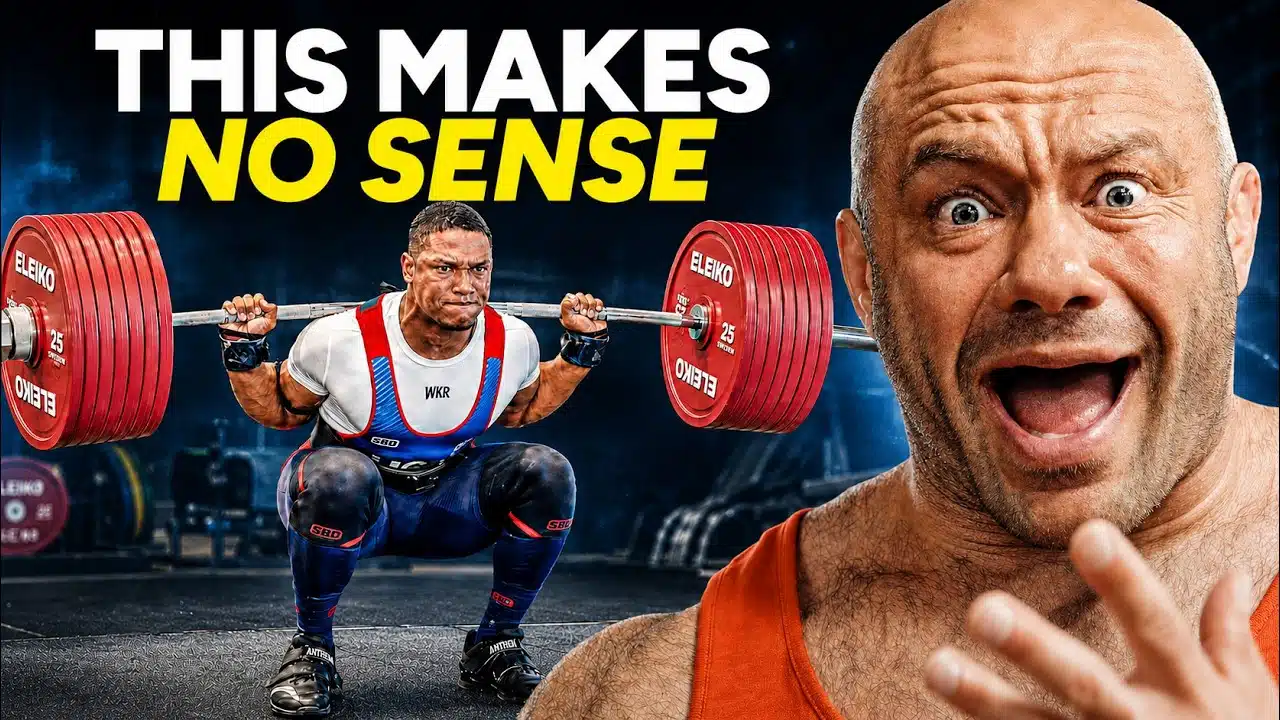
That makes him the strongest pound-for-pound drug-free powerlifter on Earth—and yet, when fitness content creator challenges him to “bro gym” exercises like machine chest presses and bicep curls, the results reveal something fascinating about how strength really works.
In a recent video collaboration, Perkins demonstrated that elite powerlifting strength doesn’t always translate to superhuman performance on every gym machine—offering valuable lessons about specificity, training adaptation, and what it really means to be strong.
Jump to:
- From Multi-Sport Athlete to Powerlifting Phenomenon
- Early Strength Without Structure
- The Turning Point: Structure and Sacrifice
- Testing Powerlifting Strength on Gym Machines
- The Science of Strength Specificity
- Nutrition: The Missing Piece
- Natural Athlete in a Skeptical World
- Never Satisfied: The Mindset of Champions
- Future Goals: Cementing a Legacy
- Lessons for Average Lifters
From Multi-Sport Athlete to Powerlifting Phenomenon
Perkins didn’t start as a powerlifting prodigy. Growing up, his father enrolled him in every sport imaginable—soccer, flag football, baseball, tackle football, and basketball.
The athletic foundation served him well, but his path took a sharp turn when he stopped growing in ninth grade. At just 5’4″, the dream of playing in the NFL evaporated.
I remember this very vivid thing actually whenever I was in high school. I think I was like 16. There was a guy that actually plays in NFL now and like the news would always come and record him and all this stuff and I remember standing there and just watching him like after practice being like interviewed and one of the other guys were like, I don’t know why you’re looking. That’s never going to be you one day.
That moment stuck with Perkins forever. Rather than accept limitations, he channeled his competitive drive into powerlifting—a sport where size matters far less than strength-to-bodyweight ratio.
Early Strength Without Structure
Perkins displayed exceptional strength early on. His first-ever deadlift at around 100 pounds bodyweight was 225 pounds—more than double his weight. His squat started around 135-140 pounds.
But impressive genetics only took him so far. From age 12 to 22, Perkins trained without any structured program whatsoever.
I just tried to deadlift 600 in the gym every day. Tried to squat 600 every day in the gym. I would go in and try to squat heavy and then after that I would just hit as much as I could on leg press. I didn’t bench at all. I didn’t bench at all in high school.
His reasoning? He wasn’t good at benching, so why bother? Looking back, Perkins admits this was foolish—prioritizing weaknesses would have accelerated his progress.
But the biggest issue wasn’t his training approach. It was his lifestyle.
The Turning Point: Structure and Sacrifice
During college, Perkins was heavily depressed. He drank excessively, smoked regularly, and sometimes showed up to powerlifting practice intoxicated.
There were some days I would show up to like training drunk sometimes, like for practice. I was heavily depressed. I was getting my ass kicked at every competition, was realizing like why can’t I be good?
Everything changed at age 22 when he met his now-wife. She encouraged him to put real effort into his training and life. That’s when Perkins finally adopted a structured program, prioritized recovery, cleaned up his nutrition, and eliminated destructive habits.
The results were transformative. From age 22 to 27, his lifts skyrocketed as his body finally received the recovery, nutrition, and programming it needed.
I think people think they need a coach. I don’t think you realistically need a coach. You just need to be on a structured program. If you’re not anything structured and you don’t put in the time and consistency, nothing’s going to work.
Testing Powerlifting Strength on Gym Machines
When challenged to “stack” various gym machines—loading them with maximum weight—Perkins delivered impressive but not superhuman performances:
- Chest press machine (260 lbs): 15 reps
- Lateral raises with 20-lb dumbbells: 21 reps
- Pull-ups (strict form): 25 reps
- Cable tricep pushdowns (full stack): 11 reps
- Preacher curl machine (120 lbs): 1 rep
These numbers are excellent for any lifter—but they’re not proportionally superhuman compared to his powerlifting totals. Why?
The Science of Strength Specificity
Perkins’ performance on gym machines illustrates a fundamental principle: strength isn’t general—it’s highly specific.
Research shows strength development depends on two primary factors:
Muscular Adaptation
The specific muscles trained will grow stronger and larger. Perkins has developed extraordinary strength in his quads, glutes, hamstrings, chest, triceps, and lower back—the prime movers in squat, bench, and deadlift.
Muscles he doesn’t train as directly, like biceps and lateral deltoids, remain strong but not superhuman.
Neurological Efficiency
Strength is largely a skill. Your nervous system must learn to recruit muscle fibers efficiently and coordinate movement patterns precisely.
Perkins has spent thousands of hours perfecting squat, bench, and deadlift technique. His nervous system is exquisitely tuned to these specific movements. Put him on a preacher curl machine he never practices? That neurological efficiency disappears.
The practical takeaway: If you want to get strong at a specific lift, you must practice that exact movement pattern regularly—even if you already have substantial muscle mass.
Nutrition: The Missing Piece
Until February of this year, Perkins barely tracked his nutrition. He estimated he was consuming just 50 grams of protein daily—catastrophically low for an elite strength athlete.
I just started actually this February like tracking my macros and everything. So, now like that’s another gear that I haven’t tapped into that I’m excited to pursue. I was probably getting in anywhere from like just 50 below on protein a day for years.
Now he’s consistently hitting 150-200 grams of protein daily. The difference has been immediate—better recovery, improved training quality, and continued strength gains.
This revelation is both inspiring and sobering: Perkins achieved world-record strength while drastically under-fueling his body. Imagine what he’ll accomplish now with proper nutrition.
Natural Athlete in a Skeptical World
Given his unprecedented strength-to-weight ratio, many question whether Perkins is truly drug-free. He addresses the skepticism directly.
I feel like you couldn’t take enhancements and stay 163 lbs. It’s hard for me to even stay at around 163. So, yeah, people are skeptical, which I mean, it makes sense when I’m the only person on Earth at my body weight that’s hitting the weights that I’m doing.
His logic is sound. Anabolic steroids promote muscle growth. Maintaining such a low bodyweight while using performance-enhancing drugs would require severe caloric restriction—counterproductive for strength development.
Perkins attributes his abilities to exceptional genetics combined with years of dedicated training—once he finally applied structure and discipline.
Never Satisfied: The Mindset of Champions
Despite being the strongest pound-for-pound tested powerlifter in the world, Perkins doesn’t feel like “the best.”
At the Sheffield competition—where only one lifter wins overall across all weight classes—Perkins took first place. Then he cried.
But not tears of joy.
I cried after cuz I didn’t hit I wanted to hit a 900 kilo total which is like a little bit under 2000 pounds and I didn’t hit that. I was 20 pounds under that and I cried cuz I was like are we serious right now.
His world record total exceeds that of lifters in weight classes above him, yet he demands more from himself. This relentless internal standard separates good athletes from legendary ones.
Perkins follows advice his father gave him from track: never look back to see who’s chasing you. Focus only on who’s ahead.
Future Goals: Cementing a Legacy
At 27 years old, Perkins has ambitious plans for the next phase of his career:
- Win world titles in three different weight classes
- Set world records that endure for decades
- Earn a place on the “Mount Rushmore” of powerlifters alongside legends like Ed Coan and John Haack
- Inspire smaller athletes to realize their potential
I want to make sure that I have longevity in the sport, people remember me, and I can motivate people to say like, oh, if I stick this out, I can do this. It’s just leaving a legacy.
With improved nutrition now added to his already exceptional genetics and work ethic, Perkins may be just getting started.
Lessons for Average Lifters
Perkins’ journey offers valuable insights for lifters at any level:
- Structure beats chaos: Raw talent without programming leads nowhere. Consistency with a structured plan produces results.
- Recovery matters as much as training: Sleep, nutrition, and stress management aren’t optional—they’re essential.
- Protein intake is critical: Even elite athletes often under-consume protein. Aim for at least 0.8-1 gram per pound of bodyweight.
- Strength is specific: Being strong at one movement doesn’t automatically transfer to others. Train what you want to improve.
- Weaknesses deserve attention: Avoiding exercises you’re bad at limits overall development.
- Comparison can motivate or destroy: Perkins uses it to drive improvement, not to feel satisfied or defeated.
Most importantly, Perkins proves that physical limitations—like height—don’t determine potential. They simply redirect it toward different opportunities.
At 163 pounds and 5’4″, Austin Perkins stands as the strongest pound-for-pound drug-free powerlifter in human history. His story is still being written, and the next chapter promises to be even more remarkable.