Popular fitness YouTuber Jay Vincent recently traded his gym routine for something far more primal: a grueling backpacking trek up a canyon near the Pacific Ocean.
He called it “the oldest workout in human history.”
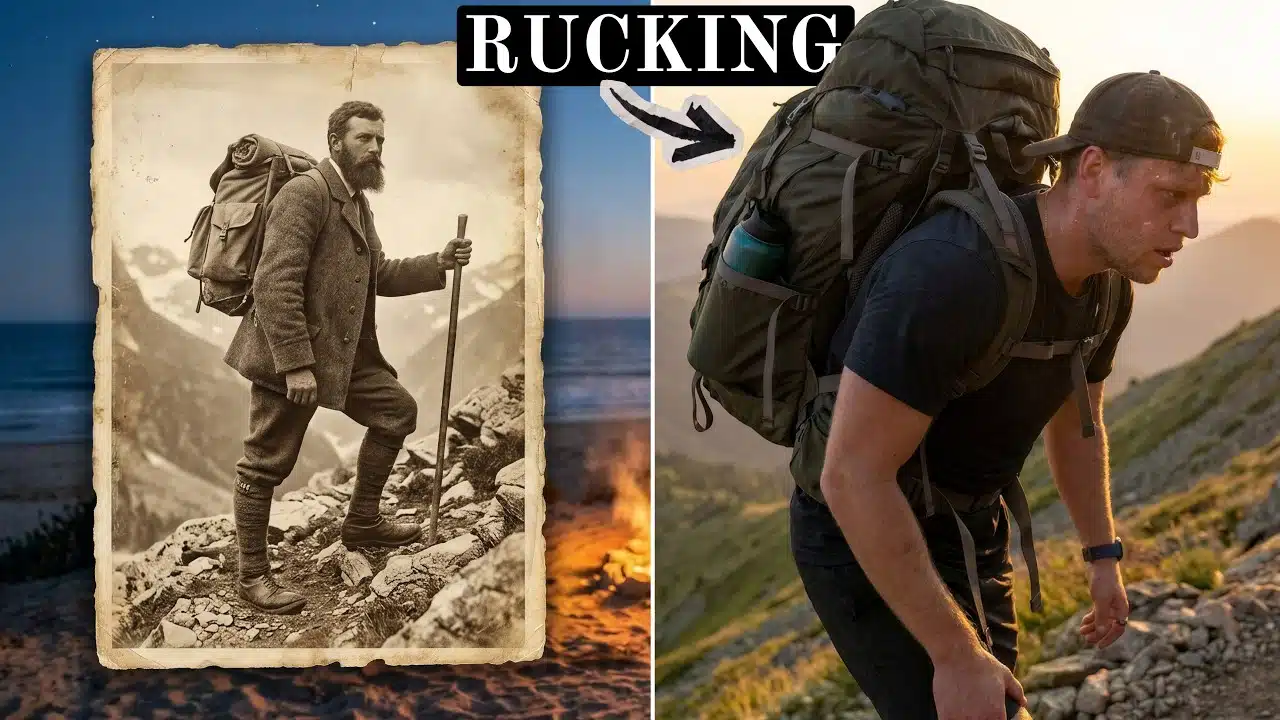
Along with his companion Ally, Vincent hauled a 38-pound pack three miles up terrain equivalent to an 80-story skyscraper, carrying everything needed to survive the night.
The mission? Test whether this ancient form of exercise—rucking and backpacking—could transform both body and mind by sunrise.
Jump to:
- Why Rucking is Humanity’s Original Fitness Test
- From Neighborhood Walks to Canyon Climbs
- The Physical Toll of Ancestral Movement
- Historical Context: Warriors and Explorers Did This Daily
- Camp Life: Reconnecting With Simplicity
- Morning Reflections and The Comfort Crisis
- Practical Takeaways for Modern Fitness
- The Verdict: Does Ancient Movement Work?
Why Rucking is Humanity’s Original Fitness Test
Vincent’s adventure wasn’t just a wilderness retreat. It was rooted in evolutionary history.
Humans have been doing this for 2 million years. They’ve been rocking, backpacking, traveling across the world to find the resources that they needed.
Long before farming, humans were nomadic. For over two million years, our ancestors carried tools, water, and collected goods across continents on their backs.
Vincent emphasized how modern conveniences have severed this connection. Stable homes, livestock, and food security are relatively new concepts in the grand timeline of human existence.
From Neighborhood Walks to Canyon Climbs
Vincent’s backpacking journey didn’t start with grand philosophical intentions. It began simply: he wanted to lose fat and reclaim his athletic form.
It’s just simply because I’m trying to lose fat and become the athlete that I once was. A loaded pack just burns more than a normal walk. That’s the whole thing.
His progression was gradual. First, he loaded a backpack with heavy books. Then he tried a weighted rucking plate, but found the straps uncomfortable.
Eventually, he borrowed Ally’s weighted vest—which became his favorite option for daily walks.
The Accidental Epiphany
After several neighborhood rucks, Vincent had a realization. This was accidental training for humanity’s oldest movement pattern.
Rather than continue the “watered-down version,” he decided to experience the real thing: a full overnight backpacking trip with all essentials on his back.
The Physical Toll of Ancestral Movement
Just 0.75 miles into the canyon, both hikers were drenched in sweat. Ally, carrying a 26.4-pound pack, noted the stark difference from regular hiking.
About 3 minutes in, I started sweating, which usually I don’t start sweating until after hiking. I’m out of breath, huh? So I think it’s a good one.
Vincent’s heart rate remained elevated throughout the climb. He reflected on what carrying extra weight truly felt like.
Makes you think this is what being an extra 40 lbs overweight would feel like.
Loaded Carries Activate Hundreds More Muscles
The science backs up why this workout feels so demanding. Loaded carries engage approximately 700 muscles, while walking alone uses only about 200.
Additionally, humans evolved with more sweat glands than any other mammal—specifically to carry loads long distances in heat. It’s our species’ physical specialty.
Historical Context: Warriors and Explorers Did This Daily
Vincent shared fascinating historical comparisons throughout his trek:
- Average hunter-gatherers: Walked 6-12 miles daily while carrying tools, water, and gathered goods
- Modern Americans: Walk less than 2 miles per day on average
- Roman legions: Carried 60-80 pounds per soldier for 20 miles daily
- Lewis and Clark expedition: Averaged 15 miles per day with massive loads
Notably, Lewis and Clark’s journals described them as “healthier, stronger, more robust” by expedition’s end. The constant loaded movement made them fitter, not more broken down.
Camp Life: Reconnecting With Simplicity
After reaching their campsite, Vincent and Ally experienced something increasingly rare in modern life: genuine stillness.
We’re like away from the world for a little bit. It’s so quiet and still up here. And you just get to kind of take everything in, and I feel like we both live very go go go lives, and don’t really have chances to do that.
Despite modern conveniences like freeze-dried meals and lightweight sleeping pads, the experience still pushed them outside typical comfort zones.
Vincent contrasted their setup with how early humans managed: no tents, no backpacking equipment, sleeping directly on dirt.
The Sunset Effect
As the sun dropped over the Pacific, Vincent explained why humans are drawn to sunsets beyond just aesthetics.
For most of human history, surviving until sunset meant making it through another day. The calm we feel watching one might be evolutionary—a built-in reward system for survival.
Morning Reflections and The Comfort Crisis
Vincent slept surprisingly well despite typically struggling with sleep while camping. Morning brought peaceful coffee and the prospect of hiking back down to the beach.
On the descent, he referenced Michael Easter’s concept of “the comfort crisis”—the idea that too much ease in modern life disconnects us from beneficial challenges.
We have everything on a silver platter. I mean, even when you think about this backpacking experience, you know, we’re stocked. We’ve got a way to make fire, easy. We’ve got packaged freeze-dried food. Obviously it’s outside of our normal comfort zone. But when you think about some of the first humans that were doing this just to survive.
Practical Takeaways for Modern Fitness
Vincent’s experiment offers actionable lessons for anyone looking to incorporate ancestral movement patterns:
- Start simple: Load a backpack with books or use a weighted vest for neighborhood walks
- Progress gradually: Begin with 10-20 pounds before attempting heavier loads
- Prioritize comfort: Proper weight distribution prevents shoulder and back strain
- Build up distance: Start with shorter distances before attempting multi-mile treks
- Embrace discomfort: Some challenge reconnects us with our evolutionary capabilities
The Verdict: Does Ancient Movement Work?
After completing his overnight canyon adventure, Vincent’s conclusion was clear. Rucking and backpacking deliver full-body conditioning, cardiovascular challenge, and mental reset that few modern workouts provide.
The physical demands are undeniable. Three miles with a loaded pack created more metabolic stress than typical gym sessions.
But beyond fitness metrics, the experience offered something harder to quantify: connection to human history, genuine stillness, and perspective on modern comfort.
Research on Blue Zones—regions where people live longest—consistently shows outdoor activity as a common factor. Vincent noted how residents of these areas spend significantly more time outside than typical modern populations.
For those seeking fat loss, improved conditioning, or simply a break from modern life’s constant stimulation, Vincent’s message is simple: the world is full of these little adventures.
Our ancestors walked thousands of miles carrying everything they owned. We can handle a weekend with a loaded pack.