Building muscle requires lifting heavy weights through full ranges of motion with progressive overload.
Yet most people abandon these principles when training abs and core.
They stick to endless crunches, planks, and sit-ups—chasing the burn instead of building strength.
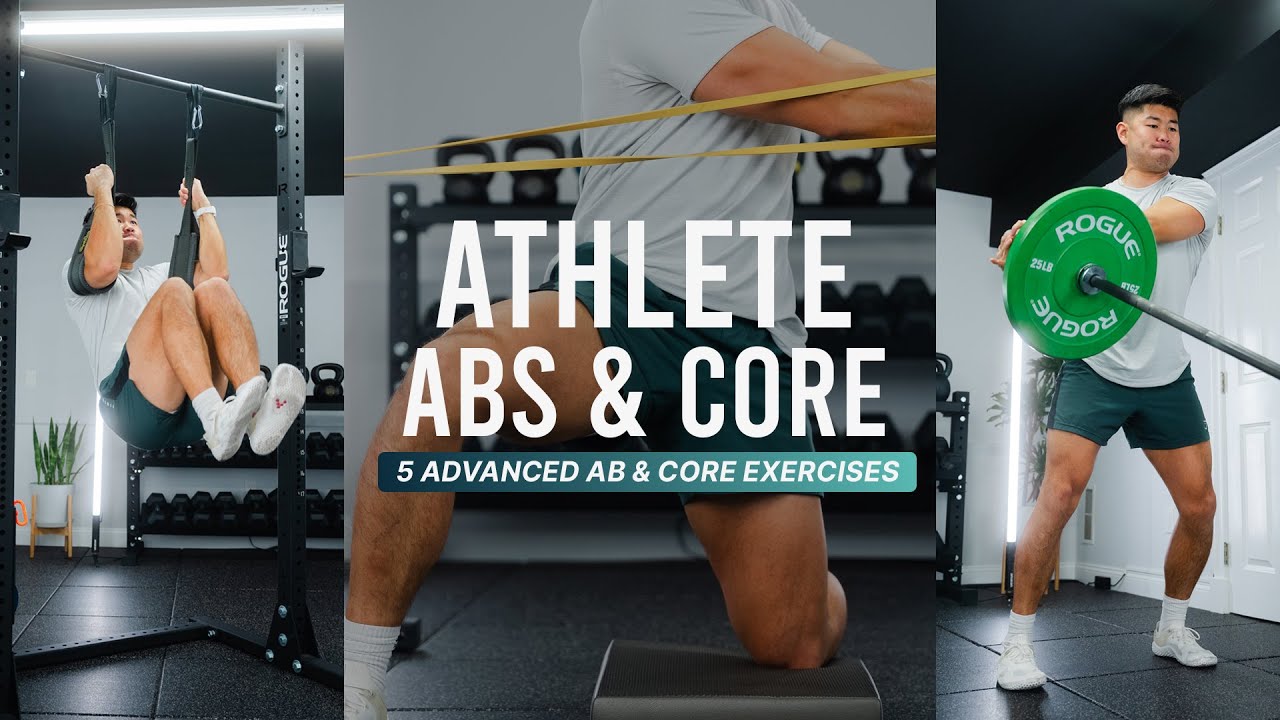
In a recent training video, fitness expert and coach demonstrates five athlete-level core exercises that utilize full ranges of motion, challenging loads, and progressive overload to build genuine abdominal strength.
Jump to:
Hanging Knee Raise: Master the Flexion Foundation
Hanging knee raises target flexion—crunching forward to maximize ab contraction. While variations exist using pull-up bars or Roman chairs, ab straps offer distinct advantages.
The straps lock arms into place, eliminating grip fatigue and shoulder strain. This allows complete focus on abdominal engagement throughout each repetition.
Proper execution begins with sliding arms through straps and establishing a dead hang position. From there, knees drive upward toward elbows before returning to full extension.
The bottom position is crucial. Rather than remaining neutral, achieve a slight arch to stretch abs fully before initiating movement.
I’m trying to think about one vertebrae at a time curling curling curling getting my knees to touch my elbows before slowly unraveling back and getting that full extension at that bottom position.
Avoid using momentum from the arched position—control matters more than speed.
Progressive Overload Strategy
Adding resistance transforms this movement. Soft leather medicine balls work exceptionally well because they grip legs effectively.
Squeeze the ball tightly between knees and maintain identical form—no rushed reps or excessive extension. The same controlled curl applies, just with significantly greater resistance.
Recommended protocol: Three sets of six to eight repetitions.
Landmine Anti-Rotation: Building Rotational Resistance
Anti-rotation exercises challenge the trunk to remain stable while external forces attempt rotation. Landmine variations provide superior range of motion compared to Pallof presses.
Setup requires an angled barbell with arms slightly bent, pressing upward so the bar extends forward. Establish a stable base with slightly bent knees.
From center position, lower the weight slowly to approximately three or four o’clock. Maintaining square shoulders and hips, sweep the bar across to eight or nine o’clock before returning.
My obliques are working really hard to maintain this position.
The bar constantly tries to rotate the body. Fighting that rotational force builds tremendous oblique strength through extended ranges of motion.
Progressive overload options include:
- Adding small weight increments (2.5 to 5 pounds)
- Slowing eccentric tempo
- Increasing repetitions
Target volume: Three sets of six to eight reps.
Barbell Rollout: Anti-Extension Under Load
Anti-extension movements prevent lower back arching while maintaining trunk stability. Barbell rollouts dramatically increase difficulty compared to stability ball or ab wheel variations.
Hand placement begins slightly outside shoulder width. Before rolling forward, drive hips forward to establish a straight line from knees through the crown of the head.
Critical positioning: Tuck pelvis under, squeeze glutes, and engage abs to prevent the butt from sticking upward.
Maintain this locked position throughout the movement. Roll forward as far as possible while preserving neutral alignment, then use lats to pull back.
Start with shallow ranges if necessary. Depth matters less than maintaining proper position throughout each repetition.
Advanced Loading Technique
Rather than adding plates to the bar—which provides minimal additional challenge—attach a resistance band from the bar to a squat rack or sturdy anchor point.
The band immediately pulls forward from the starting position, forcing lats and core to work harder maintaining position. During the rollout, the band creates additional resistance. Returning requires pulling against band tension.
It almost ends up becoming an ab wheel roll out mixed in with a lat pullover.
Thin bands generate substantial resistance—thicker options aren’t necessary initially. Increasing distance from the anchor point progressively intensifies difficulty.
Suggested sets and reps: Three sets of six to eight repetitions.
Kneeling Horizontal Chop: Pure Trunk Rotation
Unlike anti-rotation exercises, horizontal chops actively rotate the trunk. Kneeling variations isolate core rotation by eliminating hip involvement.
Position one knee down with the opposite foot anchored against a squat rack or stable object. This creates maximum lower body stability, allowing greater resistance usage.
Attach a band at approximately belly button height. Grab the band and rotate away from the anchor point before slowly returning with control.
The foot should be anchored perpendicular to the body—not in a traditional half-kneeling stance. This positioning maximizes stability during rotation.
Key execution detail: Maintain oblique tension during both concentric rotation and eccentric return. Don’t relax and let the band snap back.
Progressive overload comes from thicker bands or increased distance from the anchor. When distance increases significantly, ensure proper foot anchoring using a dumbbell, kettlebell, or bench.
Bench GHD Sit-Up: Extended Range Flexion
Glute-ham developer sit-ups extend range of motion beyond standard variations. Most training environments lack GHD equipment, making bench modifications valuable alternatives.
Position perpendicular to a bench with hips resting on the pad. Anchor feet and place hands behind the head. Extend backward as far as possible, stretching abs fully, then crunch upward.
This represents top-down flexion—trunk crunching toward pelvis—contrasting with bottom-up movements like hanging knee raises.
Arms overhead increases difficulty substantially. Maintaining a hollow hold position before extending challenges core stability immediately.
Adding Resistance
Light weights (5-10 pounds) behind the head create significant resistance. The weight constantly pulls backward, requiring continuous tension to maintain hollow positioning.
You are going to notice a tremendous amount of contraction throughout your core as you go through this because it’s going to be under constant tension.
Unlike floor variations where gravity assists during descent, this setup forces constant muscular engagement. Relaxing results in complete buckling.
Eccentric stress occurs during lowering, concentric contraction during rising. Both phases build strength through extended ranges of motion.
Volume recommendation: Three sets of 8-15 repetitions.
Training Abs Like Athletes
These five exercises share critical characteristics: full range of motion, challenging loads, and progressive overload capacity. They treat abdominal muscles like any other muscle group requiring systematic strength development.
Planks and crunches establish foundational proficiency. Once mastered, athletic core training demands greater mechanical challenge and measurable progression.
Incorporating one or several of these movements into regular programming builds functional strength beyond aesthetic development. Real core strength transfers to athletic performance, injury prevention, and overall physical capacity.
Progressive resistance matters as much for abs as any other muscle group. These exercises provide clear pathways for continuous advancement through added weight, increased repetitions, or enhanced resistance band tension.