Building a stronger back and biceps doesn’t require complicated routines or endless exercises.
In a recent YouTube video, natural bodybuilder and evidence-based fitness coach Jeff Nippard broke down his complete pull workout, featuring six strategic exercises designed to maximize muscle growth.
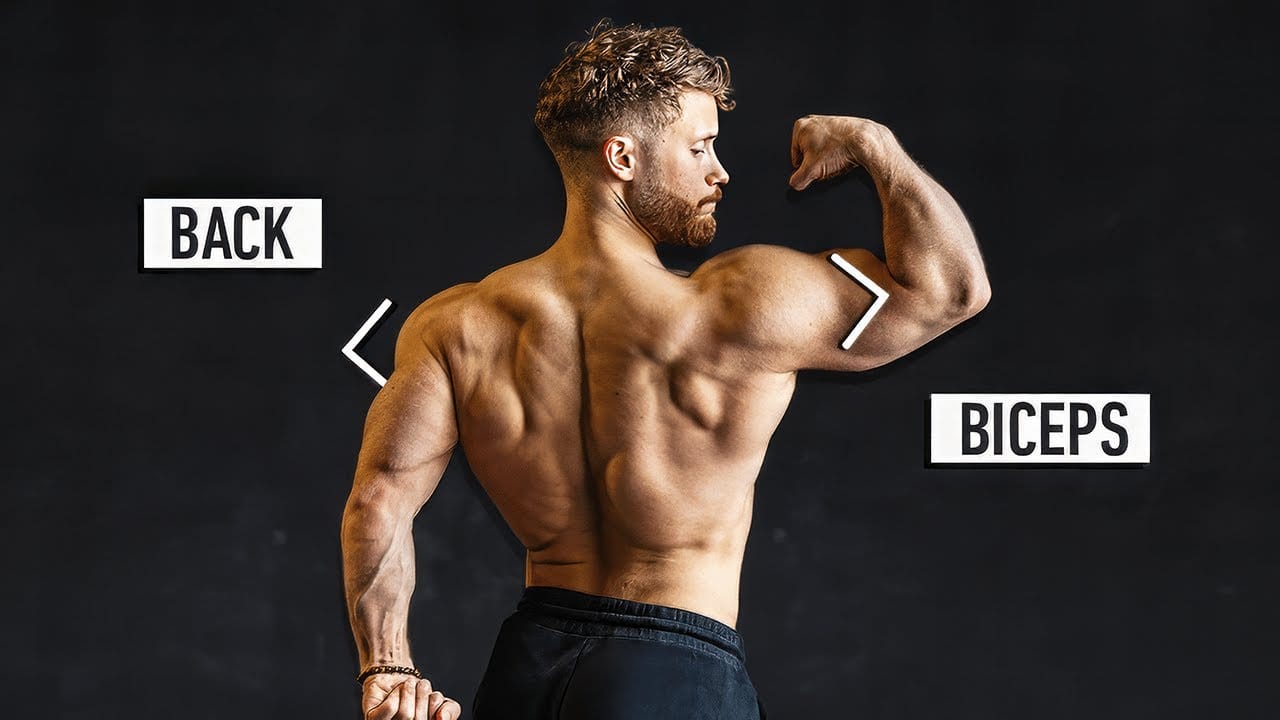
Whether you’re looking for a full pull day routine or just want to cherry-pick movements for your own training split, these exercises target every angle of back and bicep development.
Here’s exactly how to execute each movement for maximum gains.
Jump to:
Start Smart: The Warmup Protocol
Nippard kicks off every pull workout with a quick 5-minute general warmup on the treadmill or stair master, followed by dynamic stretches to prepare the joints.
This isn’t just going through the motions—it’s about priming the nervous system and reducing injury risk before heavy pulling movements.
Exercise #1: One-Arm Half-Kneeling Lat Pulldown
Sets and Reps: 3 sets of 12-15 reps
The workout begins with a unilateral lat movement that offers superior mind-muscle connection compared to traditional bilateral variations.
Proper Form Breakdown
Take a half-kneeling stance with your non-working hand braced against the knee of the same leg. This stable base directs tension more efficiently onto the lats where you want it.
Keep the cable and your forearm in a straight line throughout the movement. Stop the range of motion at your body’s midline—continuing past this point reduces lat activation as they lose leverage once your arm travels behind your torso.
Why Pulldowns Over Pull-Ins?
Nippard used to favor sideways-facing lat pull-ins, where you pull the cable toward your body from the side. He’s since shifted toward front pulldowns for most clients.
Over the last couple of years I found that some people feel a better mind muscle connection with their lats by pulling down to the front rather than pulling in from the side.
Both movements target the lats effectively through different biomechanical functions—pulldowns emphasize shoulder extension while pull-ins emphasize shoulder adduction. Without direct comparison studies, his advice is simple: choose whichever creates a stronger lat connection for you, or rotate between both periodically.
Exercise #2: Pull-Ups (One AMRAP Set)
Sets and Reps: 1 all-out set for as many reps as possible
Since the lats are already fatigued from cables, Nippard programs just one intense set of pull-ups—but it has to count.
The Compromise for Pull-Up Haters
Many bodybuilders avoid pull-ups because they’re demanding. Nippard’s solution acknowledges this while maintaining exercise efficacy.
Here’s my compromise you only have to do one set but it has to be all out. I think that’s fair.
Progressive Overload Strategy
- If bulking: Match last week’s reps (your increased bodyweight provides progressive overload)
- If cutting: Add at least one rep weekly (your decreased bodyweight reduces resistance)
Technical Execution
Use a grip approximately 1.5 times shoulder width. Lift your chest and focus on pulling elbows down and in until they’re as close to your sides as comfortable.
Aim to get your chin above the bar or your chest level with your hands. Can’t do bodyweight pull-ups yet? Use an assisted pull-up machine or loop a resistance band around the bar for assistance.
Exercise #3: Kroc Rows
Sets and Reps: 3 sets of 10-12 reps
Named after world record-holding powerlifter Janae Marie Kroc, this dumbbell row variation embraces controlled momentum to overload the back muscles more effectively.
Strategic “Cheating” Explained
Kroc rows feature a slightly more upright posture and looser form than traditional dumbbell rows—but this isn’t sloppy lifting.
Once you’ve mastered the technique Basics I don’t think there’s anything wrong with using a little controlled Body English on select movements especially if it allows you to overload the target muscle more effectively.
The reasoning is biomechanical: back exercises typically have unique strength curves where they’re easiest at the bottom and hardest at the top. Using momentum through the easy portion helps you reach true muscular exhaustion at the squeeze point where it matters most.
The key distinction: You must remain in control of the weight, especially during the negative portion.
Exercise #4: Cable Shrugs
Sets and Reps: 3 sets of 10-12 reps
Cable shrugs offer a quick, convenient upper trap option with a biomechanical advantage over traditional barbell versions.
Understanding Trap Fiber Orientation
Upper trap fibers don’t run vertically as many assume—they fan out more horizontally. This anatomical reality means shrugging both up and in hits more fibers than just shrugging straight up and down.
Cable orientation naturally encourages this diagonal pulling path. When doing barbell shrugs, Nippard recommends a slightly wider grip to achieve the same effect.
Exercise #5: Reverse Pec Deck
Sets and Reps: 3 sets of 10-12 reps
Rear delts are often underdeveloped because larger back muscles dominate compound pulling movements. This isolation exercise fixes that problem—if executed correctly.
The Critical Form Cue
Sweep the weight out and back, not just straight back. This distinction determines whether you’re hitting rear delts or mid-back muscles.
Since pull-ups and Kroc rows already hammered the mid-traps, isolating the rear delts here creates better overall development.
Hand Position Experimentation
Try varying your grip across sets:
- Set 1: Palms facing each other (neutral grip)
- Set 2: Palms facing down (pronated grip)
- Set 3: Internally rotated (if shoulder mobility allows)
Research from Brad Schoenfeld and colleagues found substantial individual variation in rear delt activation across different hand positions. While average EMG readings favored neutral grip, some subjects responded better to pronation or internal rotation—sometimes dramatically so.
If you’ve only ever used one hand position, experimenting with others could unlock better rear delt development.
Exercise #6: Overhead Cable Bicep Curl
Sets and Reps: 3 sets of 10-12 reps
The workout finishes with an unconventional bicep movement that may preferentially target the long head—the portion responsible for that coveted bicep peak.
The Long Head Advantage
Nippard was inspired to revisit overhead curls after observing natural pro bodybuilders Alberto Nuñez and Brian Minor at the N1 Training Lab comparing shoulder positions during bicep curls.
They found that for both Alberto and Brian there seemed to be a bias to the long head of the biceps when the arm was held up overhead as opposed to down to the side.
While EMG data has limitations and individual responses vary, the potential for preferential long head activation makes overhead curls worth experimenting with—especially if bicep peak is a weak point.
Execution Details
Kneel down and curl with your arm positioned out to the side and overhead. Maintain tension throughout the movement without allowing momentum to take over.
This is typically the only direct bicep work Nippard includes on pull day, though he notes that adding another 2-3 sets of curls with arms at your sides or stretched behind your torso can provide additional volume if needed.
Bringing It All Together
This six-exercise sequence strategically progresses from compound movements to isolation work, hitting lats, traps, rear delts, and biceps through multiple angles and intensity techniques.
The workout balances scientific principles with practical training wisdom—acknowledging that perfect form isn’t always optimal, individual responses matter tremendously, and sometimes the best exercise is simply the one that creates the strongest mind-muscle connection for you.
Whether you implement this entire routine or extract specific exercises for your own program, the key is consistent progressive overload while maintaining technical control. Master the basics first, then don’t be afraid to use strategic intensity techniques like controlled momentum or AMRAP sets to push past plateaus.