Cardio might be one of the most misunderstood tools in fitness.
Some people treat it like punishment, grinding through the same treadmill session every day until their knees give out.
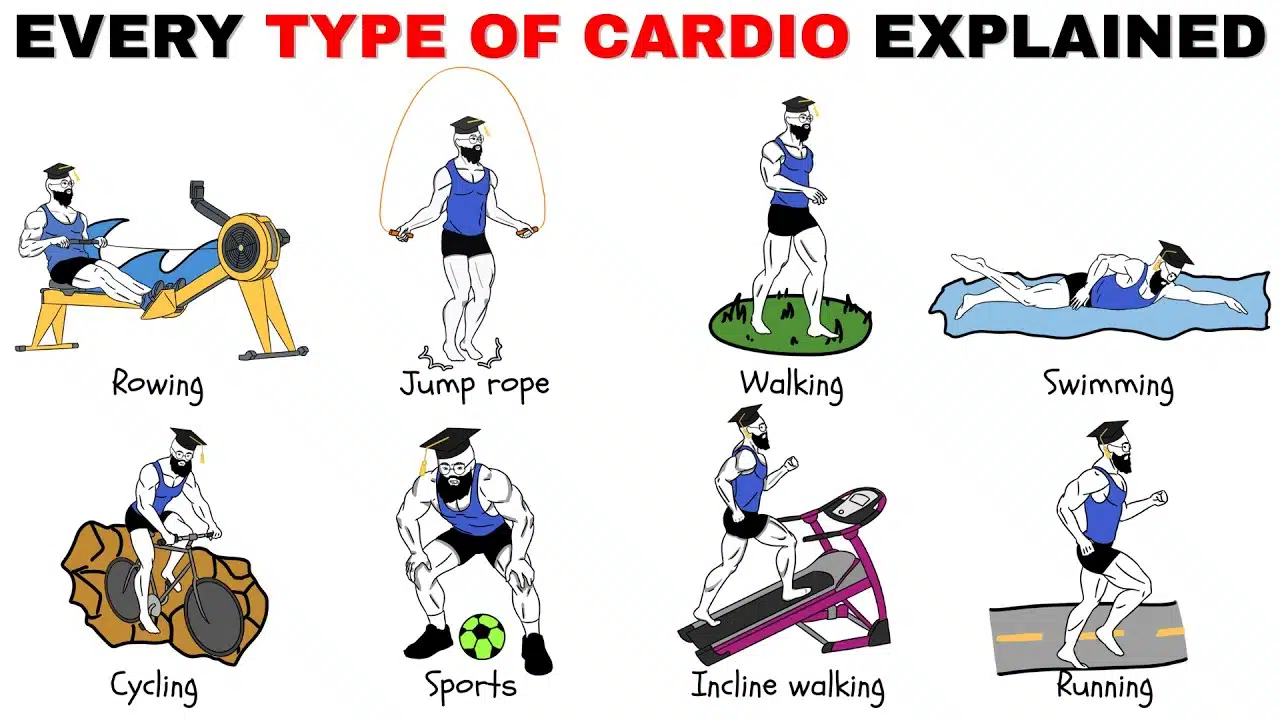
Others avoid it entirely, convinced that lifting weights alone will get them lean.
But the truth is simpler: different types of cardio do different things, and picking the right one for your body, your goals, and your lifestyle makes all the difference between progress and frustration.
Jump to:
- Rowing: Full-Body Efficiency Most People Ignore
- Jump Rope: Maximum Intensity, Minimum Time
- Walking: The Underestimated Powerhouse
- Swimming: Cardio Without Gravity
- Cycling: Joint-Friendly Cardiovascular Power
- Sports: Cardio That Doesn’t Feel Like Training
- Incline Walking: Fat Loss Sweet Spot
- Running: High Reward, High Risk
Rowing: Full-Body Efficiency Most People Ignore
Rowing might be the most underrated cardio option available because it delivers nearly everything at once, yet almost nobody uses it consistently.
A single rowing stroke engages roughly 85% of muscles in your body. Legs drive movement, back and arms finish it, and core stabilizes everything in between.

If you want something simple that actually works, this is one of the most effective tools I’ve used to build strength, conditioning, and endurance without needing a full gym setup.
- Full-body training with one weight using swings, squats, and presses
- Solid cast iron build that feels stable and lasts for years
- Comfortable grip that makes high-rep workouts easier to handle
Hard rowing sessions can torch 600 to 800 calories per hour without sprinting or destroying joints. Impact is nearly zero since feet stay strapped down and nothing pounds into flooring.
Heart rate climbs higher than expected because moving so much muscle mass simultaneously forces cardiovascular systems to work harder than equivalent treadmill time.
Technique matters enormously, though. Most beginners row with arms first, resembling someone trying to start a lawnmower, then gas out within five minutes and assume rowing is brutal.
Legs first, then hips, then arms.
Once that sequence clicks, rowing becomes one of the most efficient ways to train heart, legs, back, and conditioning simultaneously.
Jump Rope: Maximum Intensity, Minimum Time
Jump rope compresses an hour of running into roughly 15 minutes of work.
If you want something simple that actually works, this is one of the most effective tools I’ve used to build strength, conditioning, and endurance without needing a full gym setup.
- Full-body training with one weight using swings, squats, and presses
- Solid cast iron build that feels stable and lasts for years
- Comfortable grip that makes high-rep workouts easier to handle
Moderate-pace jumping burns approximately 700 to 1,000 calories hourly, ranking among the hardest cardiovascular activities possible.
Unlike forward-moving activities like running, jumping rope means bouncing entire body weight off ground repeatedly while spinning rope with wrists and forearms. Calves, shoulders, forearms, and lungs all work simultaneously.
Heart rate climbs almost immediately because energy demand stays constant and rest periods are nonexistent.
It also builds springiness in ankles and calves that most adults completely lose by their 30s, carrying over to running, sports, and general movement quality.
Impact is the downside. Jumping isn’t low-impact regardless of body weight, so grumpy knees or shins will make themselves known within minutes.
Used in short intervals, jump rope ranks among Earth’s most time-efficient cardio tools. Used as a 45-minute daily slog, it will destroy joints rapidly.
If you want something simple that actually works, this is one of the most effective tools I’ve used to build strength, conditioning, and endurance without needing a full gym setup.
- Full-body training with one weight using swings, squats, and presses
- Solid cast iron build that feels stable and lasts for years
- Comfortable grip that makes high-rep workouts easier to handle
Walking: The Underestimated Powerhouse
Walking gets dismissed because it doesn’t feel like exercise.
No buckets of sweat, no exploding heart rate, and you can talk on the phone while doing it—which makes people assume it’s accomplishing nothing.
Normal walking pace burns roughly 250 to 350 calories hourly depending on body size. Because intensity stays low, you can stack hours across a day without needing recovery.
That’s the advantage most cardio lacks: walking costs almost nothing in terms of recovery, food requirements, or sleep needs.
Heart still benefits from mild elevation over long periods, improving circulation, lowering resting blood pressure, and helping blood sugar regulation—especially after meals.
Walking also does something no other cardio provides: it calms your nervous system instead of stressing it. Cortisol drops, mood improves, and brain gets a reset that high-intensity work cannot deliver.
If you want something simple that actually works, this is one of the most effective tools I’ve used to build strength, conditioning, and endurance without needing a full gym setup.
- Full-body training with one weight using swings, squats, and presses
- Solid cast iron build that feels stable and lasts for years
- Comfortable grip that makes high-rep workouts easier to handle
For anyone overweight, deconditioned, stressed, or trying to lose fat without daily punishment, walking is genuinely one of the most powerful tools available—and people sleep on it because it looks too easy to count.
Swimming: Cardio Without Gravity
Swimming is cardio with gravity removed from the equation.
Water supports body weight, so joints, spine, and knees are essentially on holiday while training—making it one of the only serious cardio options for people who are heavier, older, or recovering from injury.
Steady swimming burns around 500 to 700 calories hourly, but differently than running or cycling because water resistance forces every muscle to work, not just legs.
Back, shoulders, arms, core, and legs all contribute, which is why swimming feels deceptively hard even when heart rate looks reasonable.
Lungs get trained uniquely because breathing rhythm is dictated by stroke pattern, forcing better breath control and bigger lung capacity over time.
If you want something simple that actually works, this is one of the most effective tools I’ve used to build strength, conditioning, and endurance without needing a full gym setup.
- Full-body training with one weight using swings, squats, and presses
- Solid cast iron build that feels stable and lasts for years
- Comfortable grip that makes high-rep workouts easier to handle
The flip side? It’s genuinely a skill. Bad technique means spending most effort fighting water instead of moving through it, which is why people who try swimming for cardio without lessons usually quit within a week feeling like they’re drowning.
With decent technique, swimming is one of the most complete cardiovascular workouts possible and one of the kindest to your body.
Cycling: Joint-Friendly Cardiovascular Power
Cycling occupies an interesting middle ground—it can be either casual joint-friendly cardio or one of the most punishing leg workouts depending on intensity.
Relaxed riding burns roughly 300 to 400 calories hourly, but hard sessions with hills, sprints, and real resistance can push toward 600 or 700 without running’s joint impact.
Quads and glutes do most work, building legs noticeably, but core and upper body barely get involved unless you’re out of the saddle hammering uphill.
Heart benefit is enormous because you can sustain elevated heart rates for long periods without legs giving out like they would in running, which is why cyclists tend to have absurdly strong cardiovascular systems.
If you want something simple that actually works, this is one of the most effective tools I’ve used to build strength, conditioning, and endurance without needing a full gym setup.
- Full-body training with one weight using swings, squats, and presses
- Solid cast iron build that feels stable and lasts for years
- Comfortable grip that makes high-rep workouts easier to handle
Outdoor cycling adds terrain, wind, and gear changes, making it more engaging and harder than indoor work. Indoor cycling offers precise zone training but most find it mentally tougher because there’s nothing to look at.
Either way, knees thank you compared to running while heart still gets most benefits from more brutal activities.
Sports: Cardio That Doesn’t Feel Like Training
Sports represent the cardio category most people forget exists because it doesn’t feel like training.
Football, basketball, tennis, badminton, hockey—intensity tends to be intervals. Sprint, slow down, sprint again, react, change direction, stop, go.
That stop-start pattern is one of the best things you can do for heart health because it pushes both aerobic and anaerobic systems in the same session, exactly what high-intensity interval training tries replicating in more boring format.
Calorie burn varies massively—anywhere from 400 up to 800+ hourly for something like squash.
If you want something simple that actually works, this is one of the most effective tools I’ve used to build strength, conditioning, and endurance without needing a full gym setup.
- Full-body training with one weight using swings, squats, and presses
- Solid cast iron build that feels stable and lasts for years
- Comfortable grip that makes high-rep workouts easier to handle
The bigger advantage is adherence. Most people who commit to running or rowing eventually start dreading it, but people who play sports tend to keep going for years because brains stay engaged, they’re competing, they’re with others, and they barely notice they’re training.
Trade-off is injury risk from unpredictable movements at high speed, often as an adult who hasn’t sprinted in five years—which is why many weekend football comebacks end with popped hamstrings in the first 10 minutes.
Incline Walking: Fat Loss Sweet Spot
Incline walking is cardio that feels like it shouldn’t work as well as it does.
Set treadmill to steep incline, walk at normal pace, and somehow end up burning 400 to 600 calories hourly with almost zero joint impact and heart rate sitting right in the fat-loss sweet spot.
The trick is gradient. Walking flat ground mostly uses calves and some quad, but walking uphill aggressively recruits glutes, hamstrings, and quads because you’re essentially lifting body weight up with every step.
Extra muscle recruitment spikes calorie burn without forcing you into knee-destroying running.
If you want something simple that actually works, this is one of the most effective tools I’ve used to build strength, conditioning, and endurance without needing a full gym setup.
- Full-body training with one weight using swings, squats, and presses
- Solid cast iron build that feels stable and lasts for years
- Comfortable grip that makes high-rep workouts easier to handle
Heart sits in a zone where sessions can last 45 minutes to an hour without feeling annihilated, which is why people doing it consistently see fat-loss results runners would expect to take twice as much work to achieve.
It’s also incredibly forgiving. No shin splints, no lower back impact, no joints screaming next morning.
Only real downside is boredom—walking on a moving belt staring at walls, which is why podcasts or phones usually become part of protocol.
Running: High Reward, High Risk
Running is the cardio everyone defaults to even when it’s genuinely not the best option for them, which partly explains why so many people end up hating it.
Steady, moderate pace burns roughly 600 to 900 calories hourly—a serious number—but impact on body is something most underestimate until something starts hurting.
Every stride sends approximately two to three times body weight through knees, shins, hips, and lower back. If form, shoes, or build-up is off, that adds up fast into shin splints, runner’s knee, plantar fasciitis, or worse.
If you want something simple that actually works, this is one of the most effective tools I’ve used to build strength, conditioning, and endurance without needing a full gym setup.
- Full-body training with one weight using swings, squats, and presses
- Solid cast iron build that feels stable and lasts for years
- Comfortable grip that makes high-rep workouts easier to handle
Benefits are real though. Running improves VO2 max more directly than almost any other activity, which is one of the strongest predictors of longevity.
It also produces hormonal responses hard to get elsewhere. The famous runner’s high is genuinely real once sessions are long enough, and mood, sleep, and stress all respond to consistent running better than most other cardio.
The trick is building slowly. People who go from sedentary to 40 minutes of running five days weekly tend to be injured within a month.
People who add five minutes weekly and stretch out their build-up tend to run pain-free for years.
Done properly, it’s one of the best things you can do for heart and head. Done impatiently, it’s one of the fastest ways to injure yourself badly enough that you cannot do any cardio at all for months.