DonnaJean Wilde doesn’t just hold planks—she lives in them.
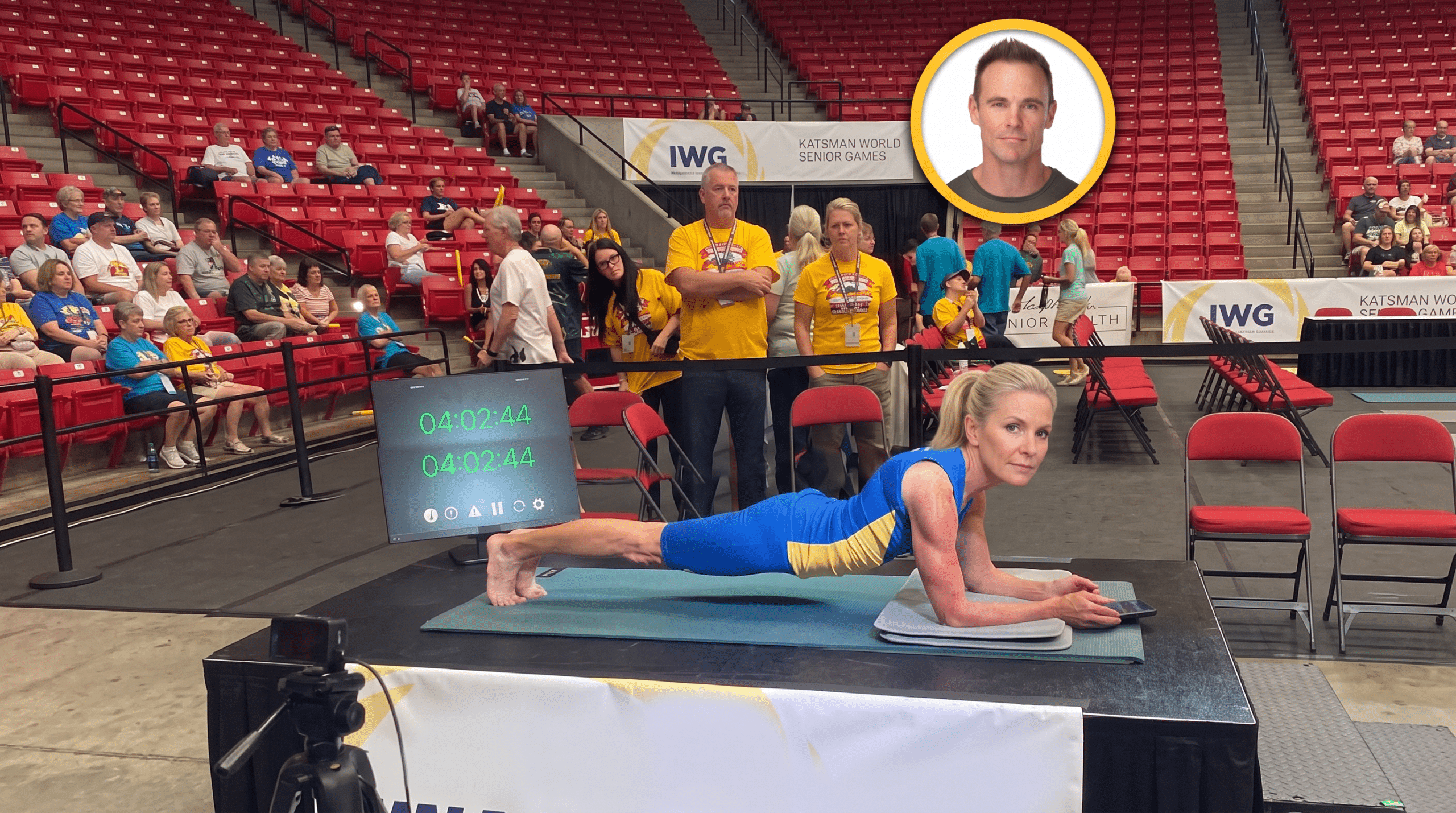
The 61-year-old grandmother of 12 from Welling, Alberta, recently shattered her own Guinness World Record by holding an abdominal plank for five consecutive hours at the Huntsman World Senior Games in Utah.
That’s longer than it takes to fly coast-to-coast across Canada, run a marathon at an easy pace, or roast an entire Thanksgiving turkey.
And she accomplished this feat while a cheering crowd watched and several judges verified every grueling second.
Jump to:
- Breaking Records Has Become a Habit
- What Exactly Is an Abdominal Plank?
- How a Broken Arm Started It All
- Not Just Planks—Pushups Too
- Multitasking While Making History
- The Physical Reality of Extreme Planking
- What Drives Someone to Plank for Hours?
- Inspiration for Everyday Athletes
- The Power of Incremental Progress
- What’s Next for the Planking Grandmother?
Breaking Records Has Become a Habit
Wilde’s latest achievement obliterated her previous 2024 record of four hours, 30 minutes and 11 seconds for the longest time holding an abdominal plank position (female).
Speaking to CBC News Network just days after the record-breaking plank, Wilde said she was “feeling good” while waiting for Guinness to make the new record official.
It just becomes easier to do the more repeated times you do it.
Her calm demeanor isn’t surprising—this retired teacher has turned extreme endurance planking into something of a personal specialty.
What Exactly Is an Abdominal Plank?
An abdominal plank is an isometric core exercise where you hold your body rigid and straight, resembling a plank of wood.
According to Guinness World Records rules, the challenger’s forearms and toes must remain in contact with the ground continuously. The rest of the body must stay lifted off the ground and perfectly straight throughout.
Most adults can manage a plank for somewhere between 20 to 60 seconds, according to Health magazine. Holding one for even three minutes is considered exceptional.
Five hours? That’s an entirely different universe of endurance.
How a Broken Arm Started It All
Wilde’s planking journey began about 15 years ago under unlikely circumstances—a broken arm.
Determined to maintain fitness despite her injury, she discovered planking was one exercise she could perform even with a cast on.
I love to work out. I love fitness, and I discovered I could plank with a cast on. And when the cast came off, it became a habit that I actually embraced and fell in love with.
When she first started, Wilde could hold a plank for about a minute to a minute and a half—respectable by any standard.
But she kept practicing. Minutes became tens of minutes. Then hours. With encouragement from her family, she pushed boundaries most people wouldn’t even consider.
Not Just Planks—Pushups Too
Wilde’s record-breaking achievements extend beyond planking. In 2024, she also broke the Guinness World Record for most pushups in one hour (female) by completing an astonishing 1,575 repetitions.
She told Guinness World Records she fell in love with pushups while doing 500 every single day as training for her plank attempts.
The grandmother of 12 now planks every day for at least a few hours—but she doesn’t see it as wasted time.
Multitasking While Making History
One of the most remarkable aspects of Wilde’s planking practice is how she’s turned it into productive time.
Just read, do texts, whatever, do schoolwork. I did a master’s degree while I was planking. Wrote a book.
Yes, you read that correctly. Wilde earned an entire master’s degree while holding plank positions.
She also wrote a book during her planking sessions—From Minutes To Hours: I Wrote This Book While Planking, which was published last year.
During her multi-hour planks, Wilde reads, writes, responds to texts, and completes schoolwork. She’s essentially turned an extreme physical challenge into a backdrop for intellectual pursuits.
The Physical Reality of Extreme Planking
While Wilde makes five-hour planks sound almost casual, the physical demands are extraordinary.
Planks primarily work the core muscles, including the rectus abdominis, transverse abdominis, and obliques. They also engage the shoulders, back, glutes, and legs to maintain proper form.
Holding any static position for extended periods creates unique challenges:
- Muscles must maintain constant contraction without rest
- Blood flow to working muscles becomes restricted
- Mental fatigue compounds physical discomfort
- Even slight form breakdown can lead to injury or disqualification
The mental component may be even more demanding than the physical one. Maintaining focus and form for five uninterrupted hours requires exceptional psychological resilience.
What Drives Someone to Plank for Hours?
When asked about her motivation, Wilde’s response was refreshingly simple.
I just love it.
Her genuine passion for the challenge shines through. This isn’t about punishment or proving a point—it’s about pursuing something she genuinely enjoys and excels at.
At 61 years old, Wilde demonstrates that age is no barrier to extraordinary physical achievement. She’s living proof that dedication, consistency, and genuine love for an activity can lead to world-class performance at any age.
Inspiration for Everyday Athletes
While most people will never attempt a five-hour plank (nor should they), Wilde’s journey offers valuable lessons for anyone pursuing fitness goals:
- Start where you are: Wilde began with one-minute planks and built up gradually over 15 years
- Consistency matters more than intensity: Daily practice, even in small doses, creates remarkable progress over time
- Adapt to circumstances: Finding exercises that work with limitations (like her broken arm) keeps momentum going
- Make it enjoyable: Wilde multitasks during planks, making the time productive and engaging
- Age is just a number: Breaking world records at 61 proves fitness has no expiration date
The Power of Incremental Progress
Perhaps the most inspiring element of Wilde’s story is the timeline. She didn’t wake up one day and decide to plank for five hours.
She started with 60 to 90 seconds fifteen years ago. Through daily practice and gradual increases, she transformed those seconds into minutes, then hours.
This progression illustrates a fundamental truth about human performance: extraordinary capabilities are built through ordinary, consistent effort over extended periods.
Wilde’s achievement also highlights how reframing challenging activities can change our relationship with them. By multitasking during planks, she’s transformed what could feel like torture into productive, even enjoyable time.
What’s Next for the Planking Grandmother?
Wilde is currently waiting for Guinness World Records to officially verify and certify her latest achievement.
Given her track record—holding two world records and continuously pushing her own boundaries—it wouldn’t be surprising if she’s already thinking about the next challenge.
Whether she attempts to extend her plank time even further or pursues other endurance feats, one thing is certain: DonnaJean Wilde has redefined what’s possible for athletes in their sixties and beyond.
Her story serves as a powerful reminder that limitations are often self-imposed. With passion, patience, and persistence, seemingly impossible goals become achievable—one minute, one hour, one plank at a time.