Building strength for a longer life might take less time than you think.
In a recent article for Business Insider, Dr. Christopher Sciamanna revealed that just four minutes of daily exercise could be enough to boost longevity and preserve independence as we age.
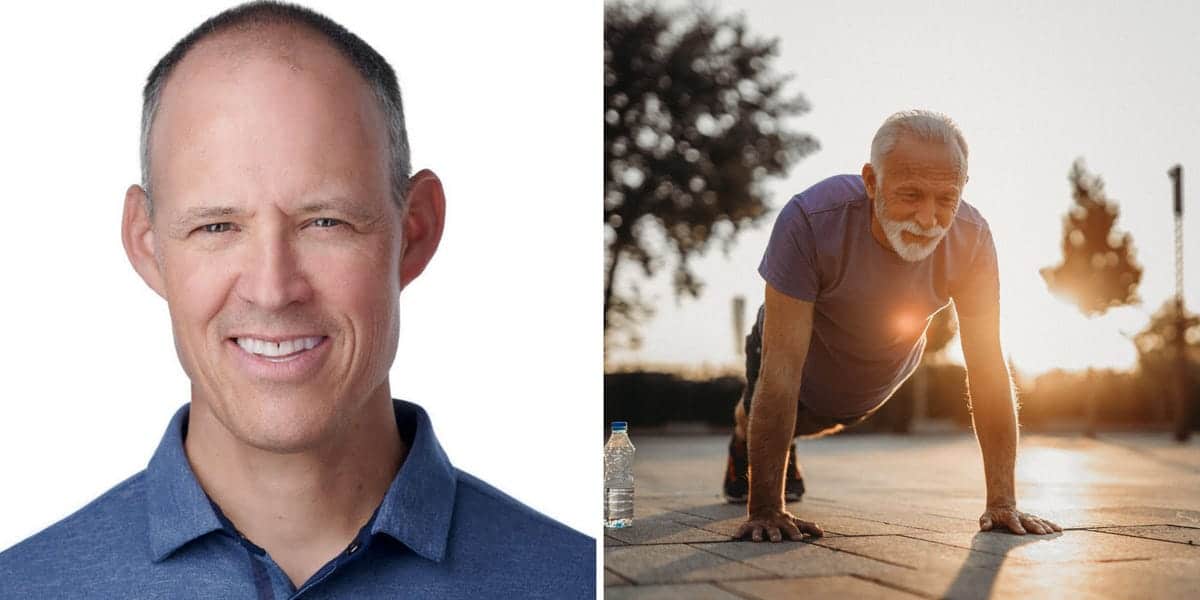
The 59-year-old Penn State professor of medicine admits he hates traditional workouts—which is precisely why he’s dedicated his career to finding the minimal effective dose of exercise that delivers maximum health benefits.
His latest research suggests that short bursts of specific bodyweight exercises might be all older adults need to maintain mobility and reduce mortality risk.
Jump to:
The Four-Minute Protocol That Changed Everything
Sciamanna designed a study testing whether adults over 65 could improve their functional fitness with ultra-short daily workouts.
Participants performed just four exercises—push-ups, squats, stair-stepping, and resistance-band rows—for 30 seconds each, with 30-second rest periods between movements. Total time? Four minutes.
The exercises could be modified based on ability. Wall push-ups replaced standard ones for those who needed them. Chair squats substituted for bodyweight versions. Participants gradually worked toward more challenging variations as they got stronger.
After 12 weeks, the results were striking. Participants who had struggled with basic walking at the study’s start showed significant improvements in their ability to stand up and balance on one leg—two critical predictors of healthy aging and lower mortality rates.
I had this kind of epiphany that if my parents had done just a set of push-ups and a set of squats every day, they probably would’ve been able to maintain their mobility and independence.
The study, published in the journal PLOS One, introduces what Sciamanna calls FAST: Functional Activity Strength Training.
Why Short Workouts Actually Work
The key to Sciamanna’s approach isn’t just the brevity—it’s the psychology behind it.
From a health perspective, the real goal is taking people from zero to one, to a little bit. What we’ve learned is that people who need exercise the most are not going to consider 45 minutes.
Traditional exercise recommendations can feel overwhelming, especially for people who are already struggling with mobility or haven’t been active in years. The fear of failure becomes paralyzing.
Sciamanna’s four-minute protocol solves this problem. People stick with it because it feels achievable, and they quickly experience tangible progress.
The specter of failure and how that will feel to you is really demotivating. We get people to try hard. Psychologically, it works great because humans love the feeling of making progress.
Previous research supports the effectiveness of minute-long strength exercises. Studies show that even brief activities like wall sits can deliver protective benefits, including lower blood pressure and improved cardiovascular health.
The Science Behind Minimal Effective Dose
While Sciamanna’s study focused on older adults, the principles apply across age groups: consistency beats duration when it comes to building strength and resilience.
Research published in the British Journal of Sports Medicine confirms that just two hours of weekly strength training is enough to improve longevity. That breaks down to roughly 17 minutes per day—or less if you train more intensely.
Sciamanna himself applies this philosophy to his own routine. At 59, he trains twice weekly for less than 30 minutes per session, focusing on one hard set of each exercise.
One of the most important pieces of this is that one set is all you need. A couple of times a week, a single set and you’ll get 80% of the strength. Your first dose is really where you get all the benefit.
There’s extensive evidence backing this approach. Research shows that the majority of strength and muscle-building benefits come from the first few sets of an exercise. Additional sets provide diminishing returns—you’ll gain more, but not proportionally to the extra time invested.
The Progressive Overload Requirement
There’s one critical caveat: each set must be challenging, and you need to gradually increase difficulty over time.
This principle, called progressive overload, ensures your body continues adapting and getting stronger. You can’t coast on the same exercises at the same intensity forever and expect results.
Sciamanna’s Personal Longevity Formula
To maximize efficiency, Sciamanna focuses on compound movements that work multiple muscle groups simultaneously:
- Chest presses for upper body pushing strength
- Pull-ups for back and arm development
- Farmer carries for grip strength and core stability
But building strength is only part of the longevity equation.
Sciamanna particularly loves box jumps because they target multiple fitness markers essential for healthy aging—agility, speed, power, and balance. As a bonus, they help him stay competitive in recreational sports like racquetball and pickleball, activities he enjoys with his 25-year-old son.
I think speed is really the next frontier of this work because aging is a loss of speed problem. So move quick.
Beyond Strength: Speed as the Overlooked Factor
While most longevity research emphasizes strength and cardiovascular fitness, Sciamanna believes speed deserves more attention.
Age-related decline often manifests as reduced movement speed—slower walking pace, diminished reaction time, decreased athletic explosiveness. Addressing this through exercises like box jumps, sprints, or agility drills could be crucial for maintaining independence and vitality.
This aligns with emerging research showing that explosive, fast-twitch muscle fiber training becomes increasingly important as we age, not less.
Making It Work for You
Sciamanna’s research offers a refreshing counterpoint to the “more is better” mentality dominating fitness culture.
The takeaway isn’t that everyone should only exercise four minutes daily. Rather, it’s that something is infinitely better than nothing, and the barrier to entry doesn’t need to be high.
For those currently inactive, starting with a four-minute daily routine of bodyweight exercises could be the gateway to lifelong fitness habits. For those already active, the research validates efficiency-focused training approaches that prioritize intensity over volume.
The key principles apply universally:
- Consistency matters more than duration
- One challenging set delivers most benefits
- Compound movements maximize efficiency
- Progressive overload ensures continued adaptation
- Speed and power training deserve attention
More research is needed on the long-term effects of FAST training specifically, Sciamanna acknowledges. But the existing evidence is compelling: brief, intense exercise consistently performed can dramatically improve health outcomes and extend healthspan.
For someone who hates exercise, Sciamanna has discovered the secret to making it sustainable—and potentially lifesaving.