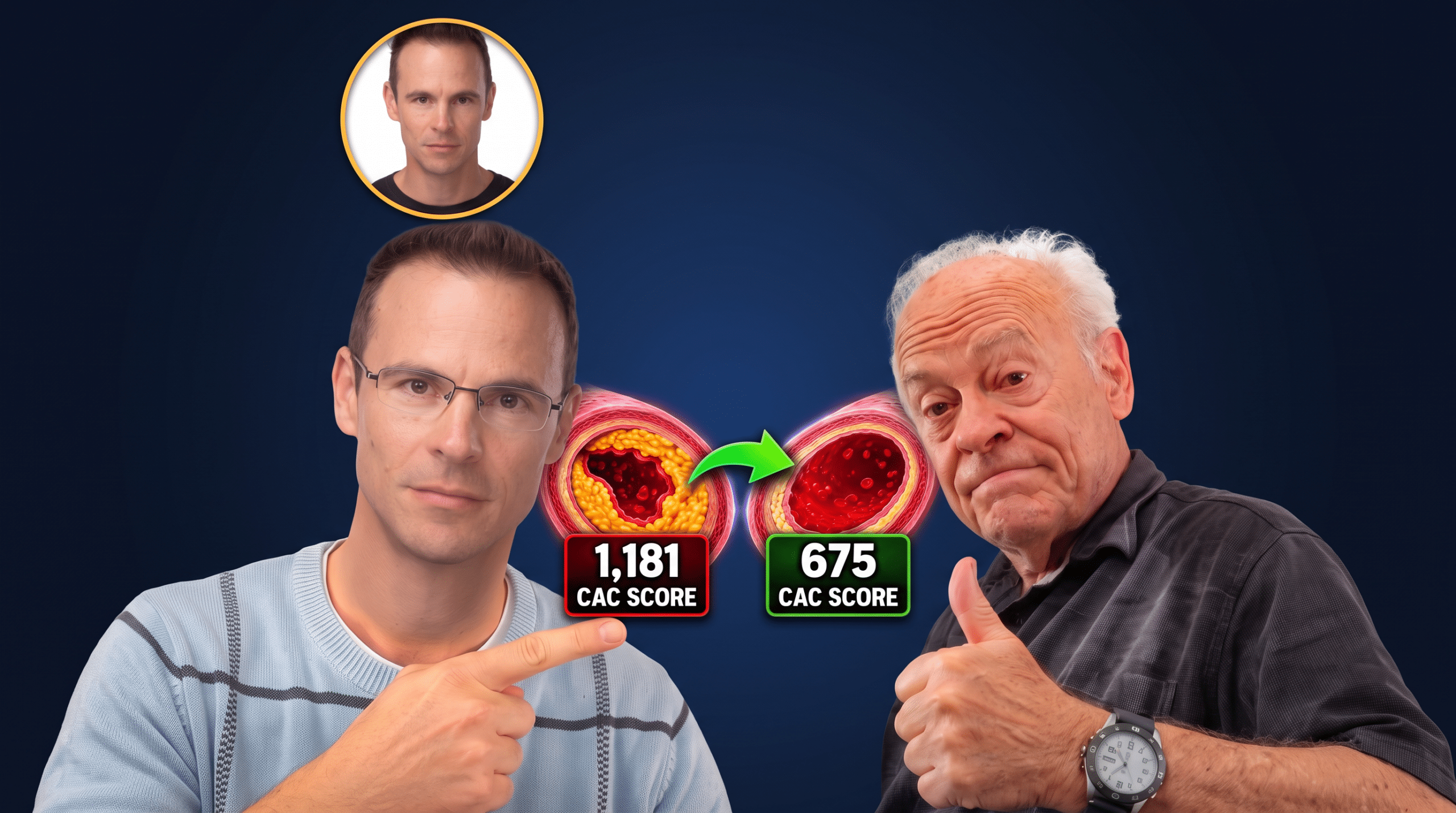
A 76-year-old retired Boeing engineer says he cut his coronary calcium score by roughly 40% without taking a single statin.
In a recent YouTube interview, a popular health creator sat down with Phil to walk through four years of scans and blood work.
Fitness influencer Mark Bell had claimed that nobody has ever reversed artery plaque, and that people who say otherwise never show their scans.
Phil showed his.
One overlooked thyroid tweak changed everything for him, but his cholesterol labs spark a heated debate.
Jump to:
- The Scan Numbers Behind the Big Claim
- The Disappointing Second Scan That Nearly Derailed Him
- The Thyroid Tweak Phil Believes Mattered Most
- What Phil Eats Now
- The Modest Supplement Stack
- The Blood Work That Divides Experts
- The Fuller Picture on Plaque, Cholesterol, and Statins
- Why Cheat Days Bothered Phil
- Practical Takeaways for Your Own Heart Health
The Scan Numbers Behind the Big Claim
Phil took his first coronary artery calcium (CAC) scan in 2020, at age 70. He felt fine, wasn’t overweight, and had zero symptoms.
- 2020: 1,169
- Year two: 1,181 (a tiny rise)
- Year three: 740 (a big drop)
- Next scan: 698
- Latest letter: roughly 675
The host highlighted that the first several scans came from one imaging company on one machine, which makes comparisons far more meaningful. The most recent result came through the VA.
Frankly, it scared me. It scared me badly because here I was, no symptoms, no problems.
His doctor immediately suggested Crestor. Phil asked to hold off and try a different route first.
The Disappointing Second Scan That Nearly Derailed Him
Phil joined cardiologist William Davis’s Undoctored program, which costs about $20 a month and centers on a keto-light diet. A year in, his score had edged up.
He was crushed. Davis’s reply reframed everything.
Trying to stop atherosclerosis is like trying to stop a freight train. You’ve been on this thing for 70 years.
Phil credits the weekly group calls with keeping him from quitting. Many people give up after one flat result, he says, especially when they’re doing it alone.
The Thyroid Tweak Phil Believes Mattered Most
Davis flagged something no prior doctor had: Phil sat in the lower third of the “normal” thyroid range.
You need to get that, particularly the free T3 thyroid number, up at least into the middle top third. That’s where some good things start happening.
Phil worked with his primary care physician and now takes thyroid medication, his only prescription drug. His TSH sits at 1.3, which the host called excellent. The next scan fell sharply.
Worth noting: Phil changed diet, supplements, and thyroid treatment within the same window. Pinning the drop on any single factor is impossible.
What Phil Eats Now
Before the shift, Phil ate a classic standard American diet: raisin bran, orange juice, toast with jelly. His doctor had also warned that blood sugar was creeping toward pre-diabetes.
- Two meals daily: a hearty breakfast and a bigger evening meal
- Breakfast staples: eggs, avocado, bacon, or an occasional protein shake
- L. reuteri yogurt: a homemade, yogurt-like food that helps curb hunger
- Unlimited meat and vegetables, with only a little fruit
- No calorie counting
Drinking water is reverse-osmosis filtered, and he sleeps about seven hours nightly. He also admits he’s not a big exerciser.
The Modest Supplement Stack
- Vitamin D3
- Vitamin K2
- Omega-3 (about 3,500 mg)
- Magnesium
- Iodine
A lot of people think that they can supplement their way out of this and that’s impossible. Supplements are more or less the icing on the cake.
The Blood Work That Divides Experts
Here’s where things get spicy. Phil’s latest labs show numbers many cardiologists would circle in red.
- Total cholesterol: 238
- LDL: 158
- ApoB: 121 (flagged)
- Small LDL particles: about 358 (Davis’s target is below 200)
- A1C: about 5.3
Phil worries most about small LDL particles, which he says linger longer after dietary slip-ups. The host pushed back.
I think a lot of times when you’re studying small particles, you’re just studying more insulin resistance.
His argument: with healthy arteries and low insulin resistance, higher cholesterol numbers are less threatening.
The Fuller Picture on Plaque, Cholesterol, and Statins
The evidence here is more mixed than the conversation suggests. Mainstream cardiology still treats elevated LDL and apoB as direct drivers of plaque buildup, not just bystanders of insulin resistance.
Statins also have a large body of trial evidence showing fewer heart attacks and strokes. The claim that they accelerate calcification is a view held by Davis and the host, not a consensus.
Phil’s story is also one person’s experience, not a controlled trial. CAC scans can fluctuate between tests, and several variables changed at once.
Still, a documented drop across scans from a single facility is a notable data point. It deserves discussion with a cardiologist, not dismissal.
Why Cheat Days Bothered Phil
Phil admits his discipline slipped around year three. Holiday pie and relaxed rules crept in, and a later scan stalled.
There came the next calcium scan and it was another wake-up call. Hey, get back on it.
His takeaway: consistency beats perfection for a week, and drifting for months shows up on paper.
Doctors Started Paying Attention
Phil’s primary care doctor, the same one who first suggested Crestor, began agreeing to every test Phil requested. Phil suspects he was curious where the numbers were heading.
Practical Takeaways for Your Own Heart Health
- Get a baseline CAC scan. Phil’s cost roughly $100 out of pocket.
- Repeat scans at the same facility, ideally on the same machine, for apples-to-apples comparisons.
- Track more than cholesterol. Phil monitored A1C, thyroid markers, apoB, and particle counts.
- Ask about thyroid labs if your numbers sit low within the “normal” range.
- Give changes time. One flat scan isn’t a verdict.
- Never stop prescribed medication on your own. Review any plan with your doctor first.
The body wants to heal itself if you’ll let it. It takes some guts to go against the mainstream medical.
Phil also notes bonus changes: fewer seasonal allergies, no acid reflux, and no hemorrhoids. Whether the diet deserves the credit remains unproven, but he’s convinced.