Gaining 10 kg of muscle in one year sounds like fantasy for most lifters.
Yet in the closing chapter of his three-year video trilogy, YouTuber Nick says a DEXA scan showed exactly that.
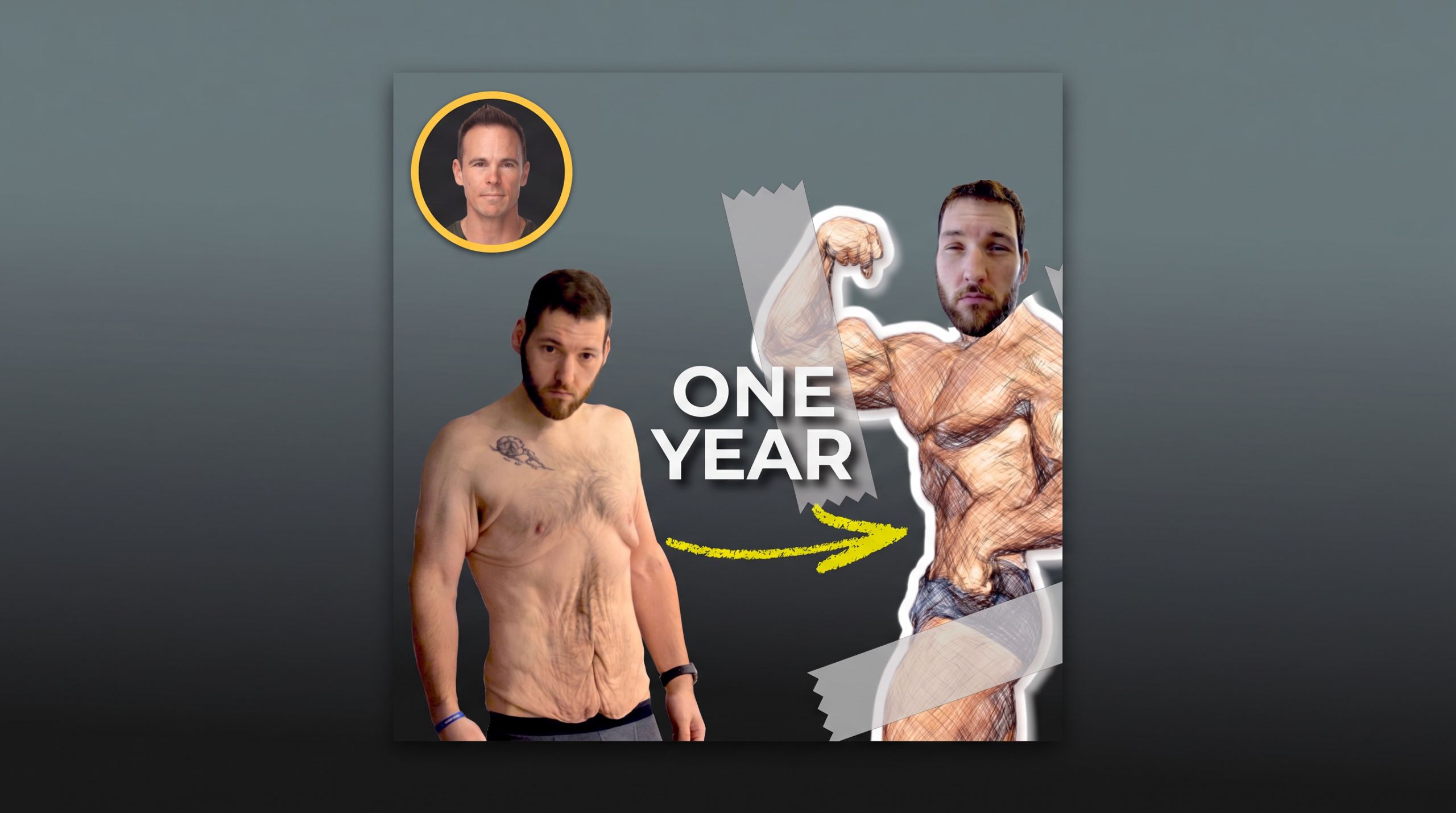
This is the same man who lost 100 kg (220 lb) in year one, then spent year two keeping it off.
Between the start and finish came a shattered collarbone, a mystery hip injury, and a burnout nobody saw coming.
What worked, what nearly derailed everything, and why one scan caught him off guard are all ahead.
Jump to:
The Headline Result: 10 kg of Muscle in Roughly 10 Months
His final scan revealed 10 kg (22 lb) of added lean mass. Even Nick struggled to believe it.
Apparently I put on 10 kg of muscle. 10. That’s 22 lb. That’s unbelievable.
He initially assumed the figure combined muscle and fat, but it was lean mass alone. That is well beyond what he expected even a beginner to gain in 12 months, and his broken collarbone trimmed his real training window to about 10.
The Fine Print Worth Knowing
The picture is a touch fuzzier than one big number suggests. DEXA uses low-power X-rays to split the body into bone, fat, and lean tissue by density, and lean mass also includes organs and skin.
Nick’s logic: a fully grown adult’s organs and skin barely change, so a rise is most likely muscle. He also flagged his own source of error.
I think I might have messed with the scans a bit by exercising before the first two scans and not exercising after the last one.
Training the day before drains glycogen and sweats out fluid, so early readings could be off by a couple of kilograms. Even after that adjustment, the gain remains huge.
Scan by Scan: How the Numbers Moved
- December baseline: body fat came in near 17%, well under his guess of low 20s, with loose skin likely nudging the reading. His left arm held clearly less muscle than the right.
- April check-in: roughly 2.6 kg of muscle in four months while body fat barely budged.
- Final scan: around 10 kg of muscle gained, with body fat at about 19%.
That April result thrilled him because muscle gain is a tug-of-war.
When you’re trying to put on muscle, it’s essentially a battle between those two figures. You want to put on muscle, you don’t want to put on body fat.
The April scan also showed his torso gaining nicely, a sign the chest, back, and core work was paying off. Legs grew less, which he expected after years of uphill mountain biking.
The Fuel: 4,000 Calories a Day
Because Nick logs everything in a spreadsheet, he could check his intake between scans. It averaged about 4,000 calories daily, far above his guess.
In essence, I did exactly what I wanted, you know, and that was on 4,000 calories a day.
Context matters here. His output was enormous, with up to 1,600 calories burned actively on some days.
Treat his number as a data point, not a prescription. Smaller or less active people will need far less.
His Weekly Training Setup
- Four gym sessions: two upper body, two lower body
- About six hours of boxing
- Heavy cycling filling most remaining time
- Tracking: the Heavy app, plus monthly benchmark lifts
The Broken Collarbone That Became an Unlikely Gift
The year began badly. A bike seized mid-ride, Nick flew over the handlebars, and surgery left a plate in his shoulder.
Biking and boxing were out. Strength training, a thing he had long claimed to dislike, became the only option.
It’s annoying for two reasons. One is that I’ve spent a long time telling you that I don’t like strength training. And the second reason that it’s annoying is because you were right. I do like it.
Looking back, he credits the setback for his results.
I probably wouldn’t have made that much progress if I wasn’t doing the kind of dedicated focus training that you do when you’re weightlifting.
His weaker left arm also rebounded fast once loaded again, outgrowing the right between scans. Muscle that has atrophied tends to return quickly.
Why Scans Beat the Scale
Nick once vowed never to exceed 100 kg again. That promise became a trap, leaving him weighing himself obsessively after big meals.
Building muscle flipped the script. He crossed 100 kg this year and felt fine.
Muscle is weight. So now weight gain in my head is associated with success. I cannot succeed without gaining some weight.
Infrequent scans also helped. Since you can’t book one daily, there is no way to fixate.
You can only see the trend, which is the more important part.
The Burnout Nobody Planned For
Once his arm healed, Nick stacked an hour of lifting daily on top of boxing and cycling that once hit 20 hours weekly. Overload crept in quietly.
Unsurprising to anybody, I’ve overdone it. I am okay. I’m not miserable. I’m just exhausted, you know?
Sore wrists, aching ankles, and dreaded gym visits compounded one another. Housework and video games slipped too.
Injuries piled up as well. A hip gave out on the treadmill, and soaked feet during a Tokyo typhoon left him limping onto a plane.
Fitness Wins Along the Way
- Tough Guy Challenge: finished eighth, beating his previous time by 19 seconds despite muddier conditions
- Half marathon: roughly 1 hour 50 minutes, about 10 minutes faster than before
- Bike trail: conquered a climb he’d chased for a year without stopping
What Nick Plans Next
Burnout did not end his love of lifting. A string of personal bests in his final week changed his mind.
I’m not going to stop weightlifting. I do like it. I really do.
Next comes a short cut to bring body fat down from 19%. He also wants more balance, plus new activities like bouldering and calisthenics.
Practical Takeaways
- Track intake and lifts: data reveals what gut feeling can’t.
- Measure rarely: spaced-out scans show trends instead of daily noise.
- Schedule rest: overtraining sneaks up, and enjoyment is a fitness metric too.
- Treat setbacks as pivots: a forced change of plan may open better paths.