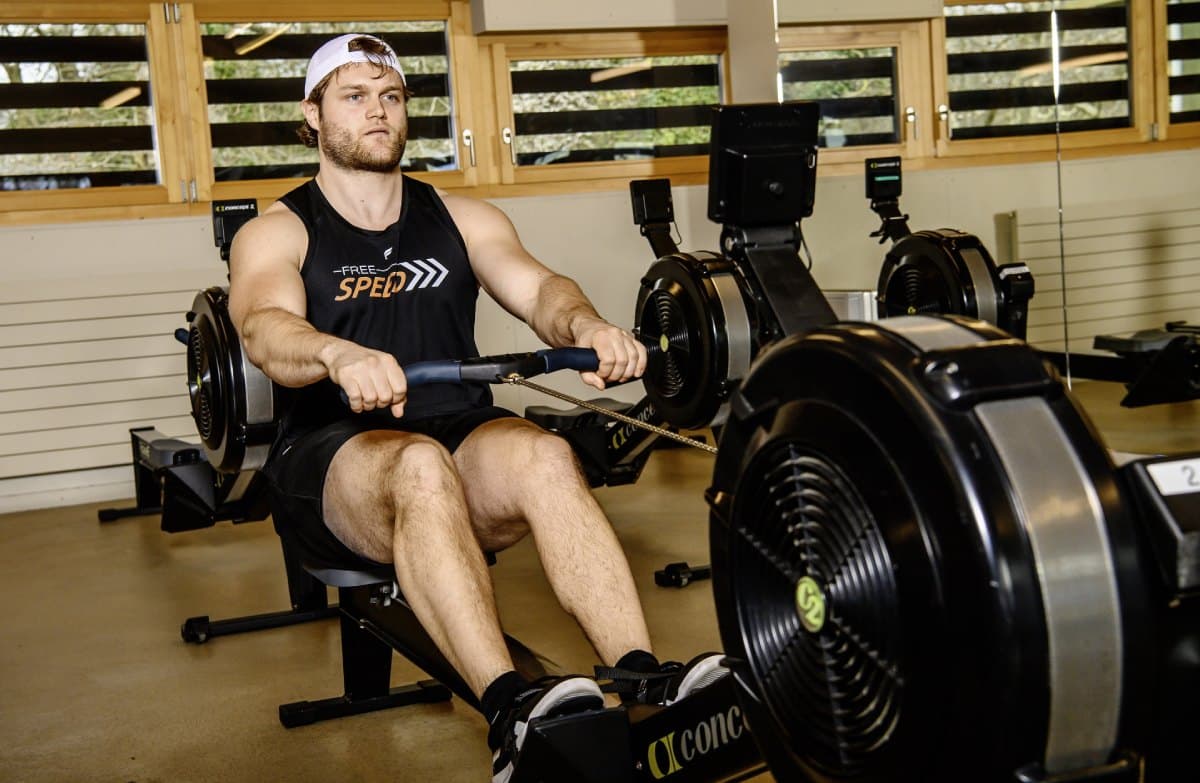
In a stunning display of human power and modern tech, Swiss athlete Loïc Schalbetter has shattered expectations—and a few data displays—by rowing 100 meters in just 12.1 seconds on a Concept2 machine equipped with slides.
This isn’t just fast. It’s historic.
Jump to:
A New Benchmark in Indoor Rowing Power
Schalbetter’s performance, confirmed by Concept2, isn’t simply a personal best. It’s the fastest recorded 100-meter row ever—a benchmark that redefines what’s possible on the erg.
Here’s what his sprint looked like in raw numbers:
- 12.1 seconds over 100m
- 1:00.5 average split per 500m
- 0:57.7 peak pace
- 1818 watts of power output
To put that in perspective, most elite CrossFit athletes finish 500m sprints between 1:20–1:30. Even Olympic-level rowers, who train for years to generate massive wattage and endurance, typically don’t hit this kind of instantaneous power output over such a short burst.
“This is more like a powerlifting one-rep max than it is an endurance event,” commented one longtime erg coach on Instagram. “You’re not rowing—you’re exploding.”
The Role of Slides and Tech in the Record
This record was achieved using Concept2 slides, which simulate water-like momentum by allowing the rowing machine to move under the athlete, rather than the athlete moving back and forth alone.
Slides help minimize the braking forces that occur during transitions between the drive and recovery phases of the stroke, allowing for a smoother and potentially faster movement pattern.
But just as important as the slides was the firmware update from Concept2. Until recently, their Performance Monitors capped out at a 1:00/500m pace reading. That meant rowers pushing beyond that threshold—like Schalbetter—couldn’t even track their full performance.
Once the new firmware rolled out, times like these became visible—and within days, Schalbetter smashed through a barrier no one had seen clearly before.
“Thank you @eltgilmore for notifying me about the @concept2inc firmware update that now displays paces under 1:00 / 500m 🤩,” Schalbetter wrote in his caption on Instagram.
The record wasn’t just a win for the athlete—it was a win for the evolution of the sport itself.
Why the 100m Row is a Different Beast
The 100m sprint on a rowing machine is not a typical event. It’s rarely seen in competitions, largely because it’s such a niche test—an explosion of pure power, not a test of aerobic capacity or pacing.
At this distance, there’s no time to settle into rhythm. There’s no room for inefficient strokes. Everything hinges on the ability to generate explosive leg drive, maintain form under extreme force, and convert strength into maximum speed—instantly.
Compare that to a 2,000-meter race, which takes Olympic rowers over six minutes, or even a 500-meter sprint in HYROX or CrossFit, and the 100m row looks more like a standing vertical jump than a race.
“This distance isn’t rowing in the traditional sense,” one coach said. “It’s a violent expression of fast-twitch muscle and peak coordination.”
Can Anyone Go Under 12 Seconds?
That’s now the big question circulating across the indoor rowing and CrossFit communities: Can anyone break the 12-second barrier?
Some believe Schalbetter’s 12.1 might be the human limit—at least until new training methodologies or equipment changes come into play.
Others see it as just the start of a new sub-discipline in rowing sport.
“There are people out there with bigger verticals, faster reaction times, or better torque-to-bodyweight ratios,” wrote one commenter. “It’s only a matter of time.”
Still, replicating that level of output—1818 watts sustained for over 12 seconds—requires a rare blend of elite athleticism, near-perfect technique, and precise timing.
For comparison:
- Most fit individuals generate between 400–700 watts during an all-out row.
- Professional CrossFitters might reach 1,000–1,200 watts briefly during sprints.
- Schalbetter sustained over 1,800 watts, nearly doubling what elite athletes typically achieve.
What This Means for Rowing Athletes and Tech
Schalbetter’s achievement is a reminder that the ceiling for human performance is constantly rising—but also that technology and metrics shape how we define that ceiling.
Concept2’s new firmware didn’t make Schalbetter faster. But it did allow us to witness just how fast he already was.
For rowers, HYROX competitors, and CrossFit athletes, this changes the game. It opens new possibilities for short-distance power testing, training benchmarks, and even new event formats.
And for fans? It’s a chance to watch what used to be invisible.
Final Thoughts
Loïc Schalbetter’s 12.1-second, 100-meter row isn’t just a viral moment—it’s a statement about what’s possible when elite athleticism meets precise training and evolving technology.
The next question isn’t whether someone can break the record—it’s when, and how far we’re willing to push the boundaries of indoor rowing.
Until then, 12.1 seconds remains the time to beat.