An 83-year-old woman who could barely walk for 30 seconds unaided just over a year ago is now closing in on her goal of walking 15 minutes without support.
Her secret? Barbell training and progressive strength work.
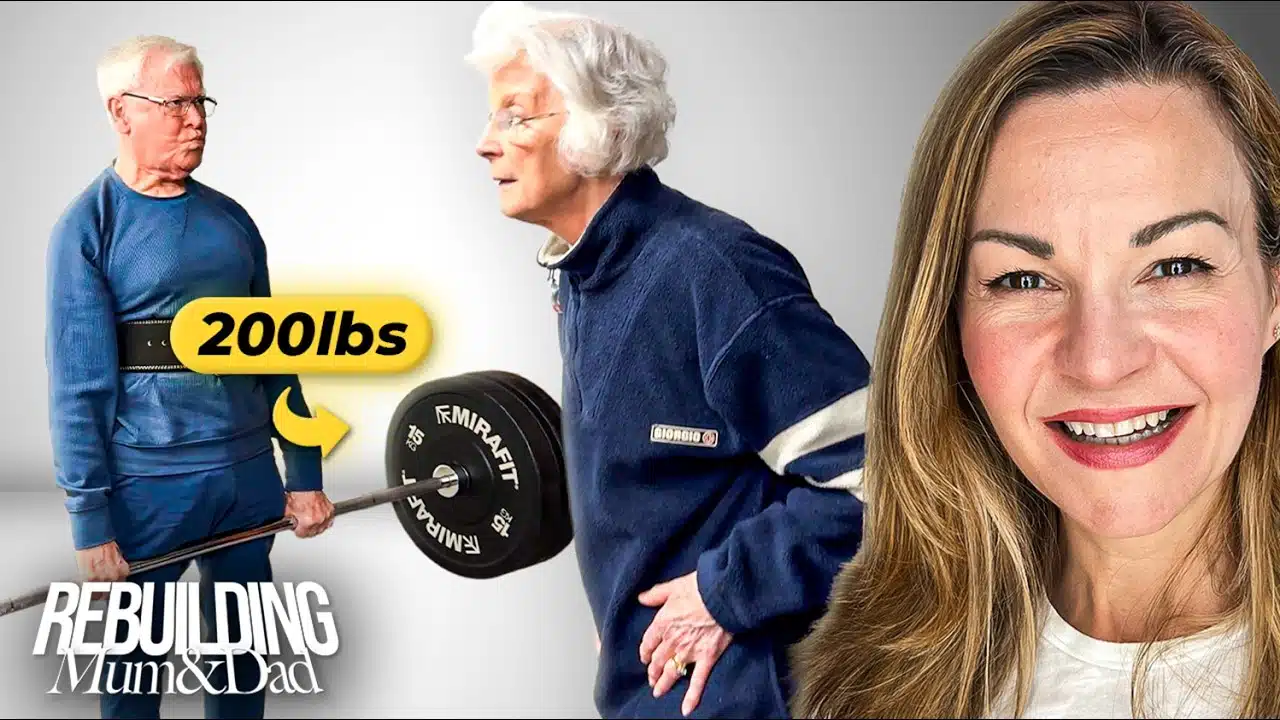
In the latest episode of Rebuilding Mom and Dad, journalist Claire Johnston documents her mother’s remarkable progress—including a recent unsupported walk of nearly 10 minutes, uphill, with no pain.
It’s a powerful reminder that muscle loss isn’t inevitable, and that resistance training can restore function even in advanced age.
Jump to:
- From 30 Seconds to 10 Minutes: Strength Training Transforms Mobility
- Lifting Heavy in Her 80s: Current Strength Stats
- Dad’s Comeback: Deadlifting Over 200 Pounds at 83
- Why Progressive Loading Works—Even at 80+
- A Walk Down Memory Lane: Beauty, Religion, and Regret
- Muscle Isn’t Just About Strength—It’s About Survival
- What’s Next for Mom and Dad
From 30 Seconds to 10 Minutes: Strength Training Transforms Mobility
Claire’s mother began barbell training in January 2024 under online coaching from Dr. Chris Ree, a physical therapist with Starting Strength Cincinnati.
Fourteen months later, her walking endurance has increased twentyfold—and she’s doing it upright, unassisted, and without the chronic pain that once plagued her.
Now that I’ve stopped walking, I can get upright. Shoulders back. Head up. That’s different to before.
During her most recent walk, Claire’s mom covered nearly 10 minutes of ground on a windy day—without her rolling walker. She even tackled an incline, something unthinkable just months earlier.
Claire noted the shift wasn’t just physical. Her mother is standing taller between walks, her hands resting higher as her posture improves.
Lifting Heavy in Her 80s: Current Strength Stats
Claire’s mother isn’t just walking better—she’s lifting better. After easing back slightly over Christmas to refine form and allow recovery, she’s now working back toward personal bests across all lifts.
Here’s where she stands:
- Deadlift: Working back toward 45 kg (100 lbs), her previous best
- Bench press: 23.5 kg (52 lbs) for three reps, up from 25 kg before Christmas
- Overhead press: 18.5 kg (41 lbs), nearing her max of 19 kg
- Squat: Five sets of three reps wearing a 20 kg (44 lb) weighted vest
Each of these numbers reflects not just raw strength, but improved work capacity and muscular endurance. She’s also dealing with thoracic kyphosis—a forward stoop common in older adults—so her focus remains on chest lift and spinal extension during every lift.
Dad’s Comeback: Deadlifting Over 200 Pounds at 83
Claire’s father is also making serious gains. After stepping back from his previous deadlift max of 94 kg (207 lbs) due to grip limitations, he’s now comfortably performing three reps at 90 kg (198 lbs).
His current lifting stats include:
- Deadlift: 90 kg (198 lbs) for three reps
- Overhead press: 22 kg (50 lbs), down from 38 kg to address lower back tightness
- Squat: Around 50 kg (110 lbs), reduced from 58 kg for form refinement
- Bench press: Returning this week to 48 kg (105 lbs)
His near-term goal? Hit 100 kg on the deadlift.
I’m beginning to test my limits again. I feel that if I’ve got to here, I should be able to get there.
But it’s not about vanity. For Claire’s dad, lifting heavy is about rebuilding confidence, preserving independence, and protecting long-term health.
Why Progressive Loading Works—Even at 80+
Claire and her parents train using the Starting Strength method, which emphasizes progressive overload with a barbell. This approach works multiple muscle groups simultaneously and allows for controlled, incremental increases in weight.
Using micro-plates—sometimes adding as little as one kilogram per week—they’ve been able to build strength safely and sustainably.
Barbell training is especially effective for older adults because:
- It builds muscle mass and bone density simultaneously
- It improves balance, coordination, and functional movement
- It boosts metabolic health and cardiovascular resilience
- It enhances cognitive function and mood
In fact, Claire’s mother experienced a nearly 7% increase in spinal bone density after just one year of training—a result revealed via DEXA scan in a previous episode.
A Walk Down Memory Lane: Beauty, Religion, and Regret
During her recent walk, Claire asked her mother about growing up in a strict religious environment in a small Scottish fishing town. The conversation revealed how deeply her self-image had been shaped by judgment and modesty culture.
When I was young, I wore a little bit of powder. And my grandmother would come in and look into my face and say, ‘Go and get that muk off your face.’ She was horrified.
Claire’s mother also shared her skincare routine—surprisingly simple and consistent since her youth. Moisturizer, cleanser, toner. No elaborate serums or treatments. Just hydration and removal of makeup nightly.
When asked about her greatest regret, she didn’t hesitate: not knowing about strength training sooner.
Absolutely. Oh yeah, if I had known. I mean, I tried so many things.
It’s a sentiment many older adults share—wishing they’d started building muscle decades earlier. But Claire’s parents prove it’s never too late to begin.
Muscle Isn’t Just About Strength—It’s About Survival
Muscle is metabolically active tissue that influences whole-body health. It regulates blood sugar, supports immune function, protects joints, and even influences brain health.
Low muscle mass and strength, on the other hand, are consistently linked to:
- Higher disease risk
- Functional decline
- Loss of independence
- Earlier mortality
That’s why protecting and rebuilding muscle across the lifespan is one of the most important things anyone can do for long-term health.
And as Claire’s parents demonstrate month after month, age is not a barrier—it’s just a variable to work with.
What’s Next for Mom and Dad
Claire’s mother is aiming to walk 15 minutes unassisted by the end of this year. Given her trajectory, that goal seems well within reach.
Her father wants to deadlift 100 kg—a round number that represents both physical and psychological victory.
Both are continuing to train consistently, refining form, building capacity, and proving that frailty is not inevitable.
Claire plans to release an upcoming interview with physiologist Dr. Stacy Sims, diving deeper into how mechanical load influences muscle fiber adaptation and what happens inside muscles during strength training.
For anyone inspired by this journey—whether caring for aging parents or rethinking their own approach to fitness—the message is clear: it’s never too late to rebuild strength, reclaim function, and change the way we age.