Choosing the right triceps exercises can make or break your arm development.
Not all movements are created equal, and some popular choices might actually be holding back your gains.
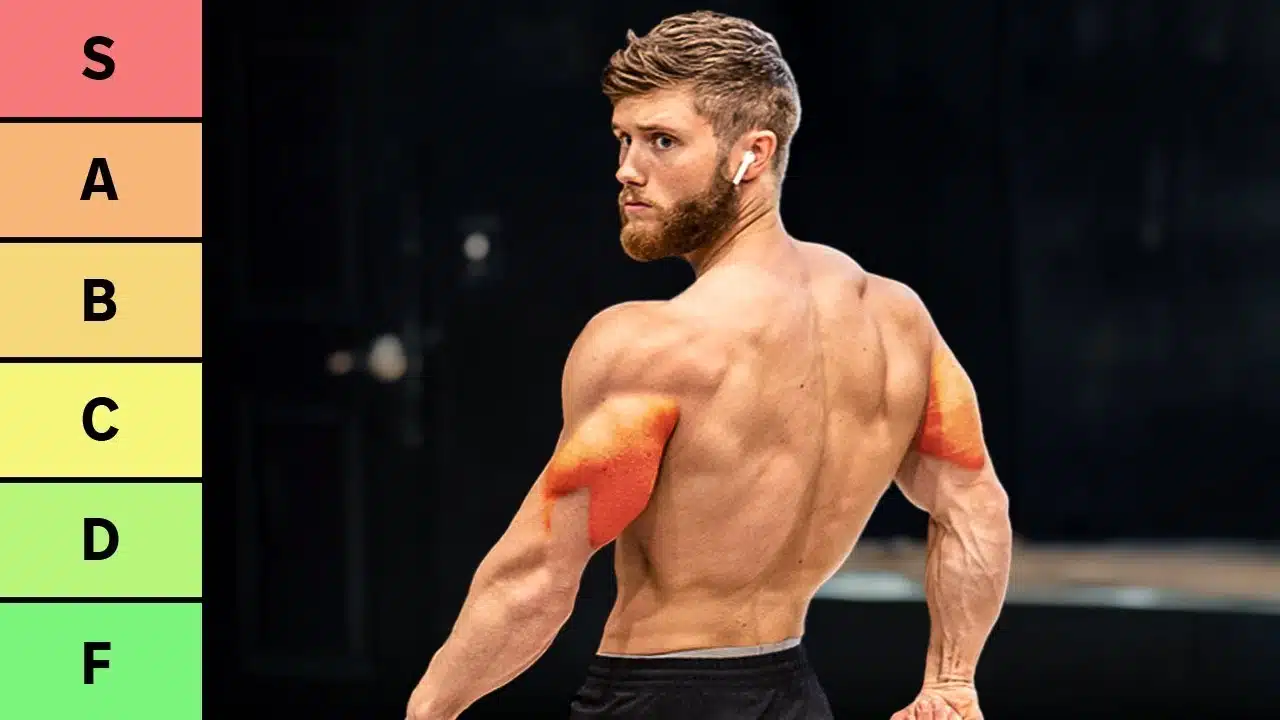
In a recent YouTube video, fitness expert Jeff Nippard ranked 20 of the most popular triceps exercises from S-tier (super) to F-tier (fail), revealing which movements deserve a spot in your training program.
The insights might surprise you—especially if you’ve been relying on dumbbell kickbacks or bench dips as staples.
Jump to:
- The Three Rules Every Great Triceps Exercise Must Follow
- Pressdowns: Good, Better, Best
- Why Overhead Extensions Reign Supreme
- The Katana Extension: A Hidden Gem
- Skull Crushers: The Free Weight King
- The JM Press: Overhyped or Underrated?
- Kickbacks: Cables Beat Dumbbells
- Dips and Presses: Compound Power With Caveats
- Push-Up Variations: Bodyweight Limitations
- The Dumbbell French Press: Solid But Limited
- Building Complete Triceps: The Strategic Approach
- The Best and Worst: Final Verdict
The Three Rules Every Great Triceps Exercise Must Follow
According to Nippard, an effective triceps exercise needs to check three critical boxes. First, it must provide high tension, especially in the stretched position. Research increasingly shows that training muscles under stretch produces superior growth.
Second, the movement needs to feel good—meaning it doesn’t cause pain and offers a smooth resistance profile throughout the range of motion. Third, it requires simple progression so you can easily add weight or reps week to week.
Understanding triceps anatomy is equally important. The muscle has three heads: the lateral head creates that horseshoe shape, the medial head runs down the middle, and the long head—the only one crossing both shoulder and elbow joints—adds mass from the rear view.
Pressdowns: Good, Better, Best
Pressdowns remain one of the most popular triceps movements, but attachment choice matters more than most people realize. Nippard tested three variations with identical weight and technique.
I got 12 reps with the rope and 16 reps with the bar. That’s four extra reps at the same weight simply by using a bar.
The rope pressdown allows you to drive the handles apart at the bottom for enhanced mind-muscle connection, but the unstable attachment limits load capacity. Nippard placed it in B-tier—solid but not optimal.
The bar pressdown provides superior stability, directing more tension to the triceps throughout the movement. It earned A-tier status, making it an excellent choice for most training programs. However, it never gets the triceps into a deep stretch, preventing it from reaching S-tier.
The reverse grip pressdown landed in C-tier. While some lifters feel it better, turning palms up doesn’t change triceps biomechanics significantly and actually weakens force output—Nippard managed only 10 reps with this grip.
Why Overhead Extensions Reign Supreme
The game-changer for triceps development? Moving your arms overhead. This simple adjustment transforms an ordinary extension into an elite muscle builder.
The overhead cable extension puts the long head under massive stretch while maintaining high cable tension in that lengthened position. A 2023 study found overhead extensions caused approximately 40% more triceps growth than standard pressdowns.
Nippard explains the biomechanics: the long head performs shoulder extension (pulling your arm down) in addition to elbow extension. When your arm is overhead, the long head experiences maximal stretch. When it’s down at your side, it’s more contracted.
The overhead cable extension with a bar earned S-tier status—Nippard’s first top-tier triceps exercise. Using a rope instead still works excellently but limits overload potential slightly, placing it in A-tier.
The Katana Extension: A Hidden Gem
The katana triceps extension—named for how you draw Japanese swords—involves crossing your arms overhead to grab opposite cables. This unique setup positions arms about 30-40 degrees forward in the comfortable scapular plane.
These hit both arms individually while saving time, making them excellent for addressing imbalances. Nippard considers them a personal favorite worthy of S-tier, but placed them in A-tier due to the learning curve and setup requirements.
Skull Crushers: The Free Weight King
Among free weight options, skull crushers stand out as Nippard’s favorite. They provide extreme tension while triceps are stretched, especially when you arc the bar back behind your head rather than stopping at your forehead.
An EZ-bar reduces wrist strain while allowing excellent progressive overload. Starting with elbows slightly back rather than perpendicular creates immediate tension, and arcing the weight behind your head maximizes the stretch. These biomechanical advantages earned skull crushers S-tier status.
Dumbbell skull crushers offer similar benefits with individual arm training, but Nippard finds them slightly more awkward to control in the overhead lying position. They dropped to A-tier despite solid fundamentals.
The JM Press: Overhyped or Underrated?
Popular in powerlifting circles, the JM press hybridizes close-grip bench press and skull crushers. Instead of lowering the bar to your chest or behind your head, you meet halfway and lower to your chin area.
Nippard finds the barbell version causes elbow discomfort and doesn’t stretch the long head as effectively as true skull crushers. It landed in B-tier. However, the Smith machine JM press fixes many issues—the fixed path helps focus tension on triceps rather than allowing pecs and delts to dominate, earning it A-tier.
Kickbacks: Cables Beat Dumbbells
Kickbacks train triceps with arms held back behind the torso, creating peak contraction in the long head—the opposite stimulus of overhead work.
Cable kickbacks provide even tension throughout the entire range of motion and feel smooth with higher reps. Nippard placed them in A-tier, appreciating their unique contribution to complete triceps development.
Dumbbell kickbacks, however, offer zero tension when triceps are stretched and maximum tension when contracted—the opposite of what’s optimal. While not completely useless, they’re better replaced by overhead dumbbell extensions if dumbbells are your only option. They landed in C-tier.
Dips and Presses: Compound Power With Caveats
Close-grip bench press excels at progressive overload, allowing you to add weight for years. It hammers the medial and lateral heads effectively with consistent bar tension. However, the long head doesn’t experience much stretch because it lengthens at the shoulder while shortening at the elbow simultaneously.
Despite being an excellent movement, this limitation dropped it to A-tier rather than S-tier.
Close-grip dips work triceps with arms back, creating strong long-head contraction but minimal stretch. Nippard finds his shoulders get cranky and his pecs easily take over, placing dips in B-tier. Machine dips offer more stability but share similar limitations—also B-tier.
Bench dips improve triceps isolation by removing pecs and delts, but progressive overload becomes awkward as you get stronger. Adding weight to your lap feels unstable, landing them in C-tier.
Push-Up Variations: Bodyweight Limitations
Close-grip push-ups mirror close-grip bench press biomechanics but suffer from difficult progression beyond the beginner stage. C-tier placement reflects their limited long-term potential.
Diamond push-ups increase difficulty considerably through a narrower base and more flared elbows. Nippard likes them as high-rep finishers, elevating them to B-tier despite progression challenges.
The Dumbbell French Press: Solid But Limited
The seated dumbbell French press stretches the long head effectively with faster setup than cables. However, dumbbells provide circular resistance—high tension at the bottom, less at the top—rather than cables’ uniform pull.
As triceps strengthen, bulky dumbbells become awkward to handle and strain wrists. These factors placed the bilateral version in B-tier.
One-arm dumbbell extensions solve several problems. You can angle elbows more comfortably for shoulder health, and smaller dumbbells eliminate awkwardness. For dumbbell-only training, these represent an excellent choice worthy of A-tier.
Building Complete Triceps: The Strategic Approach
Nippard’s ranking reveals several key principles for maximizing triceps development:
- Pressing exercises alone won’t maximize growth, especially for the long head
- Isolation work is non-negotiable for complete development
- Overhead movements are essential for long head growth through stretch-mediated hypertrophy
- Train from multiple shoulder angles for proportional development across all three heads
An optimal program includes at least one overhead movement (like overhead cable extensions), one arm-at-side movement (like bar pressdowns), and ideally one arm-behind-torso movement (like cable kickbacks).
The Best and Worst: Final Verdict
When forced to crown just one exercise as the absolute best, Nippard chose the overhead cable triceps extension. It grows all three heads effectively, provides high tension under stretch, feels smooth, progresses easily, and has been validated in long-term hypertrophy research.
For the worst of the worst? The dumbbell kickback takes that dubious honor. While not completely ineffective, better options exist for every training scenario and equipment availability.
Interestingly, no exercise received F-tier status—every movement has some merit in the right context. The key is understanding which exercises deliver the most bang for your training buck and programming them strategically for complete triceps development.