Peptides have exploded across fitness forums, biohacker circles, and even medical offices in recent years. Yet most people scrolling through peptide vendor websites find themselves staring at a wall of abbreviations and acronyms that feel more like alphabet soup than science.
Dr. Ashley Frasy recently decided to tackle this confusion head-on, creating a rapid-fire guide through approximately 50 different peptides currently circulating in wellness communities.
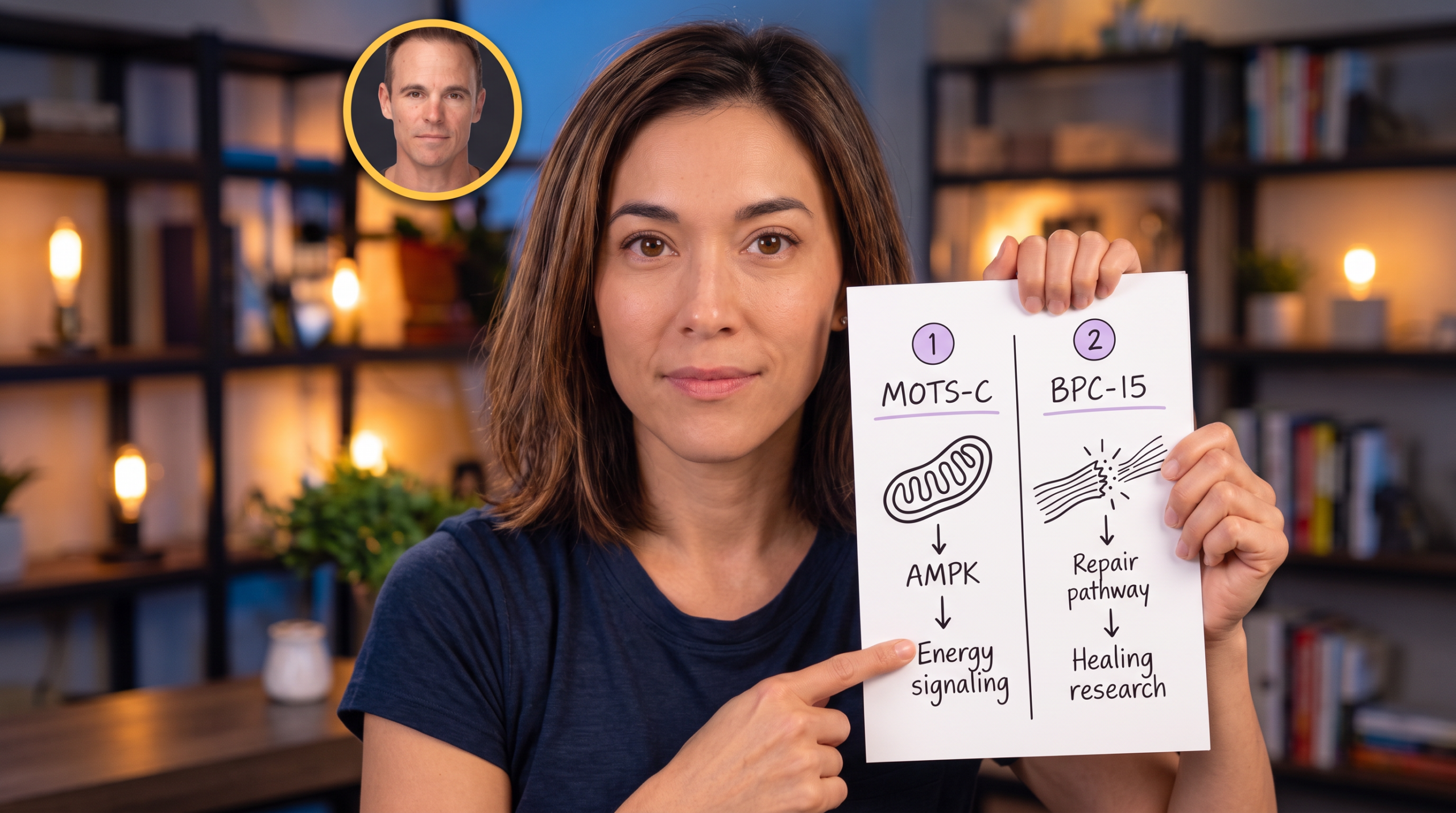
Her deep dive covers everything from tissue repair and hair growth to metabolism, mitochondrial health, and brain enhancement—but comes with an essential warning that changes how we should view these compounds.
Before rushing to any conclusions about peptides as miracle solutions, she emphasizes one critical distinction that every curious consumer needs to understand first.
Jump to:
- The Crucial Difference Between Fascinating and Proven
- The Celebrity Repair Peptides
- Unusual DNA Hackers: The Russian Bioregulators
- The Billion-Dollar Block: Weight Loss Peptides
- Mitochondrial Enhancement Peptides
- Brain and Cognitive Enhancement Peptides
- Muscle Growth and Recovery Peptides
- The High-Risk Experimental Category
- The Unregulated Gray Market Reality
The Crucial Difference Between Fascinating and Proven
Dr. Frasy opens with perhaps the most important caveat in the entire peptide conversation.
A fascinating mechanism is not the same thing as a proven treatment.
Some peptides hold FDA approval for specific medical conditions. Others have undergone human clinical trials with published results. Many have been studied only in animals or isolated cells. And some exist primarily in enthusiastic internet testimonials with virtually no formal research backing.
This spectrum of evidence matters tremendously when evaluating whether a peptide deserves attention, money, or injection into your body.
The Celebrity Repair Peptides
Among tissue repair compounds, BPC-157 stands as the undisputed celebrity. Animal research suggests impressive effects on blood vessel formation and tissue healing, particularly in tendons, organs, and injured tissue.
Its reputation vastly exceeds its documented human evidence, however. One unique feature sets BPC-157 apart: it’s among very few peptides that can be taken orally without stomach acid destroying it.
Dr. Frasy conducted her own informal survey among patients taking it orally, finding results she described as “pretty promising,” though she’s careful not to make clinical claims based on anecdotal data.
TB-500 frequently pairs with BPC-157 in repair protocols. This synthetic fragment of thymosin beta-4 directs tissue repair by helping cells migrate to injury sites—a crucial step in healing that makes the combination popular among athletes and injury recovery enthusiasts.
ARA-290: The Nerve Repair Candidate
Dr. Frasy reserves particular enthusiasm for ARA-290, a fragment of erythropoietin (the hormone that triggers red blood cell production). While erythropoietin builds blood cells, it also possesses tissue-healing properties that ARA-290 was engineered to mimic.
Research including human studies suggests ARA-290 can repair small nerve fibers, reducing nerve pain and inflammation—an application that could prove valuable for neuropathy sufferers.
The Copper Peptides for Hair and Skin
GHK-Copper gained initial fame for skin health, but research reveals much broader applications. It influences gene expression to promote collagen production and tissue repair while downregulating inflammation.
Small human studies have even shown it can regenerate hair follicles. Dr. Frasy uses a GHK-Copper serum herself and believes it works, though she acknowledges this remains personal observation.
Its cousin AHK-Copper supposedly delivers the same benefits with better targeting of hair follicles specifically. The catch? It hasn’t been tested in humans or animals, leaving the research severely lacking compared to GHK-Copper’s track record.
Unusual DNA Hackers: The Russian Bioregulators
A fascinating category of peptides called bioregulators emerged from Russian research teams who isolated them from animal and human tissue. These compounds supposedly slip directly into cell nuclei to interact with DNA, improving tissue function.
The most prominent is Epitalon (also spelled Epithalon). Research suggests it interacts directly with DNA transcription to activate telomerase, the enzyme that lengthens telomeres—the protective caps on chromosomes that shorten with cellular aging.
Longevity enthusiasts often use Epitalon once yearly hoping to slow biological aging. It also affects the pineal gland, potentially resetting circadian rhythms and melatonin production.
Dr. Frasy delivers an important caution about the remaining bioregulators, however. They face heavy criticism because of study design issues—specifically, the methodological differences between Russian studies and what would be acceptable in Western research standards.
The Evidence Problem
Other bioregulators include:
- Pinealon – supposedly improves pineal gland function for better sleep
- Visugen – studied for restoring endothelial function and vascular health
- Cartalax – tested on cartilage cells with subjective improvements in a very small 30-person study
- Ovagen and Livagen – researched for liver repair
- Bronchogen and Chonluten – aimed at respiratory health
- Cardiogen – targeted at cardiac tissue
- Vladonix – designed for immune system support
- Prostamax – focused on prostate microcirculation
- Testagen – aimed at testosterone-producing cells
Dr. Frasy admits the bioregulator data leaves her with more questions than answers, with compelling cellular data but questionable human application studies.
The Billion-Dollar Block: Weight Loss Peptides
Perhaps no peptide category has captured mainstream attention like the GLP-1 agonists and related compounds revolutionizing obesity treatment.
The journey began with Exenatide (Exendin-4), discovered in Gila monster venom. This first GLP-1 agonist mapped the pathways used by today’s blockbuster drugs but required two daily injections and simply wasn’t as effective as what came later.
Liraglutide improved on Exenatide but still needed daily injections. Then came Semaglutide (Ozempic/Wegovy), engineered with higher GLP-1 receptor affinity and longer duration, allowing once-weekly dosing that transformed diabetes and weight management.
Tirzepatide (Mounjaro/Zepbound) added GIP receptor activation alongside GLP-1 signaling, improving fat burning while reducing common side effects like nausea and constipation. Clinical trials showed it outperformed semaglutide for weight loss.
Now Retatrutide is emerging from trials adding glucagon signaling to the mix. Early data shows unprecedented fat loss, including visceral fat reduction and near-complete clearance of liver fat—potentially the new king of metabolic peptides.
The Disappointing Fat-Loss Fragments
AOD-9604 and HGH Fragment 176-191 were designed as growth hormone fragments containing only the fat-mobilizing portion. They performed brilliantly in petri dishes and caused dramatic fat loss in rats.
Human trials proved underwhelming, however. Some users still report modest effects, but nothing approaching the animal research results.
Mitochondrial Enhancement Peptides
MOTS-c represents a fascinating category—a peptide your mitochondria naturally produce in response to exercise and energy demands. Some call it “exercise in a vial” because it drives new mitochondria production.
Mouse studies show obesity reversal, improved insulin sensitivity, and enhanced physical endurance. Human research continues expanding.
SS-31 (Elamipretide) takes a different approach—instead of creating new mitochondria, it rescues damaged ones. It stabilizes cardiolipin, an important phospholipid that maintains mitochondrial structure and protects the electron transport chain where cellular energy production occurs.
Substantial human research exists for SS-31, and it holds approval for a specific rare disease.
Humanin prevents stressed cells from undergoing programmed death, potentially offering neuroprotection. It naturally declines with age, but centenarians show higher levels—suggesting possible longevity connections.
Brain and Cognitive Enhancement Peptides
Russian nootropic peptides Semax and Selank both upregulate BDNF (brain-derived neurotrophic factor), which promotes neuroplasticity and learning.
Semax is widely used for focus, utilizing stress pathways without triggering cortisol release. Eastern European human trials showed improvements in stroke recovery, optic nerve damage, and cognitive recovery after brain trauma.
Selank works differently, calming the brain through GABA transmission enhancement. Adamax is a heavily modified, more potent Semax variant lacking the human trial data of its predecessor.
P21 mimics a protein supporting neuron survival and growth while upregulating BDNF. Rat studies showed improvements in Alzheimer’s disease models, but human research remains absent.
DSIP (Delta Sleep-Inducing Peptide) promotes deep sleep and has been studied for blunting excessive stress responses during alcohol or opioid withdrawal. User reports vary widely—it seems to work for some people but not others.
Muscle Growth and Recovery Peptides
Growth hormone-releasing peptides work through two main pathways: growth hormone-releasing hormone (GHRH) receptors and ghrelin receptors.
The GHRH analog spectrum includes Sermorelin, CJC-1295, and Tesamorelin. They differ primarily in duration—from 10 minutes to six days in the body. Tesamorelin is a full GHRH clone affecting receptors beyond the pituitary, with potent visceral fat-burning effects.
Ghrelin mimetics provide an alternative growth hormone release pathway. Original versions (GHRP-2, GHRP-6, Hexarelin) also stimulated cortisol and prolactin release, causing stress sensations and potential lactation.
Ipamorelin was engineered to selectively trigger growth hormone release only, avoiding unwanted hormone stimulation. Pairing Ipamorelin with Sermorelin or CJC-1295 amplifies growth hormone output.
IGF-1 LR3 and PEG-MGF work downstream of growth hormone, directly stimulating the tissue repair that growth hormone ultimately triggers through IGF-1 production. PEG-MGF specifically targets muscle fusion and repair processes.
The High-Risk Experimental Category
Dr. Frasy closes with peptides she explicitly discourages purchasing without medical supervision.
FOXO4-DRI disrupts interactions between FOXO4 and p53, forcing senescent “zombie” cells to die and clear out. A rat study showed improved testicular function and testosterone, but users report feeling seriously ill.
PNC-27 represents the most experimental territory—studied only in cells so far. It binds proteins found on cancer cell surfaces and punctures their membranes, causing them to burst while theoretically ignoring healthy cells.
In 2017, the FDA issued a stern warning against marketing PNC-27 as cancer treatment after finding bacterial contamination in batches—a sobering reminder that “research use only” peptide vendors operate without quality standards or regulatory oversight.
The Unregulated Gray Market Reality
Dr. Frasy emphasizes that all these peptides are being purchased and used daily by people without medical guidance or supervision. Many users have no real understanding of what they’re injecting.
The goal of this was to educate and inform, not to encourage sales on the gray market.
The peptide revolution is undeniably underway, with compounds moving from research labs to bathroom counters faster than regulatory frameworks can adapt. Some peptides carry decades of research and FDA approval. Others exist only as internet rumors backed by mouse studies and Reddit threads.
Determining which vendors sell safe, pure, properly stored peptides grows increasingly difficult as the market expands. Contamination, incorrect dosing, degraded product, and outright fraud all lurk in unregulated spaces.
For healthcare practitioners, coaches, and pharmacists, understanding this landscape becomes essential—not to promote peptide use, but to help people navigate it safely when they inevitably encounter these compounds. For consumers, the message remains clear: fascinating mechanisms don’t equal proven treatments, and “research use only” means exactly that.
The peptide world offers genuine promise alongside substantial risk. Knowing the difference may be the most valuable peptide knowledge of all.