You can eat the same foods, do the same workouts, and then one day, out of nowhere, belly fat still takes over.
That’s menopause.
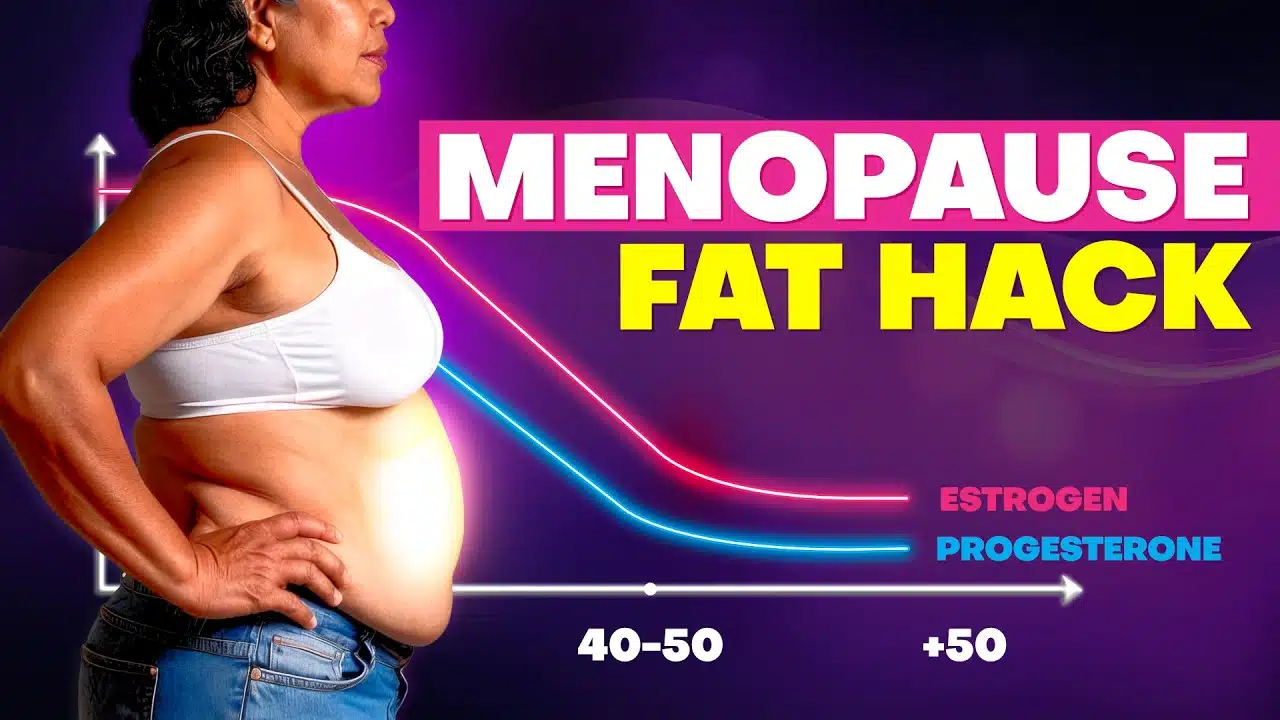
The shocking truth is that it causes fat to shift from hips and thighs to the belly, where it becomes harder to lose and more dangerous to keep.
Yet almost no one tells you how to stop it—until now.
Jump to:
- Perimenopause: When The Weight Gain Begins
- Protein: Your First Line Of Defense
- Strength Training: The Signal Your Body Needs
- Why Long Cardio Sessions May Work Against You
- Sleep: The Reset Button You Can’t Ignore
- Key Nutrients For Perimenopause
- Menopause: When Belly Fat Becomes Stuck
- Waist-To-Hip Ratio: A Better Health Measure Than The Scale
- Foods To Ditch During Menopause
- What To Eat Instead
- Nutrients To Add During Menopause
- Postmenopause: When Everything Gets Harder
- Time-Restricted Eating: A Powerful Postmenopause Tool
- Muscle Loss Speeds Up After 55
- Simple HIIT Routine For Postmenopause
- Critical Nutrients For Postmenopause
Perimenopause: When The Weight Gain Begins
Perimenopause is the stage that comes before menopause, and most women don’t even realize they’re going through it until their body starts changing.
On average, menopause happens around age 51, but the transition can start much earlier—oftentimes in the early 40s, sometimes even late 30s. It can last seven to 10 years, and during that time, hormones don’t just slowly fade; they swing up and down unpredictably.
Studies show that women gain an average of three to five pounds per year during perimenopause. Sometimes it’s sudden jumps—five to 10 pounds at a time.
The frustrating part? It often happens without any change to how you eat or exercise. You can be doing what always worked before, and suddenly it doesn’t work anymore.
For most of your adult life, estrogen helps store fat in hips and thighs. But as estrogen begins to fluctuate—high one month, low the next—the pattern starts to change. Fat shifts from the lower body to the midsection.
Women used to being pear-shaped become more apple-shaped. The alarming part? It’s not subcutaneous fat—the kind you can pinch. It’s visceral fat, the kind that wraps around organs.
During perimenopause, visceral fat explodes. If you’re able to step in early, you can actually prevent these changes from snowballing into bigger problems later.
Protein: Your First Line Of Defense
Protein is important because the weight gain you’re seeing isn’t just fat piling up—it’s muscle quietly slipping away during this time of life.
Estrogen normally helps protect muscle mass, which drives metabolism. But when estrogen levels start swinging during perimenopause, your body breaks muscle down faster and rebuilds it slower.
Since muscle is what drives metabolism, losing it makes your body burn fewer calories even at rest. Protein is your insurance policy against that.
Most women don’t realize just how important it is. If you don’t meet that daily need for protein, your body doesn’t just let it slide—it pushes you to keep eating until you get enough.
Researchers call this the protein leverage effect. That’s why so many women feel like they’re eating the same as before, but suddenly cravings are out of control and belly fat keeps climbing.
It’s not lack of willpower—it’s your body trying to close the protein gap and hold on to muscle for efficiency.
The average woman in midlife eats around 65 to 70 grams of protein per day. But your body can benefit during this period eating closer to 90 or even 110 grams, depending on the person and their size.
That means most perimenopausal women are running 20, 30, even 40 grams short every single day. When you fall short, you end up overeating everything else to try to catch up.
The ideal solution is to spread it out evenly across meals—usually 25 to 35 grams for breakfast, lunch, and dinner. Women who do this not only lose weight, but they also preserve nearly twice as much muscle.
Strength Training: The Signal Your Body Needs
Protein gives your body the raw material to preserve muscle, but strength training is the signal that tells your body to hold onto it—or even build more.
Without that signal, your body will let muscle slip away no matter how much protein you eat.
On average, women lose between 3% to 5% of muscle mass every decade after age 30. That’s why strength training shouldn’t wait until after menopause—start right now while you still have more muscle to protect.
You don’t need to spend hours in a gym. Even just two or three workout sessions each week adding in weights is enough to send the right signals to your body.
Focus on full-body movements that use multiple muscle groups at once:
- Squats
- Lunges
- Pushups
- Rows
Start with high-intensity, short-duration reps—50-second bursts exhaust the muscle, tap into cardio benefits, but don’t raise cortisol levels. Then work your way up to adding weights.
That’s the sweet spot for building and protecting muscle. As you get stronger, gradually increase speed, frequency, or resistance so muscles continue to adapt.
Why Long Cardio Sessions May Work Against You
Another mistake many women make during perimenopause is leaning harder into cardio.
When belly fat starts showing up, long cardio training sessions don’t protect muscle—they also raise cortisol levels. With lower estrogen levels already in your body, you aren’t equipped to handle elevated cortisol like you could in your 20s and 30s.
If you enjoy cardio, keep it brief—ideally 20 to 30 minutes, two to three times per week. Stick to moderate intensity to maintain lower cortisol levels.
One of the safest ways to do this is brisk walking. It supports fat loss, supports heart health, and is very cortisol-friendly—it doesn’t trigger a big stress response.
Sleep: The Reset Button You Can’t Ignore
Falling estrogen and progesterone trigger hot flashes, night sweats, and racing thoughts—preventing you from staying asleep at night.
Research shows that sleep disturbances can contribute to weight gain just as much as hormonal changes themselves. In fact, just four nights of poor sleep is enough to slash insulin sensitivity by 20% and drop fat burning by 12%.
It means your body’s storing fat instead of using it for fuel—all because you didn’t sleep well.
Protect your sleep like it’s the reset button for your body:
- Go to bed and wake up at the same time each day, even on weekends
- Create a simple wind-down ritual like reading, stretching, or prayer
- Keep your room cool—the sweet spot is around 68 degrees
- Cut out blue light from phones, TVs, and screens at least one hour before bed
- Finish eating at least three hours before bed so digestion isn’t working overtime
- Keep your room dark—an eye mask makes a huge difference
Breathing exercises or taking magnesium before bed can calm the nervous system and cut down cortisol for better sleep.
Key Nutrients For Perimenopause
Vitamin C is the biggest change you can make today if you’re in perimenopause. Women who take 750 milligrams or more of vitamin C per day see an increase in progesterone levels by 77%.
Other vitamins and minerals to consider:
- Vitamin D—a precursor to every hormone in your body
- Magnesium and zinc—precursors to female hormones
- Fenugreek—supports symptoms and mood changes day by day
Menopause: When Belly Fat Becomes Stuck
Menopause is officially defined as 12 months without a period. Most often it happens around age 51, but mid-40s to mid-50s is still normal.
In perimenopause, fat started moving from hips and thighs toward the waist. Now in menopause, hormones don’t keep swinging—they drop and stay low. Belly fat that began rising in perimenopause becomes your body’s default storage site.
Visceral fat packed around the liver, intestines, and heart doesn’t just sit there quietly. It dumps toxic fatty acids straight into the liver and releases inflammatory signals that drive insulin resistance, increase blood sugar, and create artery damage.
In a study of newly menopausal healthy women over a four-year period, women showed an increase in weight and body fat—primarily as visceral fat—which coincided with a drop in estradiol and a decrease in physical activity and energy expenditure.
Fat cells themselves produce estrogen. Your body releases hormones, fat releases hormones, which leads to more fat, which releases more hormones—it gets worse in a vicious cycle.
Waist-To-Hip Ratio: A Better Health Measure Than The Scale
The scale might not even warn you. Having less muscle and more visceral fat means you could weigh the same but be way more fat than muscle—even without a big change in weight.
Just because you’re skinny doesn’t make you healthy. Waist-to-hip ratio is a far better measurement of health during menopause than getting on a scale.
Here’s how to check it:
- Measure around the narrowest part of your waist (usually just above the belly button)
- Measure the widest part of your hips
- Divide the waist number by the hip number
You want to be below 0.85 to be in a safe range. If it’s closer to one or above, that means you probably have too much visceral fat—and it’s time to make a significant change.
Foods To Ditch During Menopause
Each meal you eat is either adding to your belly or helping you get rid of it. Get rid of foods that are working against you and making visceral fat worse.
Here’s what to avoid—use the acronym CRAP:
- Carbohydrates and sugars that are refined—white breads, white pastas, pastries, candies, sodas, fruit juices
- Rancid oils—canola, soybean, corn, cottonseed, sunflower, safflower; anything fried in those oils
- Artificial ingredients—especially sweeteners like aspartame and sucralose, food dyes, preservatives, MSG
- Processed proteins—deli meats, hot dogs, sausages, bacon, or meats with hormones and antibiotics
Basically, anything humans have overly processed, overly refined, or tampered with is probably making visceral fat worse.
What To Eat Instead
Focus on clean proteins, healthy fats, and fiber.
When menopause hits, fiber goes from nice-to-have to non-negotiable. One study showed a direct link between more daily fiber and less belly fat over time.
The problem? Most people eat about 15 grams of fiber per day—roughly half of what’s recommended. Increase your fiber through vegetables, seeds, low-sugar fruits, legumes, and beans.
Healthy fats are equally critical. Your brain is made of fat, so if there’s brain fog and irritability, feed it healthy fats. Women who increase their omega-3 fatty acids—like salmon or chia seeds—had significant reductions in belly fat and triglycerides.
Another study found that meals rich in monounsaturated fats like olive oil and avocados led to more fat burning during menopause.
Nutrients To Add During Menopause
Chasteberry has solid research supporting its ability to relieve menopausal symptoms and abnormal periods. It can be used earlier in life but is especially helpful during menopause.
Black cohosh is another helpful remedy that relieves menopausal symptoms by up to 26%.
Postmenopause: When Everything Gets Harder
Postmenopause begins the day after you’ve gone 12 months straight without a period. It’s usually from your mid-50s onward and lasts for the rest of your life.
Less than 1% of the estrogen you had at age 25 is left. Progesterone is virtually gone. Testosterone is down to about half of what it was.
This is why belly fat becomes so entrenched in postmenopause. There’s not enough estrogen to protect you from chronic inflammation, so inflammation rises across the body—in joints, pushing more fat into the belly, creating even more inflammation.
It’s a vicious cycle between fat production, inflammation, fat production, inflammation. The body gets soft.
Time-Restricted Eating: A Powerful Postmenopause Tool
Studies show postmenopausal women have a harder time burning fat through exercise alone, but time-restricted eating works just as well in this stage as it does for younger women.
That means you don’t have to accept belly fat as permanent. You can still train your body to burn fat by simply changing your eating window.
Here’s how to get started:
- Pick a 10-hour eating window every day (say 8 a.m. to 6 p.m.) and stick with it for a week—no snacking
- When it feels comfortable, shrink it down to an 8-hour window or half-size your breakfast
- Try night fasting—finish your last meal by 2, 3, or 4 p.m.
Eating earlier in the day lowers insulin and allows growth hormone to rise overnight so your body can burn fat in your sleep. People who finish meals by 3 p.m. lost five more pounds of fat in eight weeks than those who ate later—even though both groups ate the exact same food.
Muscle Loss Speeds Up After 55
Starting in your mid-50s, muscle loss speeds up in a way that’s hard to ignore. On average, women lose about 1% of muscle every single year they’re not actively protecting it.
Over a decade, that’s 10% of lean tissue gone.
Even when you do exercise, fat loss returns aren’t the same as they were in your 30s and 40s. Studies show that postmenopausal women simply burn less fat from the same workout compared to younger women.
That doesn’t mean exercise stops working—but it does mean light workouts won’t do the job anymore. High-intensity interval training (HIIT) has been scientifically proven to reduce belly fat better than long cardio sessions while strengthening muscles at the same time.
Simple HIIT Routine For Postmenopause
Pick a simple, full-body exercise like pushups, squats, burpees, or mountain climbers.
- Push hard for 50 seconds
- Take a 10-second break
- Move to the next exercise—50 on, 10 off
- Repeat for one round
- Take a 40-second break and repeat two more times
That’s a 9-minute, 50-second workout. Done six times per week, it’s less than an hour total—and one of the best tools to fight menopausal belly fat at age 55 and beyond.
Critical Nutrients For Postmenopause
Bone density hits hard during postmenopause. Vitamin D3 and K2 are what protect bone density and place calcium in bones—these two need to be taken together.
Epimedium (also known as horny goat weed) prevents bone loss and supports women’s hormones, especially during this season.
Menopause doesn’t mean belly fat is permanent. Whether you’re in perimenopause, menopause, or postmenopause, you have the power to fight back with the right combination of nutrition, exercise, sleep, and targeted nutrients.