Eating carbs at the right time could be the difference between muscle gain and unwanted fat storage.
It all comes down to understanding a little-known biological mechanism called GLUT4.
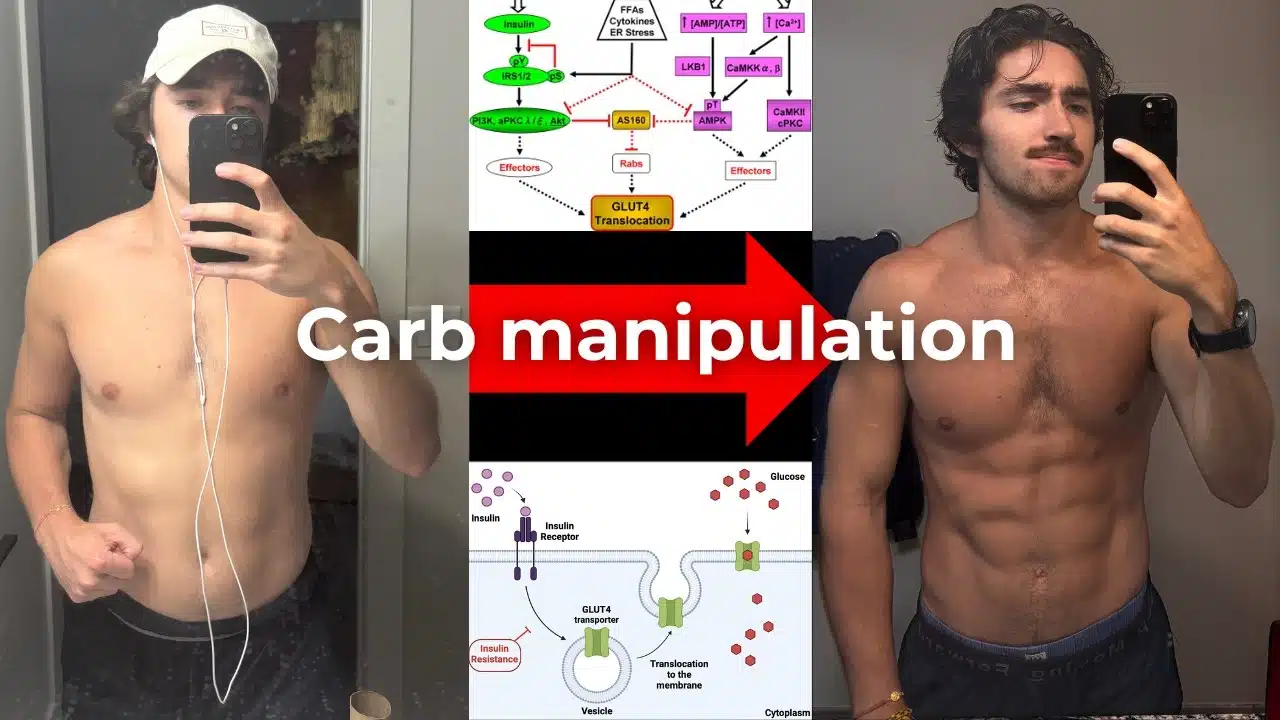
In a recent YouTube video, fitness coach and content creator shared how exploiting this glucose transporter changed his entire approach to nutrition—leading to better recovery and faster muscle growth.
Here’s exactly how to use this science-backed strategy to bias carbs toward muscle cells instead of fat.
Jump to:
- What Is GLUT4 and Why Does It Matter?
- Insulin Activates GLUT4 in Both Muscle and Fat
- Muscle Contraction: The Game-Changer
- The Post-Workout Window Is Real
- Glucose vs. Fructose: Not All Carbs Are Equal
- How to Structure Your Carb Intake
- Boost Insulin Sensitivity for Better Partitioning
- Can You Eat Carbs Outside the Window?
- Real-World Application
What Is GLUT4 and Why Does It Matter?
GLUT4 stands for Glucose Transporter Type 4, and it’s essentially the gatekeeper that allows glucose—derived from carbohydrates—to enter cells.
Both muscle cells and fat cells contain GLUT4 transporters. Normally, GLUT4 stays hidden inside cells, but it moves to the cell surface under two specific conditions: when insulin is present, or when muscles contract during exercise.
This is basically just glucose transporter 4. So, this is what allows glucose, which is carbs, to enter either muscle or fat cells.
The key is learning how to activate GLUT4 in muscle cells while minimizing its activity in fat cells.
Insulin Activates GLUT4 in Both Muscle and Fat
When carbs are consumed, insulin levels spike. This triggers GLUT4 to move to the surface of both muscle and fat cells, allowing glucose entry.
The problem? Fat cells are often more biased toward absorbing glucose when relying solely on insulin signaling. That glucose then combines with dietary fat to increase fat storage.
That’s why timing and activity matter so much.
Muscle Contraction: The Game-Changer
Here’s where things get interesting. When muscles contract during exercise, GLUT4 is activated independent of insulin—and this effect is specific to muscle cells.
When there’s muscle contraction, it’s going to happen independent of insulin. So you don’t have to actually eat carbs to move the GLUT4 to the membrane of the cell.
Even light activity like walking can stimulate GLUT4 to a degree, though resistance training and cardio provide far greater benefits.
This is the biological foundation of the so-called post-workout window—a real, measurable phenomenon rooted in how glucose transporters behave after training.
The Post-Workout Window Is Real
After a workout, muscle cells become highly sensitive to insulin. GLUT4 rushes to the cell surface, creating a primed environment for nutrient absorption.
Glycogen stores are depleted during training, leaving muscles in what’s described as a “hungry, sponge-like state.”
Carbs consumed within zero to two hours post-workout are far more likely to be shuttled into muscle for glycogen replenishment rather than stored as fat.
Like for me personally, I go to the gym, I’ll do my lift, and then I also do some zone 2 cardio to further increase both GLUT4 and insulin sensitivity. Takes me about 20 to 30 minutes depending on the day.
Following his workout and cardio, he drives home and consumes a post-workout meal rich in carbs and protein, with minimal fat.
Glucose vs. Fructose: Not All Carbs Are Equal
Understanding carbohydrate types is critical when exploiting GLUT4.
Glucose uses GLUT4 and directly replenishes muscle glycogen. It’s found in foods like white rice, sweet potatoes, and most starchy carbs.
Fructose, on the other hand, uses a different transporter (GLUT5) and is processed primarily by the liver—not muscle. Excess fructose can be converted into fat.
Your muscles cannot actually use fructose. So this uses GLUT5 which is completely different. It’s only going to be fructose here.
That doesn’t mean fruit and honey should be avoided entirely. In fact, combining glucose and fructose post-workout can help refill both muscle and liver glycogen when they’re most depleted.
But the majority of carb intake should come from glucose-based sources.
How to Structure Your Carb Intake
To maximize muscle gains and minimize fat storage, carb timing and distribution should follow these principles:
- Pre-workout: Consume moderate carbs (primarily glucose) to fuel training demand
- Post-workout: Eat the bulk of daily carbs—around 60–75%—within two hours of finishing exercise
- Post-meal activity: A 5–10 minute walk after eating further promotes nutrient delivery to muscle over fat
- Avoid being sedentary after high-carb meals: Without activity, GLUT4 activation is equal in fat and muscle, increasing fat storage risk
Boost Insulin Sensitivity for Better Partitioning
Improving insulin sensitivity amplifies the effects of GLUT4 exploitation. When muscles are more insulin-sensitive, they preferentially absorb nutrients over fat tissue.
Regular resistance training, zone 2 cardio, and post-meal walks all contribute to better insulin sensitivity over time.
This creates a nutrient partitioning advantage—where the body naturally funnels more calories toward muscle growth and recovery.
Can You Eat Carbs Outside the Window?
Yes, but understand the trade-offs.
Carbs consumed outside the post-workout window still trigger insulin and activate GLUT4—but without the exercise-induced muscle contraction advantage, fat cells compete more aggressively for glucose uptake.
You can have carbs outside of the workout window, just know it’s going to be more biased towards fat storage because both fat cells and muscle cells have that GLUT4 activation when insulin spikes.
For those focused on body composition, strategic carb timing offers measurable benefits.
Real-World Application
Implementing these strategies doesn’t require drastic changes. Small, consistent habits yield results over weeks and months.
- Train with intensity to deplete glycogen and activate GLUT4
- Add light cardio or walking post-session
- Prioritize glucose-rich carbs in your post-workout meal
- Include some fructose (fruit, honey) but keep it secondary
- Stay active after meals—even brief movement helps
These principles aren’t about perfection. They’re about optimization—getting more from every gram of carbohydrate consumed.
Understanding GLUT4 won’t replace hard training or smart nutrition. But it offers a biology-backed edge that compounds over time, turning daily meals into better muscle-building opportunities and fewer fat storage risks.