Legend says one of history’s strongest men built his power not in a gym, but in chains.
Russian strongman Alexander Zass discovered a training method during World War I that would revolutionize strength development forever.
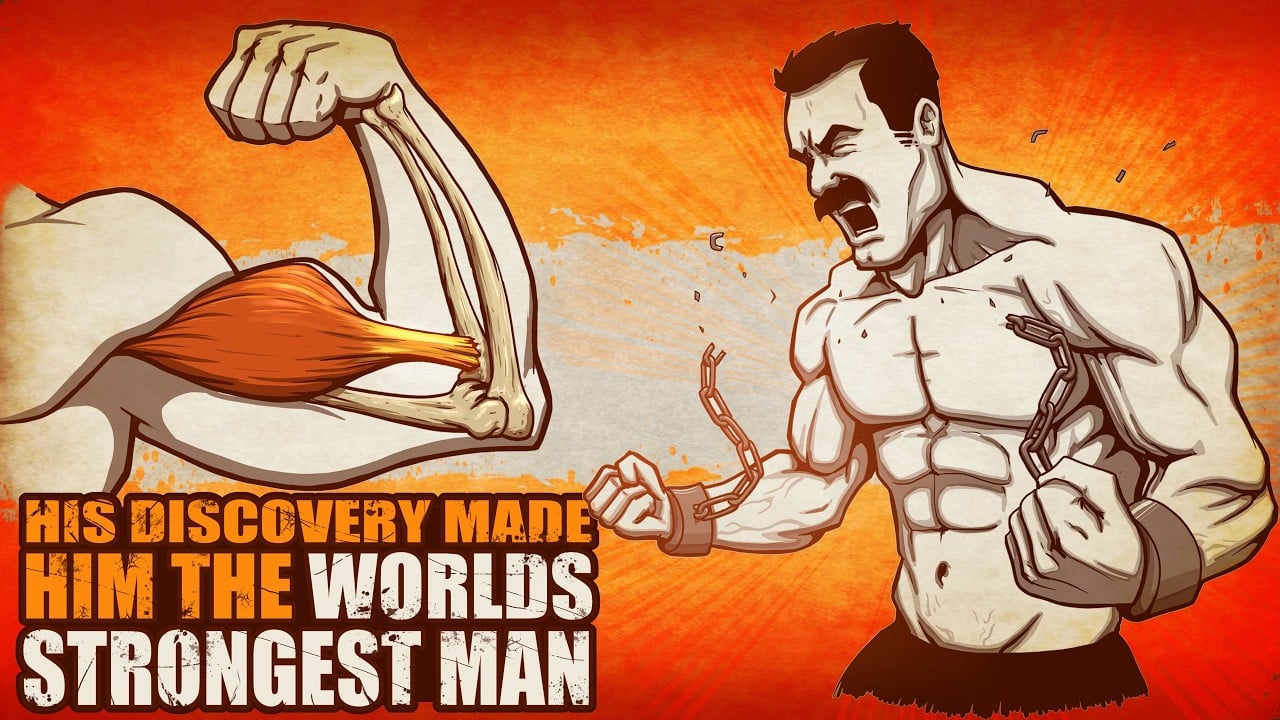
After multiple escape attempts from an Austrian prison, guards shackled him in solitary confinement, binding his wrists and ankles.
What happened next defied everything conventional wisdom taught about building strength.
Jump to:
The Birth of Isometric Training
Zass began pulling against his chains with maximum force, straining against the immovable restraints day after day. To his shock, he grew stronger than before imprisonment.
After returning to general population, he applied this same principle to prison bars at night. Eventually, he ripped one completely from its mounting and escaped.
Following the war, Zass’s strongman career reached legendary status. He bent steel bars barehanded, carried horses across his shoulders, and caught cannonballs fired at full speed.
Zass became convinced that true strength resided not in muscles, but in tendons. This revelation birthed what became known as overcoming isometrics, and Zass earned recognition as the father of isometric training.
The Science Behind Tendon Transformation
Over a century of research has revealed exactly why Zass’s prison training worked so effectively. Overcoming isometrics involves pushing or pulling against an immovable object with maximum force.
This training method dramatically increases tendon strength and structural integrity by triggering complete collagen fiber remodeling. What starts as a chaotic bundle of tendon fibers rebuilds into tightly aligned structures with regular cross-links that enhance both strength and stability.
The result? Tendons become far less likely to tear and significantly more capable of transferring forces from muscles to skeletal structure.
The “Skinny Strong” Phenomenon
This tendon remodeling helps explain another phenomenon Zass observed firsthand: developing exceptional strength without extra bulk.
Overcoming isometrics has earned a reputation for creating individuals who appear moderately strong but perform feats seemingly impossible for their size. Today, this effect gets called “skinny strong,” explaining why this training has produced some of history’s most deceptively powerful humans.
Low Fatigue, High Reward
Because overcoming isometrics involve zero movement, joints experience almost no shear forces, resulting in minimal wear and tear.
Despite high intensity, muscles don’t lengthen under load—the eccentric contraction phase where most muscle stress and damage typically occurs. Remove that component, and soreness rarely develops while muscles stay relatively fresh.
Here’s where overcoming isometrics differ dramatically from yielding isometrics. While yielding variations require 30 to 60 seconds or longer, overcoming isometrics produce highly effective results with sets of only 5 to 6 seconds.
This represents a massive advantage for time-crunched athletes. These brief load times produce strength adaptations comparable to powerlifting maximums but with incredibly low fatigue.
This works brilliantly alongside standard strength practices because it eliminates the need for constant high-intensity work. Athletes can perform moderate-intensity strength training with overcoming isometric sets added in, achieving the same strength stimulus as heavy lifting without equivalent damage.
This proves particularly valuable for older athletes or anyone managing chronic joint issues, previous injuries, and accumulated wear and tear who still want building high-level strength.
Neural Priming: Unlocking Hidden Strength
Strength that exceeds body size isn’t magic—it’s neurology.
One compelling example involves a friend breaking through a long-standing plateau, blowing past his bench press personal record after spending roughly 6 seconds pushing against a wall beforehand.
This effect, called neural priming, represents one of the best ways to couple overcoming isometrics with dynamic strength training or power skills.
Maximum Motor Unit Recruitment
During overcoming isometrics, athletes attempt pushing or pulling with absolute maximum effort against something immovable. This requires genuinely aggressive intent just to perform correctly.
Exerting everything against an immovable object, even briefly, activates nearly all available motor units in working muscles. The nervous system recruits every currently available muscle fiber for contraction.
Overcoming isometrics produce motor unit activation nearly identical to a true one-rep max in powerlifting. Yet unlike maxing out, it carries:
- Far less injury risk
- Significantly reduced fatigue
- Zero threat of failing under loaded bars
This combination of motor unit recruitment and collagen remodeling explains why overcoming isometrics carries such powerful reputation for maximizing pound-for-pound strength.
How Neural Priming Actually Works
First, perform an overcoming isometric exercise to maximally activate the nervous system and fully recruit motor units.
Rest several minutes before performing another strength or power exercise targeting the same basic movement pattern.
The overcoming isometric creates an ideal window of roughly 3 to 8 minutes after the set where short-term nervous system fatigue clears, but the nervous system remains primed and firing at very high levels.
Athletes essentially piggyback off the neural effects of isometrics to push other lifts and exercises to new heights.
This technique has been repeatedly shown to increase strength and power output short-term. With consistent use, it accelerates long-term strength and power gains as well.
For athletes pursuing all-out performance maximization, neural priming remains one of the most underutilized tools available.
Getting Started With Overcoming Isometrics
Bruce Lee was a huge fan of overcoming isometrics, achieving great results experimenting with them as standalone strength routines performed alongside conditioning and martial arts training.
Starting requires only an immovable object to push or pull against. Common options include:
- Pushing against walls
- Pulling on anchored ropes
- Using barbells immobilized in racks
- Iso chains (chains anchored to floors with handles)
Iso chains can be purchased online or built for under $30 to $40 using basic materials: 2×6 boards, chain, carabiners, and handles.
Three Critical Guidelines
First, target mid-range joint angles for general strength and tendon development. This represents the safest, most productive starting point with the most general carryover.
Second, match joint angles to specific sticking points when breaking through plateaus. Overcoming isometrics performed at exact plateau positions directly address weaknesses.
Third, train positions your sport demands. Combat athletes might hold isometric punches against walls at exact contact points, directly hardening strength and neural drive at specific positions.
Workload and Frequency
Stick to two to four exercises per session, performed one to four times weekly.
While overcoming isometrics won’t produce much muscular fatigue, they remain maximum effort and do tax the nervous system. Respect recovery, and training adaptation will stay ahead of fatigue.
Whether rebuilding from injury, training for longevity, or chasing maximum strength, overcoming isometrics offer a scientifically validated path to exceptional power without the traditional costs of heavy lifting.