Understanding how to organize your training doesn’t have to be complicated.
Dr. Milo Wolf, a kinesiology expert and content creator, recently broke down a framework that cuts through the confusion of exercise names and categorizations.
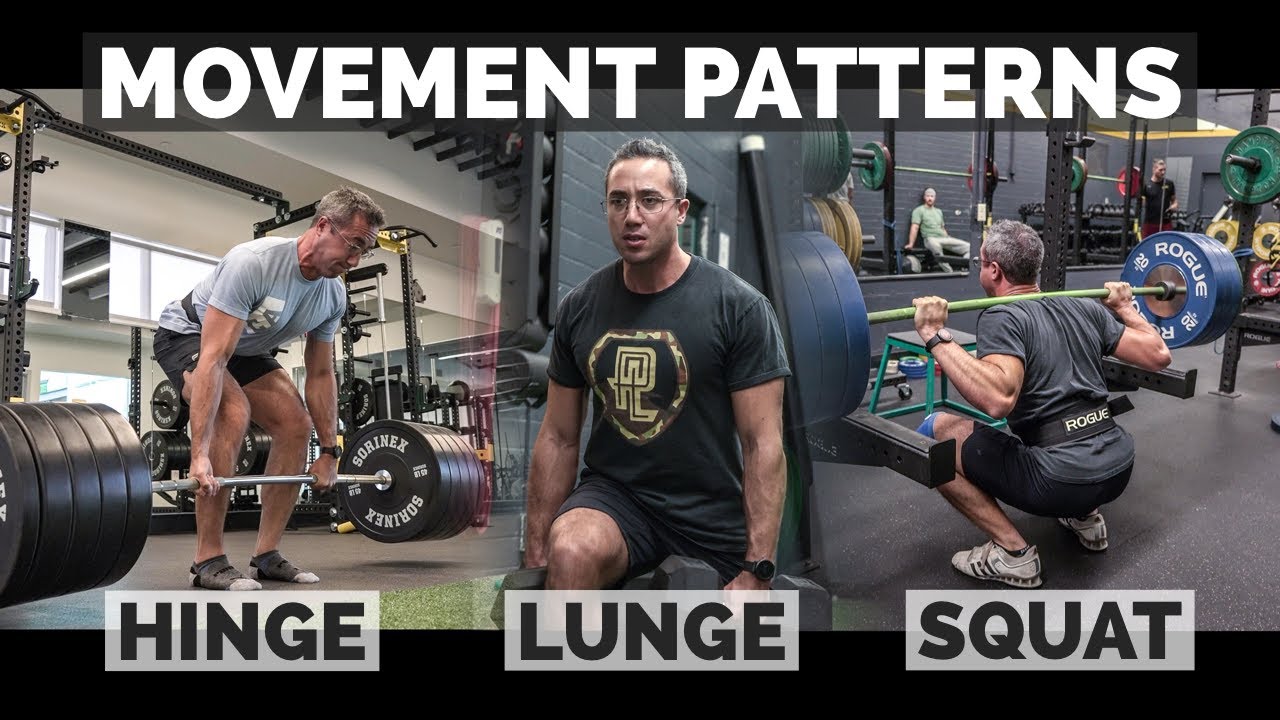
Instead of getting lost in whether an exercise is named after a country, a person, or a muscle group, he recommends thinking about seven fundamental human movement patterns.
If you hit all seven patterns each week, you’re guaranteed to train every major muscle group while building functional strength that translates beyond the gym.
Jump to:
Why Movement Patterns Matter More Than Exercise Names
Exercise terminology can be bewildering. Romanian deadlifts, Bulgarian split squats, Arnold presses—these names tell you nothing about what the movement actually does.
Traditional categorization methods create even more confusion. You might classify exercises by equipment (barbell versus dumbbell), by muscle group (quads versus glutes), or by training goal (strength versus power).
But these systems overlap constantly. A barbell back squat is simultaneously a barbell exercise, a quad exercise, and a glute exercise.
Dr. Wolf’s solution? Focus on how your body moves, not what the exercise is called.
The Seven Fundamental Movement Patterns
According to Dr. Wolf, all human movement can be categorized into seven patterns: squatting, hinging, lunging, pushing, pulling, bracing, and locomotion.
Each pattern trains specific muscle groups and serves distinct functional purposes. Here’s how each one works.
Squatting: The Foundation of Lower Body Strength
The squat pattern involves simultaneous hip flexion, knee flexion, and ankle dorsiflexion. You descend until you run out of range of motion—or just before your spine starts to round.
You take a deep breath of air, you brace and then you descend into the squat. This is hip flexion, knee flexion and ankle dorsiflexion happening simultaneously.
The ascent requires driving through your entire foot—not just the heel—to return to standing through plantar flexion, knee extension, and hip extension.
Primary muscles trained:
- Quadriceps
- Glutes
- Hamstrings
- Hip adductors
- Lumbar spinal erectors (isometrically)
- Upper back (especially in front squat variations)
While barbell back squats and front squats are the most common strength-building variations, Dr. Wolf notes there are hundreds of squat variations that can train different fitness qualities—from hypertrophy to speed.
Hinging: Mastering Posterior Chain Power
The hip hinge involves pulling your chest toward the floor while pushing your hips backward. Knees stay slightly unlocked but mostly straight.
If you feel a massive stretch in your hamstrings during the descent, you’re doing it right. The key is maintaining a neutral spine throughout—chest proud, shoulders back, chin neutral.
The biggest mistake? Initiating the upward movement with your lower back instead of engaging glutes and hamstrings first.
People initiate that movement back up that concentric portion with their spinal erectors pushing into hyperextension of their lumbar spine first instead of keeping the spine neutral while you engage the glutes and the hamstrings to leverage the body back up to the standing position.
Common variations: Conventional deadlifts, Romanian deadlifts, trap bar deadlifts
Primary muscles trained:
- Glutes
- Hamstrings
- Lumbar spinal erectors (isometrically)
- Upper back and lats
- Abdominal muscles (through bracing)
Dr. Wolf explains that trap bar deadlifts involve more knee flexion than conventional deadlifts, making them more “squatty” and potentially better for athletic transfer to jumping and cutting movements.
Lunging: Building Unilateral Leg Strength
Unlike squats and hinges, lunges are unilateral—different sides of your body do different things simultaneously.
Start standing tall, feet together. Take a medium step forward—not too long, not too short. Descend vertically as your back knee travels toward the ground, gently tapping it before driving back up through the front leg.
Think 80% of the work comes from your front leg, 20% from the rear.
Dr. Wolf particularly recommends reverse lunges because they place less stress on the patellar tendon compared to forward lunges.
You can bias muscle emphasis by adjusting your technique:
- More quads: Stay upright with shorter steps, allowing your knee to travel forward
- More glutes: Slight forward trunk lean
- More hamstrings: Larger steps while staying upright
Primary muscles trained: Quadriceps, glutes, hamstrings, with less lower back involvement than squats
Pushing: Building Upper Body Pressing Strength
Pushing movements come in two flavors: vertical and horizontal.
Vertical pushing (like overhead presses) emphasizes deltoids. Start with the load in front of your clavicles, drive straight up while bringing your chest forward and through, finishing with the implement slightly behind the top of your head.
Horizontal pushing (like bench press) emphasizes pectorals. The bar starts over your clavicles, arcs down to touch the bottom of your sternum, then drives back up to the starting position.
Vertical pressing trains:
- Lateral deltoids (and all deltoid heads)
- Upper pec fibers
- Triceps
- Upper and mid trapezius (through scapular rotation)
Horizontal pressing trains:
- Entire pectoralis muscle
- Anterior deltoids
- Triceps
You can adjust bench incline to target specific pec fibers due to the muscle’s fan-like structure.
Pulling: The Mirror Image of Pushing
Instead of pushing loads away, you’re pulling them toward you or pulling your body toward a fixed object.
Vertical pulling includes pull-ups, chin-ups, and lat pulldowns. Start with fully extended shoulders and elbows, then pull through shoulder flexion and adduction while flexing your elbows.
The trick? Don’t overpower the movement with just your biceps.
Instead of thinking about pulling the weight to your chest, think about driving your elbow straight back. That will help you to place some of that mind muscle connection.
Horizontal pulling includes rows—barbell, dumbbell, or cable variations. Focus on pulling your shoulder blade into retraction as you drive your elbow back.
Primary muscles trained:
- Biceps and other elbow flexors
- Latissimus dorsi
- Rhomboids
- Upper, middle, and lower trapezius
For pull-ups, Dr. Wolf emphasizes pulling your chest to the bar, not just your chin—your entire body should be working, not just your neck.
Bracing: The Core’s True Function
Your midsection’s primary job isn’t crunches—it’s transmitting force from lower body to upper body during complex movements.
Think about throwing a ball or blocking a tackle. Force starts at your feet, travels through your core, and finishes in your upper body. A weak core means lost force and wasted energy.
The core works two ways: resisting movement (isometrically, like planks) and creating movement (isotonically, like crunches or rotational throws).
Primary muscles trained:
- Rectus abdominis
- Internal and external obliques (rotation and lateral flexion)
- Transverse abdominis (the deep “belt” muscle)
- Spinal erectors
Don’t neglect posterior midsection muscles—they need direct training beyond what squats and deadlifts provide.
Locomotion: Functional Movement That Gets Forgotten
Any cyclical movement that takes you from point A to point B counts: walking, running, swimming, cycling, carrying heavy objects.
Weightlifters and bodybuilders often ignore this pattern entirely, but it’s critical for translating gym strength into real-world function.
Dr. Wolf suggests programming locomotion based on your goals. Training a strongman? Skip the jog and do heavy farmer’s walks. Working with a soccer player? Add hill sprints or loaded carries.
By adding some sort of a loaded carry or a sled pushing type of activity into your program, now we’re taking the strength that you’re developing in the gym and we’re translating it into more of a functional pattern that you can use in daily life.
It also addresses the often-neglected conditioning component of complete fitness programming.
How to Program All Seven Patterns Into Your Week
You don’t need to cram all seven patterns into every workout. Dr. Wolf recommends focusing on three or four per session, then rotating through them across your training week.
Sample 4-day split:
- Day 1: Squats and pushes
- Day 2: Hinges and pulls
- Day 3: Squats, pushes, and lunges
- Day 4: Bracing and locomotion (core/metabolic circuit)
Not every exercise fits neatly into one category. A clean and jerk combines multiple patterns, and exercises like clean pulls blur the line between hinging and squatting.
But most traditional lifts slot clearly into one of these seven categories, making programming straightforward and comprehensive.
By ensuring you hit all seven movement patterns weekly, you guarantee balanced development across every major muscle group while building strength that actually transfers to sports and daily life—not just gym performance.