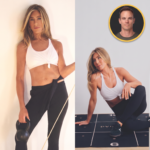
IFBB Pro Bikini competitor Shaina Garcia recently teamed up with renowned coach Jared Feather for an intense lower body training session—and the results speak volumes about what actually works for glute development.
Two weeks into her contest prep, Garcia has made remarkable progress since her first training session with Feather over a year ago.

The transformation is striking: from 92 pounds at her previous stage weight to now maintaining 53 kilograms with significantly more muscle mass.
This session reveals the technical adjustments and training philosophy that helped build that development—and challenges some popular fitness myths along the way.
Jump to:
The Power of Deficit Reverse Lunges
Garcia credits deficit reverse lunges as a game-changer for her glute development. Feather introduced her to this exercise in their first collaboration, and she’s been progressive overloading ever since.
My ass was like so flat back then and I kept carrying that on from that session and I’ve made a lot of progress since then. In that video there was no plates on there and now I’m carrying weight.
The key technical adjustment? Reaching back with the hip before descending.
Feather emphasizes pushing the trailing hip backward to maximize glute stretch at the bottom position. This creates significantly more tension through the target muscles compared to simply stepping back and dropping down.
The Controversial Valgus Cue
Perhaps the most surprising technical element: Feather actually coaches a slight controlled valgus (knees moving inward) during the concentric phase of lunges.
When people squat, you notice when it gets really hard and they can’t keep it in their quads anymore, what’s the first thing that they do? They try to push it back up. So like a slight controlled valgus on these is okay. And it actually hits your glutes a little more.
This runs counter to typical coaching advice. However, Feather emphasizes this is an advanced cue requiring complete control and should only occur over the big toe during light exercises like lunges.
The rationale? It shifts tension directly into the glute musculature when combined with the deep hip stretch.
The RDL vs. Straight Leg Deadlift Debate
One of the session’s most enlightening moments came when Feather challenged the distinction between Romanian deadlifts and straight leg deadlifts.
Garcia mentioned alternating between the two variations weekly, believing RDLs hit her glutes more while straight leg versions emphasized hamstrings. Feather had a different perspective.
People do an RDL because they’re full of shit. They want to use more weight and look cool. Whether it’s an RDL or you want to write it as SLDL, it’s the same movement. It’s just RDL is the one that people try to shorten the range of motion and put a bunch of weight on the bar to look cool.
His argument centers on a simple principle: why artificially limit range of motion?
Research consistently shows that stretch under load produces superior muscle development. Stopping at mid-shin rather than achieving full hip flexion simply reduces the mechanical tension on target muscles.
The Real Difference
According to Feather, any perceived difference between variations comes down to execution quality, not the exercise label itself.
- Full range of motion: Touch the plates to the floor on every rep
- Hip hinge emphasis: Push hips back aggressively while maintaining spinal position
- Slight knee bend: Natural flexion occurs, but legs stay relatively straight
- Bar path: Keep the bar close to the body throughout the movement
When Garcia implemented full range of motion on the Smith machine, she immediately felt the difference in her glutes despite using less weight than her typical “RDL” loading.
Hip Thrust Technical Refinements
Garcia typically performs hip thrusts in the 12-15 rep range. For this session, Feather introduced modifications that dramatically increased muscular tension.
First, he widened her foot position slightly with toes pointed outward. This immediately improved her ability to activate the glutes.
Having my feet closer and then you brought my feet just that tiny bit wider there, I felt it a lot more.
The Eccentric and Concentric Strategy
The real innovation came with the knee positioning throughout the movement.
During the eccentric (lowering) phase: Push knees slightly inward toward valgus while achieving a deep stretch.
During the concentric (lifting) phase: Drive knees outward while squeezing glutes at the top.
This technique maximizes both the stretch and contraction components of the exercise. Garcia’s response was immediate and dramatic.
When I push my knees in, I felt the increase of the stretch when I did valgus and then when I pushed out on the way up, that just increased it by massive.
They implemented rest-pause sets, taking Garcia close to failure, resting briefly, then continuing for additional reps. This metabolic approach created intense muscular burn despite using half her normal weight.
Programming Structure for Contest Prep
Garcia’s weekly lower body split demonstrates intelligent exercise selection for bikini competition preparation.
- Session 1: Glute and hamstring emphasis (deficit reverse lunges, RDL/SLDL, abductions, hip thrusts)
- Session 2: Quad-included day beginning with squats
- Session 3: Pure glute isolation work
This structure allows Garcia to minimize quad development while maximizing glute stimulus—critical for bikini proportions.
During contest prep, volume management becomes essential. Feather noted that this particular session involved seven working sets with multiple approaches to failure through rest-pause techniques.
She’s in contest prep, so she’s dieting down, which means she’s not building a ton of muscle right now. She’s just maintaining the muscle tissue she already has. So as long as her leg volume is split evenly through the week, she’s going to be doing just fine.
The Internet Misinformation Problem
Throughout the session, Feather addressed the proliferation of questionable training advice on social media platforms.
His particular frustration centers on EMG-obsessed content creators who prioritize electrical muscle activity readings over practical hypertrophy outcomes.
You hear a lot of bullshit on the internet from EMG sycophants. They just have no idea how to actually interpret the way muscles move and work. All that like feet completely forward and tuck your chin, it’s all just complete garbage.
He pointed out that glutes function optimally when feet are positioned naturally—slightly turned out—rather than forced into perfectly neutral positions that produce higher EMG readings but feel unnatural.
The Sesquipedalian Problem
Garcia and Feather discussed how fitness influencers use complex terminology to appear knowledgeable without providing practical value.
If people aren’t as knowledgeable and then as soon as someone uses like a smart term or something they’ve never heard before, immediately they think that’s like facts without even knowing.
Feather introduced the term “sesquipedalian”—ironically, a complex word meaning the use of big words to sound smart. The fitness industry overflows with this tendency, particularly on platforms like TikTok.
Results and Progression
The proof lies in Garcia’s development. From 47-48 kilograms during their first collaboration to 53 kilograms now, she’s added approximately 5-6 kilograms of muscle mass.
More importantly, she’s maintaining that tissue through contest prep—evidence that the muscle is genuine rather than simply excess body fat.
When people go like, ‘Oh, I drop booty like straight away as soon as I cut,’ I’m like, ‘Well, that’s probably just fat.’ If you built like solid tissue, it does not drop that fast.
Despite using significantly less weight with improved technique, Garcia achieved a superior muscle pump with half her typical training volume. This demonstrates that execution quality trumps load when pursuing hypertrophy.
Key Takeaways for Glute Development
Several principles emerge from this training session that contradict popular fitness advice.
- Maximize range of motion: Don’t artificially limit depth to use more weight
- Prioritize stretch under load: Deep positions create superior mechanical tension
- Natural foot positioning: Slight external rotation allows better glute activation than forced neutral positions
- Strategic technique adjustments: Controlled valgus can shift tension when applied correctly
- Volume management in prep: Quality approaches to failure matter more than total set count
Garcia’s biomechanics coursework combined with practical coaching from experienced professionals like Feather created the knowledge foundation for her impressive physique development.
Rather than blindly following internet trends, she learned to feel exercises correctly and understand the anatomical reasoning behind technical adjustments.
For competitive bikini athletes or anyone pursuing glute development, the message is clear: technique refinement and full range of motion produce better results than ego-driven load progression with compromised execution.