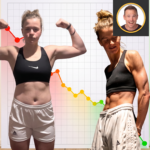
Strength coach and powerlifter Stefi Cohen recently delivered a masterclass on periodization that challenges conventional thinking in the fitness industry.
In a detailed presentation to her mentorship group, Cohen reframed the traditional periodization discussion from “strength versus hypertrophy” to something far more practical: performance versus aesthetics.

Her reasoning cuts through years of misunderstanding about how athletes and everyday lifters should structure their training.
“I believe that’s the wrong framing,” Cohen explained about the traditional approach, noting that strength is essential for hypertrophy goals and vice versa.
Jump to:
- Why The Old Framework Doesn’t Work
- What Periodization Actually Means
- The Two-Rabbit Problem
- Performance Versus Aesthetics: The Key Differences
- Is Periodization Even Necessary For Aesthetics?
- Cohen’s Five-Step Periodization Model
- Modifying The Model For Aesthetics
- The Smart-Equals-Strong Philosophy
- Practical Takeaways
Why The Old Framework Doesn’t Work
Cohen’s first major point dismantles a common assumption: that periodization strategies should be divided between strength and hypertrophy training.
Instead, she argues both qualities exist within any well-designed long-term plan, regardless of your ultimate goal.
Strength is one of the phases that we do for performance over the long-term plan just as is hypertrophy and vice versa is also true.
Performance goals—whether powerlifting, weightlifting, strongman, CrossFit, rugby, or martial arts—require developing multiple physical qualities.
Different sports demand different attributes, so peaking strategies must adapt accordingly.
Aesthetics-focused training, conversely, centers primarily on hypertrophy with body composition managed through nutrition.
What Periodization Actually Means
Cohen takes issue with overly formal definitions that confuse rather than clarify.
When she asks coaches if they follow periodization, most say yes—but can’t explain what it actually means.
Her practical definition: Periodization is your long-term plan that logically sequences different training phases (endurance, hypertrophy, strength, power) to peak at a specific time.
Programming sits within that periodized plan, not the other way around.
The Two-Rabbit Problem
Cohen uses a brilliant analogy to explain why focused training beats scattered efforts.
The man who chases two rabbits doesn’t eat. What do those rabbits represent? The rabbits represent our training modalities.
When athletes try developing multiple qualities simultaneously with equal emphasis, they achieve mediocre results across the board.
Successful periodization prioritizes one primary physical quality while maintaining others at lower volumes.
This doesn’t mean ignoring other attributes—it means strategic focus prevents diluted outcomes.
Performance Versus Aesthetics: The Key Differences
Performance training requires developing several physical qualities based on sport-specific demands.
A powerlifter needs maximum strength in three specific lifts, while a rugby player needs strength, power, speed, and sport-specific conditioning.
Aesthetics training focuses overwhelmingly on hypertrophy with strategic exercise selection targeting specific muscles.
The crucial distinction: Specificity in performance means excelling at your sport’s exact demands; specificity in aesthetics means the target muscle is the limiting factor during exercises.
Is Periodization Even Necessary For Aesthetics?
Cohen addresses a controversial question head-on: Do bodybuilders and physique athletes need periodization?
Her answer: Technically no, but it’s still beneficial.
Hypertrophy training is remarkably forgiving—there’s no single mandatory exercise, and numerous tools achieve similar results.
Want bigger quads? Squats, hack squats, lunges, leg extensions—all work when programmed properly.
Furthermore, bodybuilding isn’t about maximum muscle everywhere; symmetry and proportion matter tremendously.
That said, Cohen recommends periodization even for aesthetic goals because structured progression yields superior long-term results.
Cohen’s Five-Step Periodization Model
Based on Tudor Bompa’s research but simplified into plain language, Cohen’s model works for complete beginners building toward any goal.
Step 1: Learn To Move
Master fundamental movement patterns before anything else.
Cohen recommends four categories: squat, hinge, push, pull.
Choose one exercise per pattern and repeat the same workout two to three times weekly.
- Squat pattern: Goblet squat or appropriate variation
- Hinge pattern: Conventional deadlift with kettlebell or barbell
- Push pattern: Dumbbell press (incline or flat)
- Pull pattern: Lat pulldown
Complex movements like squats and deadlifts warrant lower reps (avoiding technical breakdown), while simpler pushing and pulling movements allow higher ranges.
This phase typically lasts two to four weeks depending on coordination and commitment.
Step 2: Build Work Capacity
Beginners lack the conditioning to handle high-volume hypertrophy training effectively.
Cohen’s favorite strategy: add one set per week to main movements.
Week one might be two sets, week two adds a third, week three a fourth, progressively building tolerance for training volume.
Simultaneously, lifters learn what hard training feels like by gradually working closer to muscular failure.
Step 3: Hypertrophy Phase
This represents the highest-volume phase in most periodization plans.
Research suggests 10-20 sets per muscle group weekly, though Cohen typically programs 8-12 sets for most clients.
I very rarely perform the top end of that range, 20 sets per muscle group per week with anyone that I work with, beginner, intermediate, or advanced.
Volume increases primarily through load progression, not adding endless sets.
A meta-analysis by Brad Schoenfeld found hypertrophy occurs across rep ranges from 5-30 when sets reach similar proximity to failure.
However, exercise complexity determines appropriate ranges—complex movements like squats warrant lower reps; isolation work like calf raises benefits from higher reps.
Step 4: Strength Phase
Reduce reps, increase load to approximately 80% of one-rep max (roughly six reps or fewer).
Research by Rhea and colleagues suggests 3-4 sets per movement pattern, performed two to three times weekly.
Cohen typically uses conjugate-style programming here: the primary movement follows strength protocols while accessory work maintains hypertrophy stimulus.
You don’t perform bicep curls with 80% max just because it’s “strength day”—exercise selection dictates appropriate intensity.
Step 5: Peaking Phase
Maximize performance through extreme specificity while minimizing volume.
For powerlifters, this means practicing near-maximum lifts in competition movements.
For sprinters, it means running at top speed with reduced training volume.
Intensity stays high—you’re not “deloading” in the traditional sense.
Instead, eliminate non-specific exercises (those amazing bicep curls and calf raises) to reduce accumulated fatigue while maintaining sport-specific intensity.
Modifying The Model For Aesthetics
For purely aesthetic goals, Cohen recommends the same progression through learning movement, building capacity, hypertrophy, and strength phases.
The peaking phase, however, becomes unnecessary unless competing on stage.
Instead, she advocates monthly undulating periodization—alternating between hypertrophy and strength phases indefinitely.
Interestingly, Cohen notes that Josh Lenartowicz, an Olympia-level bodybuilder, commented that this matches his exact training approach.
The Smart-Equals-Strong Philosophy
Throughout her presentation, Cohen emphasizes education over blind programming.
Something that I always learned was the smarter I got, the stronger I got. So that’s how I like to treat all of the people that I work with is teach them about the concepts that taught me how to be really, really strong.
Understanding why you’re following a specific program creates buy-in and long-term success.
Cohen deliberately simplifies complex concepts so anyone can grasp periodization principles, not just industry professionals.
Practical Takeaways
Cohen’s approach offers several immediately actionable insights:
- Don’t chase multiple qualities equally—prioritize one while maintaining others
- Beginners need movement competency first, not aggressive volume
- Build work capacity gradually before implementing high-volume hypertrophy blocks
- Volume increases through load progression, not just adding sets
- Peaking reduces volume, not intensity—specificity matters most
- Aesthetic goals benefit from periodization despite common claims otherwise
Her default 16-week training block provides sufficient time to see meaningful results while keeping clients engaged and motivated.
Whether training for a powerlifting meet, bodybuilding show, or simply looking better for summer, Cohen’s framework provides a scientifically-backed roadmap that adapts to individual goals and circumstances.