Most conversations around thinning or graying hair point straight to stress, genetics, or the inevitable march of time.
But the biology behind hair loss and hair graying is far more precise—and far more actionable—than most people realize.
Recent evidence shows that specific enzymes, receptors, and cellular processes drive both conditions, and in many cases, they can be influenced without reaching for prescription drugs.
Even more surprising: emerging research suggests that graying hair may actually be reversible under the right conditions.
Jump to:
Hair Loss Starts With DHT—But Not All DHT Blockers Work the Same Way
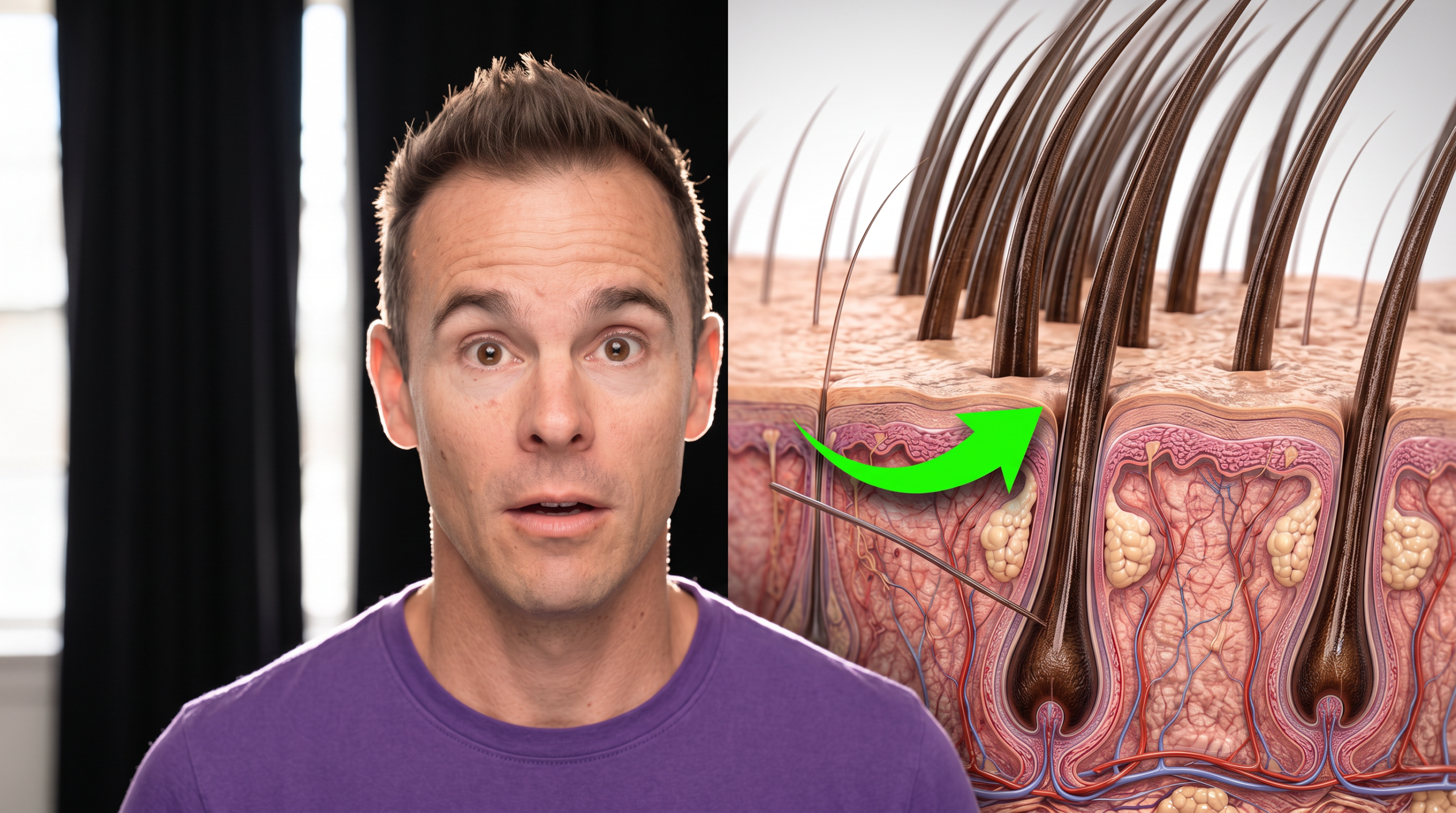
Male pattern hair loss isn’t random. It’s driven primarily by dihydrotestosterone (DHT), a hormone converted from testosterone by an enzyme called 5-alpha reductase.
Once DHT binds to androgen receptors on hair follicles, it triggers a process called miniaturization. Over time, follicles shrink with each growth cycle until they stop producing visible hair altogether.
Pharmaceutical interventions like finasteride suppress circulating DHT by around 60 to 65%, which is typically enough to slow or halt follicle loss. But natural compounds may offer a different—and potentially complementary—route.
Pumpkin Seeds: A Natural DHT Modulator With Dual Action
Pumpkin seeds contain delta-7 sterols, plant compounds that inhibit 5-alpha reductase and may reduce DHT production by approximately 40%. While that’s below the pharmaceutical threshold, it’s still a meaningful reduction—especially for men dealing with early-stage thinning rather than full baldness.
What makes pumpkin seed oil particularly interesting is its second mechanism. A 2018 study published in Pharmacology and Pharmacy tested delta-7 sterols and pumpkin seed extracts against DHT binding at the androgen receptor itself. The results showed that these compounds competed directly with DHT for receptor sites in a dose-dependent manner.
In other words, pumpkin seed compounds don’t just reduce DHT—they physically occupy the receptor sites that DHT would normally bind to. That means even moderate DHT suppression could have a stronger-than-expected effect at the follicle level.
This is fundamentally different from how finasteride works, and it suggests that natural interventions might not need to hit the same 60% suppression threshold to produce visible results.
Clinical Evidence: Hair Count Increased by 40% in One Trial
A randomized, placebo-controlled trial published in Evidence-Based Complementary and Alternative Medicine enrolled 76 men with mild to moderate androgenetic alopecia. Participants took 400 mg of pumpkin seed oil daily for 24 weeks.
Mean hair count increased by 40% compared to just 10% in the placebo group. That’s a significant clinical signal, especially for a food-based intervention.
One caveat: the capsule used in the study also contained other proprietary compounds, so it wasn’t a single-ingredient test. Still, pumpkin seed oil was the dominant ingredient, and the results suggest real promise for men seeking non-pharmaceutical options.
This isn’t pharmaceutical-grade DHT suppression. But for early intervention, prevention, or those who want to avoid the side effects of finasteride, pumpkin seed oil represents one of the strongest natural options currently supported by data.
Hair Graying Is a Different Problem—And It Might Be Reversible
While hair loss is a hormonal and receptor-driven issue, hair graying is rooted in oxidative stress and stem cell exhaustion.
Hair pigment comes from melanocytes—specialized cells that produce melanin and deposit it into each growing hair shaft. These melanocytes are replenished each cycle by melanocyte stem cells that reside in the follicle bulge.
As long as that stem cell reservoir stays intact, hair remains pigmented. But when those stem cells are damaged, depleted, or forced to differentiate prematurely, the follicle begins producing gray or white hair.
Oxidative Stress Kills Pigment Production
Research published in the International Journal of Trichology found that gray hair follicles show elevated levels of hydrogen peroxide and reactive oxygen species (ROS). These oxidative byproducts damage tyrosinase, the enzyme responsible for melanin production.
In other words, gray follicles have more oxidative stress and fewer antioxidants, which directly suppresses pigmentation machinery.
A study in Applied Sciences also found that oxidative and inflammatory stress cause melanocyte stem cells to differentiate too early—or even leave the follicle niche entirely. Once that happens, future hair cycles lose their pigmentation source.
Mitochondrial Health Plays a Central Role
Underneath both oxidative stress and stem cell depletion is mitochondrial dysfunction. Research published in Cell Regeneration showed that mitochondrial impairment in follicle tissue leads to increased ROS production and suppressed stem cell activity.
Poor metabolic health—driven by refined carbohydrates, sugar, and inflammation—directly impacts mitochondrial function. That mitochondrial stress leaks into follicle tissue, damages melanocytes, and accelerates graying.
Improving mitochondrial efficiency, then, becomes a key lever for protecting pigmentation over time.
Gray Hair Can Regain Pigment—Mid-Shaft
For decades, reversing gray hair was considered biologically impossible. But a 2021 study published in eLife challenged that assumption.
Researchers analyzed hundreds of individual hairs and digitally mapped pigment density across their length. They compared those timelines with participants’ self-reported stress histories.
The findings were striking: some gray hairs regained pigment mid-shaft, even after graying had already begun. These reversals aligned with periods of reduced psychological stress, while acute stress periods corresponded with rapid graying segments.
This suggests that the pigmentation machinery isn’t permanently destroyed when gray hairs appear. Instead, it can switch off under stress—and back on during recovery.
A clinical study in Applied Sciences tested a proprietary polyphenol blend on cultured hair follicles under stress. After four months, researchers observed a statistically significant reduction in both the proportion and number of gray hairs per square centimeter.
These are early but encouraging signals that graying may be partially reversible with the right interventions.
Red Light Therapy: Biohacking or Evidence-Based Tool?
Red light therapy has moved from fringe biohacking circles into clinical use, and for good reason. It works by stimulating cytochrome c oxidase in complex IV of the mitochondrial electron transport chain, effectively boosting cellular energy production.
Hair follicles require significant energy to function. When mitochondrial efficiency improves, follicle health improves—and that can translate into better hair growth and reduced oxidative stress at the follicle level.
While red light therapy devices range from full panels to wearable caps, the underlying mechanism is consistent: supporting mitochondrial function to reduce stress and improve cellular regeneration.
A Practical Protocol for Thinning and Graying Hair
Addressing hair thinning and graying naturally requires targeting both DHT signaling and oxidative stress. Here’s a science-backed approach:
For Hair Thinning
- Pumpkin seed oil: 400 mg per day, taken consistently for at least 3 to 4 months
- Whole pumpkin seeds: A daily handful (roughly 100 g) provides delta-7 sterols plus zinc, which supports hair health
- Patience: Natural DHT modulation takes time to show visible results
For Hair Graying
- Antioxidant support: Prioritize vitamin C, vitamin E, selenium, zinc, and magnesium through whole foods
- N-acetylcysteine (NAC): A precursor to glutathione, NAC helps combat oxidative stress at the follicle level
- Nicotinamide mononucleotide (NMN): Supports mitochondrial function and cellular energy production
- CoQ10: Another mitochondrial supporter with early trial data suggesting efficacy for graying
- Metabolic health: Reduce refined carbohydrates and sugar intake to lower systemic oxidative stress
- Sleep hygiene: Use glycine supplementation, avoid carbs 3 hours before bed, and practice breathwork or cold water face splashes to activate the mammalian dive response and promote relaxation
Red Light Therapy
Whether using a panel, mat, or targeted cap, consistent red light exposure may support mitochondrial health in follicle tissue. This isn’t a standalone solution, but it complements dietary and lifestyle interventions.
Expectations Should Be Realistic—But the Mechanisms Are Real
None of these interventions are pharmaceutical-grade treatments. They won’t replicate the DHT suppression of finasteride or the clinical potency of prescription drugs.
But they target real biological mechanisms—receptor competition, oxidative stress, mitochondrial function, and stem cell health—that pharmaceuticals often don’t address. And they come without the documented side effects that make drugs like finasteride a difficult choice for many men.
For those dealing with early-stage thinning or graying, or those seeking preventive strategies, these approaches offer evidence-based options worth considering. The key is consistency, realistic timelines, and a willingness to address the underlying biology—not just the symptoms.
Hair health is a reflection of metabolic health, hormonal balance, and cellular resilience. Addressing those foundations may not reverse decades of damage overnight, but it can slow progression, support recovery, and—in some cases—restore what was thought to be lost.