At first glance, rope flow might just look like swinging a rope around in circles. But for many top-level athletes and movement coaches, it’s become a go-to tool for improving mobility, symmetry, coordination, and even striking power.
In a recent Youtube video, Tim Ferris and Nsima Inyang shared how rope flow—popularized by David Weck, the creator of the WeckMethod—became a transformative practice in their training arsenal.
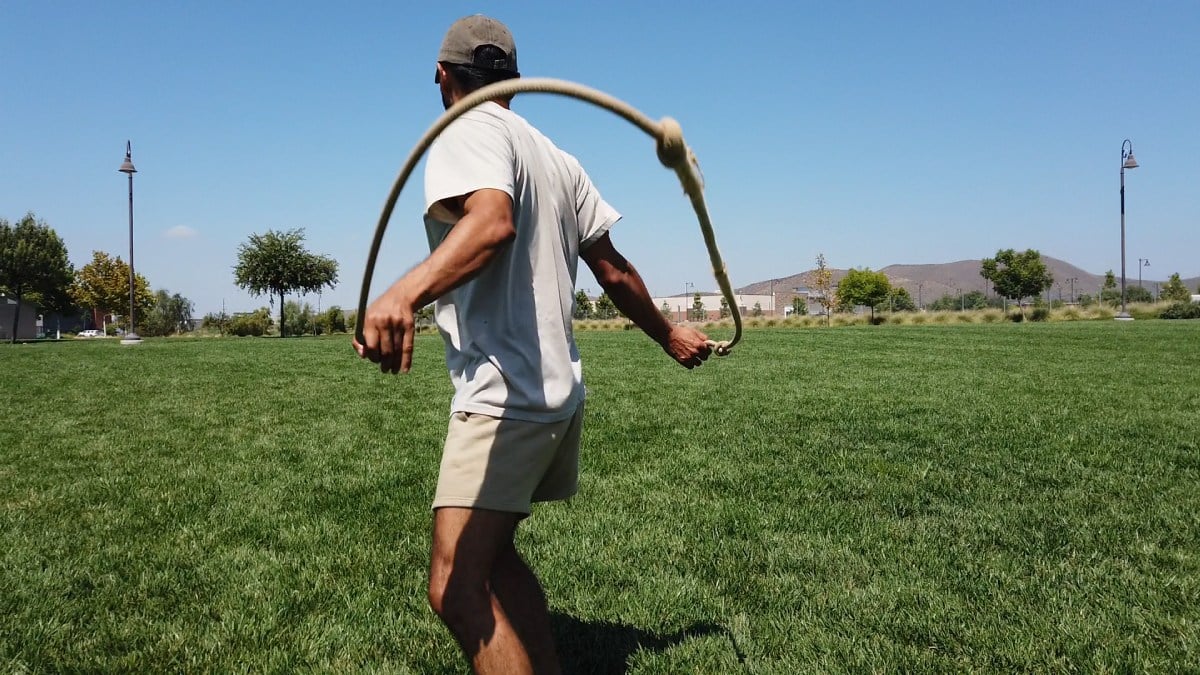
From jiu-jitsu to boxing, rope flow taps into fundamental human movement that modern training often neglects.
Below, we break down what rope flow really is, how it works, and why it may be the missing link in your programming—especially if you feel stiff, unathletic, or imbalanced.
Jump to:
What Is Rope Flow?
Rope flow is a movement practice that involves swinging a heavy rope around your body in coordinated patterns—often in figure-eights—while shifting your weight and rotating your spine, shoulders, and hips with rhythm and control. Although it may resemble a martial arts drill or a dance, it serves a deeper purpose than aesthetics alone.
David Weck, best known for inventing the BOSU ball, is credited as the founder of rope flow. Early on, he was seen practicing on rooftops long before the movement gained mainstream attention. His mission was to help people rediscover fluid, rotational movement that reinforces natural locomotion—how we walk, run, and rotate. Rope flow is a cornerstone of that approach, now adopted by athletes across the world.
“It’s Not a Workout. It’s Play.”
Unlike conventional gym routines built around sets and reps, rope flow is not “exercise” in the familiar sense. It’s informal, rhythmic, and intuitive. One user described it like this:
“You just go. You rotate, you move, you put the rope away, and you go do what you do. It’s not a workout—it’s play.”
Much like slacklining or dancing, rope flow encourages improvisation and exploration. There’s no need to count repetitions or chase performance metrics. Instead, you gain skill and mobility by logging time and letting your body figure out the patterns. This relaxed approach lowers the barrier to entry and makes consistency easier.
Why Rope Flow Works: Reps, Symmetry, and Feel
One of the unexpected strengths of rope flow is the sheer volume of quality repetitions you can accumulate in a short time. Unlike barbell lifts or machine exercises—where technique can degrade with fatigue—rope flow offers immediate feedback. If your timing or coordination slips, the rope doesn’t lie.
As one practitioner put it:
“If it doesn’t feel good, you’re going to know. If it feels fluid, you’ll know. You have the benefit of volume on your side.”
This rapid rhythm builds what some call a “water feel”—a smooth, effortless coordination across both sides of the body. That point is central: rope flow is inherently symmetrical. You rotate both left and right, retraining your non-dominant side and smoothing out imbalances often created through traditional training.
Fixing Rotational Imbalances in Sports
These asymmetries are particularly common in fighters and grapplers. Many, like the jiu-jitsu athlete interviewed, rely heavily on one-sided sweeps, takedowns, and passes. Over time, the dominant side gets “greased,” while the other remains uncoordinated. Rope flow helped level the playing field:
“I started noticing the sweep I usually do to my right—now felt powerful from the left. Passes to my left side started feeling better. My body was learning to rotate both ways.”
In this way, rope flow unlocks physical potential that often goes untapped in athletes who move dominantly in one direction. It restores a sense of full-body intelligence.
How It Improves Striking, Movement, and Athleticism
Another key benefit comes from the way rope flow trains rotation from the ground up—the same mechanism used in throwing punches, serving a tennis ball, or launching a baseball. The practice subtly teaches how to generate torque and power through the legs, hips, spine, and shoulders in order.
“Go throw some uppercuts after doing rope flow. You’ll feel that power coming from the ground, through your fist. Many people say it’s improved their punching just from learning how to swing the rope.”
That’s not just placebo. Rotational force—also known as spinal engine power—is at the heart of almost every dynamic athletic movement. Whether you’re cutting on the field, throwing a hook, or initiating a takedown, moving fluidly in multiple planes gives you an edge. Rope flow creates this awareness organically.
Bonus: Your Walk Will Change
Perhaps the most surprising side effect is how rope flow changes your everyday movement. One user pointed out that after a session, you might notice a natural swagger or rhythm in your gait. That’s your spinal engine turning on:
“You’re walking through space now with rotation. You’re moving with that natural spinal rhythm.”
This rhythmic gait is part of what makes elite athletes look effortless in motion. It’s a subtle, yet powerful shift in the way your body communicates—through your feet, spine, and shoulders all working as one.
How to Start Rope Flow (Even If It Feels Frustrating)
Like anything new, rope flow can be intimidating or awkward at first. It often feels clunky. Many people get a rope, try it once, and give up when the movement doesn’t click right away. That’s normal. Here are a few ground rules to get started:
- Choose the right rope: Start with a heavier, softer rope—ideally 1.5 to 2 inch diameter. Brands like WeckMethod and Octomoves specialize in beginner-friendly designs.
- Start with basic patterns: Begin with figure-eights, called “underhand matadors.” Master the feeling of guiding the rope versus forcing it.
- Practice a little each day: Just 5–10 minutes can lead to useful breakthroughs over time.
- Don’t chase perfection: Flow will come gradually. Focus on feel, not performance.
- Use video tutorials: Resources on YouTube from David Weck and others, like Chris Chamberlain, guide beginners through every step.
Most importantly, give yourself permission to play. Rope flow works best when approached with curiosity and consistency—not competition.
Who Should Try Rope Flow?
Rope flow is ideal for a wide range of individuals:
- Martial artists and fighters looking for better power and rotational movement
- Lifters and gym-goers who feel stiff or locked up
- Athletes needing multi-directional coordination
- Older adults wanting functional, gentle movement
- Movers and dancers seeking new flow modalities
It fills a void left by machine-based routines and sagittal-plane-only work. And because it’s low-impact, it’s safe and accessible—yet still physically rewarding.
Final Thoughts: Rope Flow Reconnects You to Movement
In a world of digital screens and rigid programming, rope flow invites people to move, feel, and play again. It’s not a magic bullet or a fitness fad—but it is a practical, powerful, and portable habit that can rewire the way you relate to your body.
With no workout gear needed, no strict plan to follow, and unlimited potential to explore new patterns, rope flow offers a true movement practice that develops not just strength, but awareness. As one experienced practitioner put it: “It teaches your spine how to dance again.”
If you’ve been feeling stuck in your body or your training—maybe it’s time to pick up a rope and let it flow.