Sports medicine chiropractor Mandy recently made a striking claim that challenges conventional wisdom about injuries.
For 85% of injuries, runners should be working through the problem rather than resting completely.
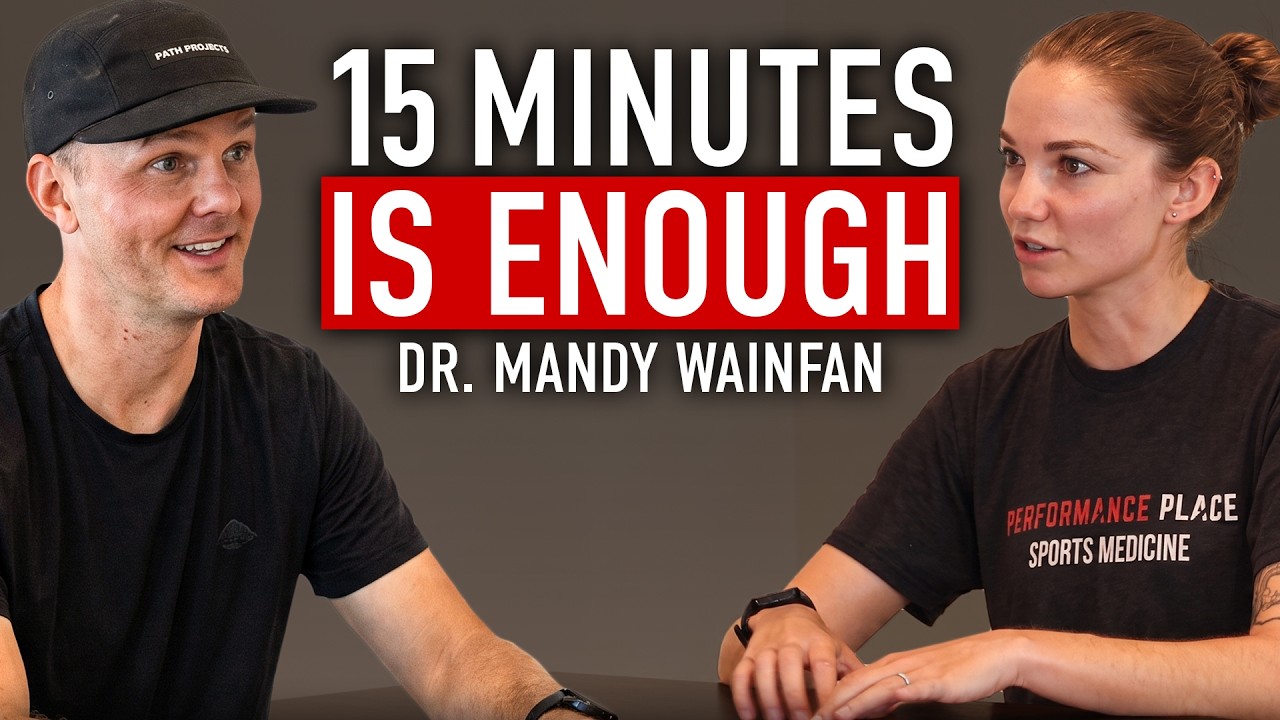
In a detailed conversation breaking down the most common running injuries, she explained why the instinctive response to back off from pain often makes things worse.
Her approach centers on understanding what your body is actually telling you and applying the correct load to heal faster.
Jump to:
- Why Rest Often Makes Injuries Worse
- The Real Problem With Complete Rest
- Testing The Waters: Finding Your Starting Point
- Plantar Fasciitis: Two Hidden Flavors
- Achilles Tendinitis: The Intensity Problem
- IT Band Syndrome: Stop Foam Rolling
- Runner’s Knee: Age Matters
- Hamstring Issues Versus Nerve Pain
- Minimum Effective Strength Training
- When Rehab Isn’t Working
- The Hip Internal Rotation Secret
- The Mental Battle Of Recovery
- When Surgery Becomes Necessary
Why Rest Often Makes Injuries Worse
Pain signals threat, not always damage. That’s a critical distinction most runners miss.
Mandy specializes in running injuries and has helped hundreds of athletes return to training. She explains that while complete rest seems logical, it typically digs the hole deeper.

If you want something simple that actually works, this is one of the most effective tools I’ve used to build strength, conditioning, and endurance without needing a full gym setup.
- Full-body training with one weight using swings, squats, and presses
- Solid cast iron build that feels stable and lasts for years
- Comfortable grip that makes high-rep workouts easier to handle
For 85% of injuries you should be working through it not resting.
The remaining 15% require relative rest, meaning activities that don’t stress the injured area. Swimming or aqua jogging for plantar fasciitis would be examples.
Runners who rest completely often find themselves in a vicious cycle. They take time off, feel better initially, then ease back into training only to have pain return at lower training volumes each time.
The Real Problem With Complete Rest
Complete rest lowers the threshold for when pain returns.
An injury might feel fine at 30 miles per week after rest, but flare up when intensity is added. More rest follows, and suddenly the pain threshold drops to 20 miles, then 15, then 10.
You get in kind of a cycle that devolves as time goes on.
The body needs appropriate stress to adapt and strengthen. Without it, structures become more sensitive rather than more resilient.
Testing The Waters: Finding Your Starting Point
Rehabilitation requires testing what you can tolerate. Mandy emphasizes doing the hardest thing you can do well.
If you want something simple that actually works, this is one of the most effective tools I’ve used to build strength, conditioning, and endurance without needing a full gym setup.
- Full-body training with one weight using swings, squats, and presses
- Solid cast iron build that feels stable and lasts for years
- Comfortable grip that makes high-rep workouts easier to handle
This means finding activities that challenge the injured area without causing significant pain, typically keeping discomfort under 3-4 out of 10.
The general guideline: perform the hardest exercise you can complete well for 80% of repetitions. The last few being somewhat difficult is acceptable.
Two critical warning signs indicate you need to regress:
- Pain significantly worse the following morning
- Pain exceeding 4 out of 10 during activity
Plantar Fasciitis: Two Hidden Flavors
Plantar fasciitis presents as pain at the bottom of the foot, typically near the heel. The classic presentation involves feeling like you stepped on a rock first thing in the morning.
But there’s a twist many practitioners miss.
There’s true planter fascitis which is inflammation of the actual planter fascia and then there’s fake or pseudo planter fascitis which is actually nerve referral.
True plantar fasciitis stays localized. If pain moves around—hurting at the ball of the foot one day and near the Achilles another—it’s likely nerve-related.
If you want something simple that actually works, this is one of the most effective tools I’ve used to build strength, conditioning, and endurance without needing a full gym setup.
- Full-body training with one weight using swings, squats, and presses
- Solid cast iron build that feels stable and lasts for years
- Comfortable grip that makes high-rep workouts easier to handle
This distinction matters tremendously for treatment. Misidentifying the problem explains why some cases persist for years or even decades.
The Best Rehab Approaches For Plantar Issues
Chronic plantar fasciitis (lasting more than a few weeks) requires active rehabilitation, not rest. Acute cases from sudden volume spikes might benefit from a few days of reduced activity, but rarely longer than a week.
Big toe mobility serves as an excellent starting point. Limited big toe range often predisposes runners to plantar problems.
Mandy recommends toe threading—a technique that looks unusual but produces remarkable results. Interlace fingers between toes and move the foot through various ranges of motion.
- Perform about 10 reps of each movement
- Hold the arch stable, then move toes
- Hold the heel stable, then move arch and toes
- Limit to twice daily to avoid joint irritation
Offloading to the hip reduces stress on irritated foot structures. Deadlifts work exceptionally well because they shift load away from small foot muscles to the more capable hip.
Achilles Tendinitis: The Intensity Problem
While plantar fasciitis often stems from volume issues, Achilles problems typically arise from intensity.
If you want something simple that actually works, this is one of the most effective tools I’ve used to build strength, conditioning, and endurance without needing a full gym setup.
- Full-body training with one weight using swings, squats, and presses
- Solid cast iron build that feels stable and lasts for years
- Comfortable grip that makes high-rep workouts easier to handle
Adding speed work, hill repeats, or moving to hillier terrain frequently triggers Achilles tendinitis. The classic symptom: running feels fine, but getting up after sitting creates severe stiffness and pain.
Tendons are actually fairly simple if you load it correctly. They work fantastically. You just need to load it heavy cuz if you’re just doing body weight, it’s completely fine. You’re not really adapting to anything, so you need to do the heaviest that you can do.
Isometrics: The Tendon Solution
Isometric exercises—contracting muscles without changing length—work remarkably well for tendon issues.
The standard protocol from researcher Jill Cook:
- Five sets of 45-second holds
- Two minutes rest between sets (mandatory, not optional)
- Load heavy enough to be challenging
- Pain should improve by the second or third set
The extended hold time squeezes excess fluid from irritated tendons. This mechanical process explains why pain often decreases during the workout itself.
Muscles adapt quickly, but tendons take longer due to less blood flow. Consistency matters more than intensity spikes.
IT Band Syndrome: Stop Foam Rolling
IT band syndrome causes sharp pain on the outside of the knee, often feeling like a stabbing sensation when going downstairs or during runs.
If you want something simple that actually works, this is one of the most effective tools I’ve used to build strength, conditioning, and endurance without needing a full gym setup.
- Full-body training with one weight using swings, squats, and presses
- Solid cast iron build that feels stable and lasts for years
- Comfortable grip that makes high-rep workouts easier to handle
The IT band is thick fascia running from hip to knee. Despite popular belief, you cannot meaningfully stretch it.
People stretching their IT band like you’re not necessarily changing the length of it. you’re probably changing the signal of it’s tight to now the signal of it’s looser, but you’re not necessarily changing like the physiologic length of it long term.
Foam rolling the IT band? Mandy doesn’t find it useful. If someone loves it and gets relief, fine. But it’s not her recommendation for patients.
The knee functions as a “stupid joint” with limited muscle support. IT band issues almost always require offloading to the hip.
Deadlifts and hip hinges are the secret sauce. Hip thrusts work excellently. Anything making glutes intensely sore typically helps.
Runner’s Knee: Age Matters
Runner’s knee splits into different categories by age.
Younger runners typically deal with patellar tendinitis (also called jumper’s knee). Jake Tuura specializes in this condition and offers excellent protocols.
If you want something simple that actually works, this is one of the most effective tools I’ve used to build strength, conditioning, and endurance without needing a full gym setup.
- Full-body training with one weight using swings, squats, and presses
- Solid cast iron build that feels stable and lasts for years
- Comfortable grip that makes high-rep workouts easier to handle
Older runners (typically 60+) often experience chondromalacia patella—fraying of cartilage under the kneecap. This doesn’t heal, but becomes asymptomatic with proper management.
Both conditions respond to the same fundamental approach: strengthen above and below the affected area, particularly the hip.
Hamstring Issues Versus Nerve Pain
Hamstring pain and sciatica share enormous symptom overlap, making differentiation challenging.
True hamstring tears produce a pop sensation and visible bruising. These require immediate loading—starting isometric exercises within days.
Chronic hamstring tightness that keeps recurring without bruising likely involves nerve referral from the back. Treatment focuses on the spine rather than the hamstring itself.
Minimum Effective Strength Training
Most runners dramatically overthink strength training. The minimum effective dose prevents most injuries.
If you want something simple that actually works, this is one of the most effective tools I’ve used to build strength, conditioning, and endurance without needing a full gym setup.
- Full-body training with one weight using swings, squats, and presses
- Solid cast iron build that feels stable and lasts for years
- Comfortable grip that makes high-rep workouts easier to handle
Ideal frequency: Two times weekly
Realistic frequency: Once weekly
Five essential movement patterns cover everything:
- Squat
- Hinge (deadlift variations)
- Single leg pattern (squat or hinge)
- Carry (farmer’s carry with heavy weight)
- Push and pull (upper body, optional for time-constrained runners)
If you’re like, I got 30 minutes and then I got to take my kid to school. Get a squat in, get a hinge in, get a carry in.
Perform 4-5 sets of 4-6 repetitions with weight heavy enough that you could do 2-3 more reps after finishing but no more.
When Rehab Isn’t Working
Plantar fasciitis should resolve in weeks or a few months maximum, not years. Yet studies show 40% of sufferers still have pain after 15 years.
This statistic reveals a fundamental problem: people continue ineffective treatments far too long.
If you’re doing something, say you’re diagnosed with planner fascitis and you’ve been trying to treat it for a long time and it’s not working, you need to change.
Seeking second opinions, trying different approaches, and consulting practitioners familiar with running-specific demands becomes essential when stuck.
If you want something simple that actually works, this is one of the most effective tools I’ve used to build strength, conditioning, and endurance without needing a full gym setup.
- Full-body training with one weight using swings, squats, and presses
- Solid cast iron build that feels stable and lasts for years
- Comfortable grip that makes high-rep workouts easier to handle
The four-visit rule: if there’s no improvement within four appointments, something was missed. Time to get imaging, involve another specialist, or try a different provider.
The Hip Internal Rotation Secret
If runners could focus on one mobility area, Mandy recommends hip internal rotation.
Runners consistently show poor internal rotation, yet this movement is essential for extending the leg behind the body during running.
Without adequate hip internal rotation, compensation occurs downstream—manifesting as back pain, knee overload, or foot problems.
Address this through stretching (hurdler stretch works well) plus loaded mobility work where muscles contract while in the stretched position.
The Mental Battle Of Recovery
Psychology profoundly impacts injury recovery. The medical field increasingly embraces the biopsychosocial model—recognizing that biology, psychology, and social support all influence pain experience.
If you want something simple that actually works, this is one of the most effective tools I’ve used to build strength, conditioning, and endurance without needing a full gym setup.
- Full-body training with one weight using swings, squats, and presses
- Solid cast iron build that feels stable and lasts for years
- Comfortable grip that makes high-rep workouts easier to handle
Identifying with injury prolongs it. “I am someone with foot pain” creates worse outcomes than “I’m experiencing foot pain temporarily.”
The mind often fights harder than the body during rehab. Having a professional provide guidance and permission to load injured structures helps overcome this psychological barrier.
It’s important to remember that discomfort, if you flare it up, in almost all cases, it will go away at some point.
Natural healing occurs when structures aren’t repeatedly re-injured through massive overload.
When Surgery Becomes Necessary
Surgery is rarely first-line treatment for running injuries, but specific situations warrant it.
Physical barriers—like bone spurs creating mechanical impingement—can’t be worked around indefinitely. Conservative care should be attempted first, but imaging may reveal structural issues requiring intervention.
Most back pain in runners does not require surgery. Many patients arrive having had multiple surgeries yet still experience pain.
If you want something simple that actually works, this is one of the most effective tools I’ve used to build strength, conditioning, and endurance without needing a full gym setup.
- Full-body training with one weight using swings, squats, and presses
- Solid cast iron build that feels stable and lasts for years
- Comfortable grip that makes high-rep workouts easier to handle
The key: ensure imaging findings clinically correlate with symptoms before pursuing surgical options.
Mandy’s final advice for runners centers on finding practitioners who understand the sport’s specific demands. Someone treating sprinters won’t have the same perspective as someone working with marathon and ultra runners.
The question isn’t whether to rest when injured, but how to apply appropriate load for optimal healing. That distinction determines whether recovery takes weeks or becomes a multi-year struggle.