There’s something deeply satisfying about lifting heavy objects off the ground.
It’s primal, instinctive, and connects us to a fundamental human strength.
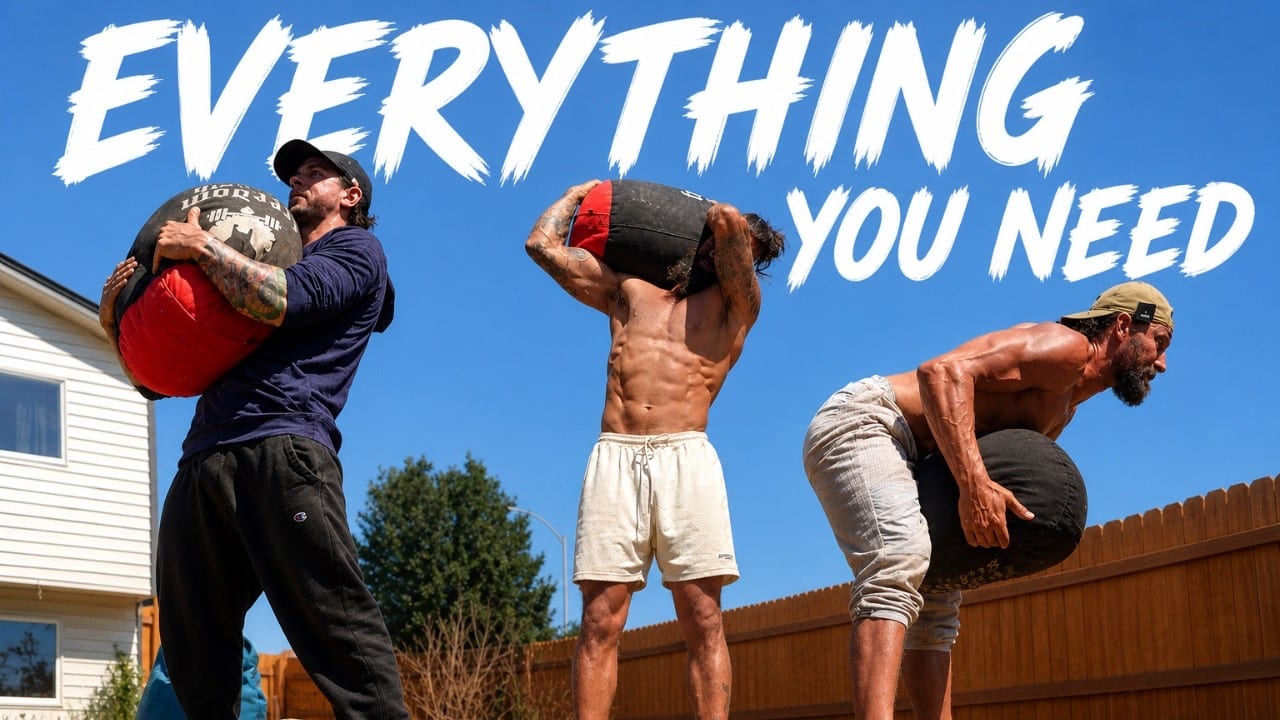
But while lifting stones might be the ultimate test of raw power, sandbag training offers something equally transformative—and far more accessible.
Cody from Stone Circle has spent years mastering sandbag training, and his approach reveals why this unconventional tool might be the missing piece in your strength journey.
Jump to:
- Why Sandbag Training Deserves Your Attention
- Foundation First: Mastering Sandbag Rows
- Getting Bags From Ground to Lap: Two Critical Techniques
- Box Squats: The Ultimate Full-Body Sandbag Movement
- Bear Hug Carries: Building Functional Armor
- Sandbag to Shoulder: Explosive Power Development
- Programming Sandbag Training Effectively
- Real Results From Unconventional Training
Why Sandbag Training Deserves Your Attention
Sandbag training isn’t reserved for elite athletes or strongman competitors. Cody makes this clear from the start.
Don’t be intimidated by sandbag. You don’t have to be a huge strong man to get started. Like, I’m just a little guy and just get a sandbag and pick it up and you’ll see. It’s really fun and I just want everyone to have fun with their training and enjoy it cuz that’s what life’s about, right?
His philosophy centers on enjoyment and accessibility. Unlike rigid barbell programs that demand perfect form and specific equipment, sandbags adapt to you.
The instability forces every muscle to engage, revealing weaknesses and building functional strength that translates directly to real-world movements.
Foundation First: Mastering Sandbag Rows
Every sandbag journey begins with one movement: the row.
Got to start with the row. In my opinion, it’s the foundation of everything. It’s going to train all the muscles you need to be good at lifting sandbags. And in my opinion, a stronger sandbag row means a stronger sandbag everything.
Unlike traditional barbell rows that isolate upper back and lats, sandbag rows demand total body tension. Cody emphasizes positioning: hands underneath sides, feet outside the bag, hips high with an arched lower back and proud chest.
This setup creates maximum back flatness while engaging hamstrings and lower back intensely.
Grip Variations That Matter
Grip technique varies based on individual mechanics and torso angle capabilities.
- False grip: Hands positioned fully underneath bag—ideal for lifters with strong deadlift mechanics who maintain high torso angles
- Claw grip: Using fingers instead of full palm—better for those who struggle maintaining upright positioning
Cody notes that chest positioning changes dramatically with grip choice. Full underhand grip places chest lower, creating longer range of motion. Finger grip allows higher chest position, shortening travel distance while maintaining strength.
Developing finger and grip strength becomes essential. Sandbags don’t forgive weak links.
Getting Bags From Ground to Lap: Two Critical Techniques
Before any major lift, bags must travel from floor to lap. This transition—often overlooked—makes or breaks heavier attempts.
Two distinct approaches exist: deadlift technique versus row technique.
Deadlift technique begins with standard hip hinge mechanics—hips back, chest up, driving through heels. Clean but sometimes inefficient with sandbags.
Row technique initiates by literally rowing the bag directly to your lap, utilizing muscles already primed from sandbag row training.
In my opinion, starting with the row, it’s made me so much stronger. I was having trouble once I got to the 220 bag when I try to deadlift it up and it was so slow. I’d end up getting it to about here and having to like wiggle it up. Once I started doing the row, focusing on it, it’s like my strength just exploded.
Leverages change completely between methods. Row technique generates more power through stronger pulling angles, eliminating frustrating sticking points.
Box Squats: The Ultimate Full-Body Sandbag Movement
Transitioning from lap to chest creates opportunities for extraordinary muscle building through modified box squats.
Standard lap-to-chest lifts work well. Hold bag, stand up. Simple, effective.
But Cody discovered something remarkable by adding strategic momentum and box positioning.
What I found actually here is if I propel myself off the box, so lean back and throw myself up, what actually ends up happening is that my legs and my back fatigue at an even pace. So now the exercise is hitting more muscle. You’re able to do more reps and get much stronger.
This modification transformed basic lifts into complete strength endurance challenges. Cody’s personal best? 600 consecutive reps over two hours without setting the bag down.
Why Box Squats Beat Standard Squats
Traditional freestanding squats with sandbags create constant tension. No rest, continuous grip demand, perpetual bracing.
This turns movements into endurance battles rather than pure strength builders.
Box squats provide brief reset opportunities at bottom position. Take deep breath, reposition bag if needed, explode upward. Reset, repeat.
Grip becomes supporting factor rather than limiting factor. Legs and lower back receive primary stimulus without premature grip failure.
Optimal Setup Guidelines
- Box height: Thighs reach approximately parallel position
- Grip choice: Interlocked fingers for beginners (reduces grip demand), S-grip for advanced lifters
- Rep ranges: Anywhere from 5 to 30+ reps depending on goals
- Rest periods: Keep pauses on box between 1-2 seconds for continuous work; longer pauses (10-20 seconds) for extreme rest-pause training
Using momentum doesn’t diminish training effect—it enhances it by allowing balanced fatigue across muscle groups.
Bear Hug Carries: Building Functional Armor
If any single exercise defines sandbag training benefits, it’s bear hug carries.
Multiple carrying positions exist—vertical, horizontal, overhead, shouldered. But chest-height bear hugs deliver comprehensive developmental stimulus.
Setup appears deceptively simple: lift bag to chest, squeeze tight, walk. Reality hits quickly.
Breathing Through Hell
Breathing becomes the primary challenge during carries. Bags compress diaphragm and rib cage, making oxygen exchange brutally difficult.
Cody’s solution involves strategic positioning and breathing patterns:
- Lower bag slightly below sternum height to reduce diaphragm compression
- Take deep breath before standing, maintaining expansion
- Practice slow, controlled breaths while walking rather than gasping
- Imagine torso “cast from steel” to maintain rigidity
Your initial instinct is going to be to breathe out when you reach the top, right? Most exercises you would. With this, I would recommend holding it at first so you can keep more expansion in your stomach. And then start doing slow breaths. It’s going to feel terrible at first.
Every bit of compression matters. Once rib cage collapses, regaining expansion becomes nearly impossible mid-carry.
Muscle Building Through Isometric Torture
No movement occurs during carries. Yet massive muscle development happens.
Think about deadlifts—spinal erectors contract isometrically throughout movement. Nobody questions deadlift effectiveness for back development.
Bear hug carries apply identical stimulus across entire posterior chain: upper back, lats, lower back, hamstrings, plus anterior muscles like pecs and biceps.
Tiny stabilization adjustments while walking create continuous tension. Weak points reveal themselves systematically.
When I think of carries, I think of them as this kind of super machine that goes through your body and systematically weeds out weakness. When you first start, most people, it’s probably going to be, ‘Wo, my biceps, I didn’t know I needed strong biceps for heavy weights.’ Those are going to wear out. The bear hug carry is going to show you that you got to bring those biceps up.
First biceps fail. Then grip. Then lower back. Then upper back. Each weakness surfaces, gets addressed, strengthens.
Carries also fix postural dysfunction. Gravity constantly pulls bodies forward. Carries force opposite positioning—chest up, shoulders back, spine extended. Hours spent hunched reverse through minutes spent carrying.
Sandbag to Shoulder: Explosive Power Development
For many lifters, sandbag-to-shoulder movements represent peak sandbag appeal. Explosive, athletic, challenging—and incredibly effective.
Cody approaches this movement as sport unto itself, encouraging technique refinement through practice rather than rigid form requirements.
Quadruple Extension Technique
Cody’s preferred method—learned from Scottish stone lifter Andy Crawford—utilizes what he calls “quadruple extension.”
Traditional Olympic lifts emphasize triple extension: ankles, knees, hips. Sandbag lifts add thoracic spine extension, creating fourth power generator.
Execution breakdown:
- Position bag horizontally on ground
- Wrap arms over top as high as possible
- Drive hips back like preparing to jump
- Explode upward using simultaneous jump and throw
- Extend through ankles, knees, hips, and thoracic spine
- Rotate bag mid-air, reach arm underneath
- Catch on bicep (not forearm) to minimize tendon stress
At the base level, just think of this as a simultaneous jump and throw. So, you’re jumping and you’re throwing the sandbag. You’re here. You’re going to roll that thing up and kind of slide one side up and then reach your arm under and catch it on top of your bicep.
Catching on bicep itself rather than forearm eliminates bicep tendon tension—common concern when lifting heavy loads with underhand grip positions.
Alternative Techniques Worth Exploring
Hip pop method uses primarily lower body drive—bag starts vertical, explosive hip extension drives upward, minimal upper body involvement.
Throw-and-catch (sandbag hang clean) isolates upper body rotation—practice pulling one side more to rotate bag, catching cleanly on shoulder. Excellent drill performed for sets of three.
Beauty lies in experimentation. Find technique that feels natural, powerful, fun. Then practice like athletic skill.
Programming Sandbag Training Effectively
Sandbag training doesn’t require complicated periodization or rigid programming.
Focus on four foundational movements:
- Rows (foundation for everything)
- Box squats (lap to chest with momentum)
- Bear hug carries (systematic weakness elimination)
- Shoulder lifts (explosive power development)
Rep ranges vary widely based on movement and goals. Rows work well from 5-15 reps. Box squats shine anywhere from 5-30+ reps. Carries measure by distance or time rather than repetitions. Shoulder lifts typically stay lower (3-8 reps) due to explosive nature.
Rest-pause training extends work capacity dramatically. Brief pauses between reps—especially during box squats—allow higher total volume without grip or endurance becoming limiting factors prematurely.
Start lighter than ego suggests. Sandbag instability humbles even strong lifters initially. Build weight gradually as technique solidifies and weak points strengthen.
Real Results From Unconventional Training
Skepticism toward unconventional training methods is understandable. Barbells and dumbbells dominate gym floors for good reason—they work.
But sandbags offer something different. Not better or worse—different.
One trainer who implemented Cody’s methods experienced notable physique changes: leaner body composition, five pounds heavier bodyweight, and most significantly, improved “connected strength”—functional power that transfers seamlessly between movements.
This connected strength manifests as coordination, stability, and confidence moving through space. Sandbags force adaptation across planes of motion simultaneously rather than isolating single muscle groups through fixed movement patterns.
Postural improvements emerge quickly. Hours spent carrying heavy, unstable loads correct forward head posture, rounded shoulders, and weak upper back positioning that plague desk workers and phone users.
Grip strength skyrockets. Everything requires crushing grip—bags don’t cooperate otherwise.
Perhaps most valuable: training becomes enjoyable again. Novelty, challenge, tangible progress on movements that feel primal and satisfying.
It’s really fun and I just want everyone to have fun with their training and enjoy it cuz that’s what life’s about, right?
Strength training shouldn’t feel like punishment or obligation. When training excites rather than drains, consistency follows naturally. Consistency produces results.
Sandbags strip away complexity. No racks, benches, specialty bars, or cable machines required. Just you, bag, ground. Pick it up, carry it, put it down. Repeat until stronger.
That simplicity carries profound power.