“Go heavy or go home” is gym gospel for shoulders, yet plenty of lifters still wonder why their delts refuse to grow.
In a recent YouTube video, 61-year-old attorney and fitness creator Keith Hanenian proposed the exact opposite.
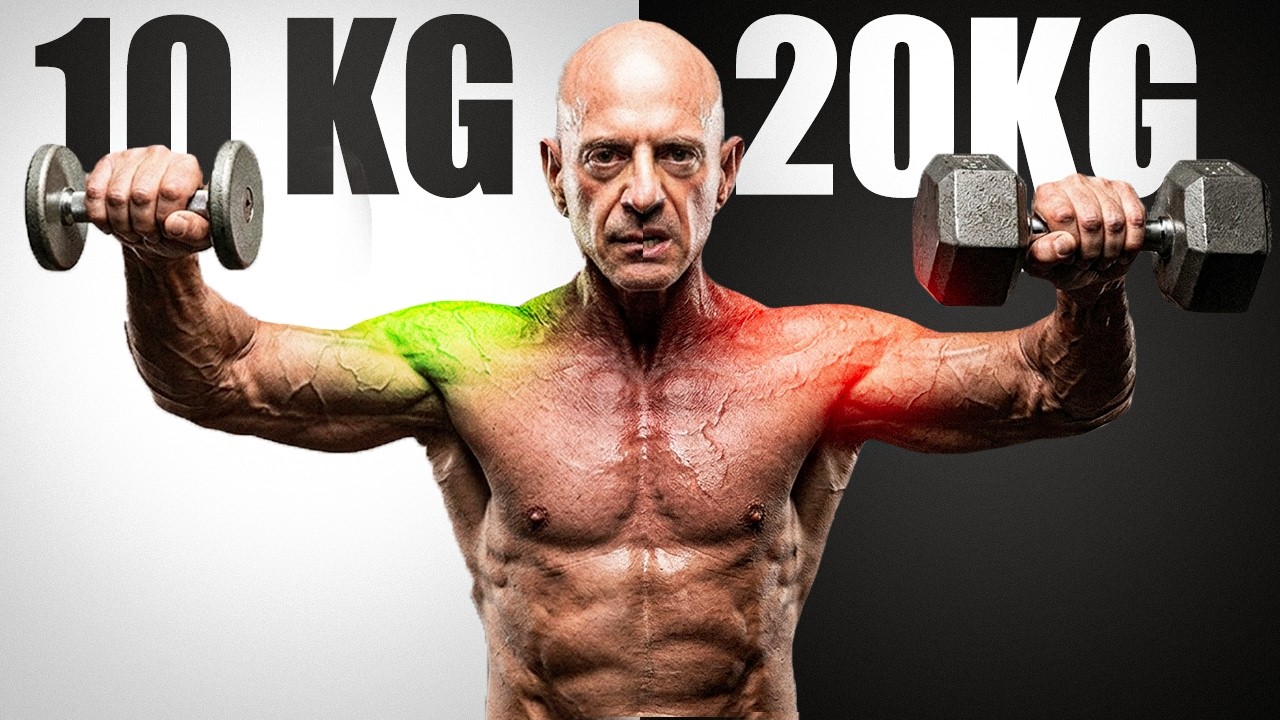
His method? Grab the lightest dumbbells on the rack and bury your delts in volume.
Three exercises, four rounds, barely any rest.
Curious what a 2-pound dumbbell can do to your shoulders? Keep reading, because a simple rule near the end reveals exactly when to climb the rack and when to drop back down.
Jump to:
Why Featherweight Dumbbells Can Light Up Your Delts
Hanenian calls his approach “spamming” the delts: high reps, strict form, minimal load. His pitch speaks to lifters stuck chasing numbers instead of sensation.

If you want something simple that actually works, this is one of the most effective tools I’ve used to build strength, conditioning, and endurance without needing a full gym setup.
- Full-body training with one weight using swings, squats, and presses
- Solid cast iron build that feels stable and lasts for years
- Comfortable grip that makes high-rep workouts easier to handle
Think about spamming the shoulders. Spamming your delts with lightweight.
Starting weights are 2, 3 or 5 pounds. Laughable? Wait until the burn arrives.
And what you’re going to find is that your delts are going to be on fire if you follow along with this process.
Lighter loads also pull attention toward the working muscle. That mind-muscle connection sits at the heart of his philosophy.
And by going lighter, you’re forcing yourself to focus on that.
The Circuit: Three Moves, Four Rounds
Everything runs back to back, front, mid and rear delts in one roundhouse.
- Exercise 1: seated lateral raise (mid delts)
- Exercise 2: bent-over rear delt raise (rear delts)
- Exercise 3: front raise (front delts)
- Reps: 20 to 25 per exercise
- Rounds: 4
- Rest: 45 to 60 seconds between rounds
Add it up and a single round delivers 75 to 100 reps. Four rounds mean roughly 300 to 400 total reps for your shoulders.
This is a completely different approach than doing compound movements, shoulder presses, upright rows, all these different types of exercises.
Exercise 1: Seated Lateral Raise
Standing works, though Hanenian prefers a bench. Elbows do the leading here.
We lead with our elbow. We keep the dumbbell below our elbow and below our shoulder when we do this exercise.
- Raise your elbow only to about parallel with your shoulder
- Keep each dumbbell below elbow height throughout
- Skip obsessive counting early; ease into a zone of 20, 25, even 30 reps
I can truly feel the burn. I can truly feel the pump as I’m moving through the exercise.
Exercise 2: Bent-Over Rear Delt Raise
Staying on the bench, fold forward and sweep weights up and out. Elbows track behind your thighs, still leading the movement.
If you want something simple that actually works, this is one of the most effective tools I’ve used to build strength, conditioning, and endurance without needing a full gym setup.
- Full-body training with one weight using swings, squats, and presses
- Solid cast iron build that feels stable and lasts for years
- Comfortable grip that makes high-rep workouts easier to handle
You can really feel the back area of your delts when you do this.
Two Cues That Change Everything
- Pinky pad: press attention into the outer edge of your hand
- Thumb out: keep thumbs outside the dumbbell for a fuller range of motion
Focus on the pad of your pinky in your hand as you move the weights out.
Exercise 3: Front Raise (Your Variation, Your Call)
Raise and lower for another 20 to 25 controlled reps. Hanenian prefers one hand position because it sharpens his focus, yet he gives lifters freedom.
It really doesn’t matter. You want to go this way? You can do it this way.
Ambitious? Perform both variations and turn the circuit into four moves.
Rest Periods and the Move-Up Rule
Give yourself about 45 to 60 seconds max of a break.
Next round, let performance steer your weight choice:
- Struggled through the set? Repeat the same dumbbells
- Felt manageable? Step up one size
- Can’t squeeze out 10 reps after stepping up? Return to the lighter pair
The whole concept is working volume in a controlled fashion with the proper range of motion.
Expect numbers to dip as fatigue builds. Hanenian himself aims for 15 to 20 reps in later rounds, using the same weight for demonstration.
Heavy Is Subjective, Not Banned
Hanenian is not telling anyone to abandon progressive overload. His point: loading should be thoughtful, not ego-driven.
We work our way up the rack so long as we can do at least 12 to 16 reps and we’ve mastered that particular exercise to move up.
Treat this circuit as one tool in a bigger toolbox. Pair it with heavier pressing if your goals call for it.
If you want something simple that actually works, this is one of the most effective tools I’ve used to build strength, conditioning, and endurance without needing a full gym setup.
- Full-body training with one weight using swings, squats, and presses
- Solid cast iron build that feels stable and lasts for years
- Comfortable grip that makes high-rep workouts easier to handle
Built for the Long Game
Patience drives the whole philosophy. Not a sprint. A marathon.
We’re in it because we want to be in it 10 years from now.
Test it this week: pick the lightest pair you own, run four rounds, and judge your delts by the burn rather than the number stamped on the dumbbell.