

Ancient Shaolin monks developed a training method that transforms the human body into something resembling armor.
Called “iron body,” this technique has been practiced for generations and even caught the attention of modern scientists.
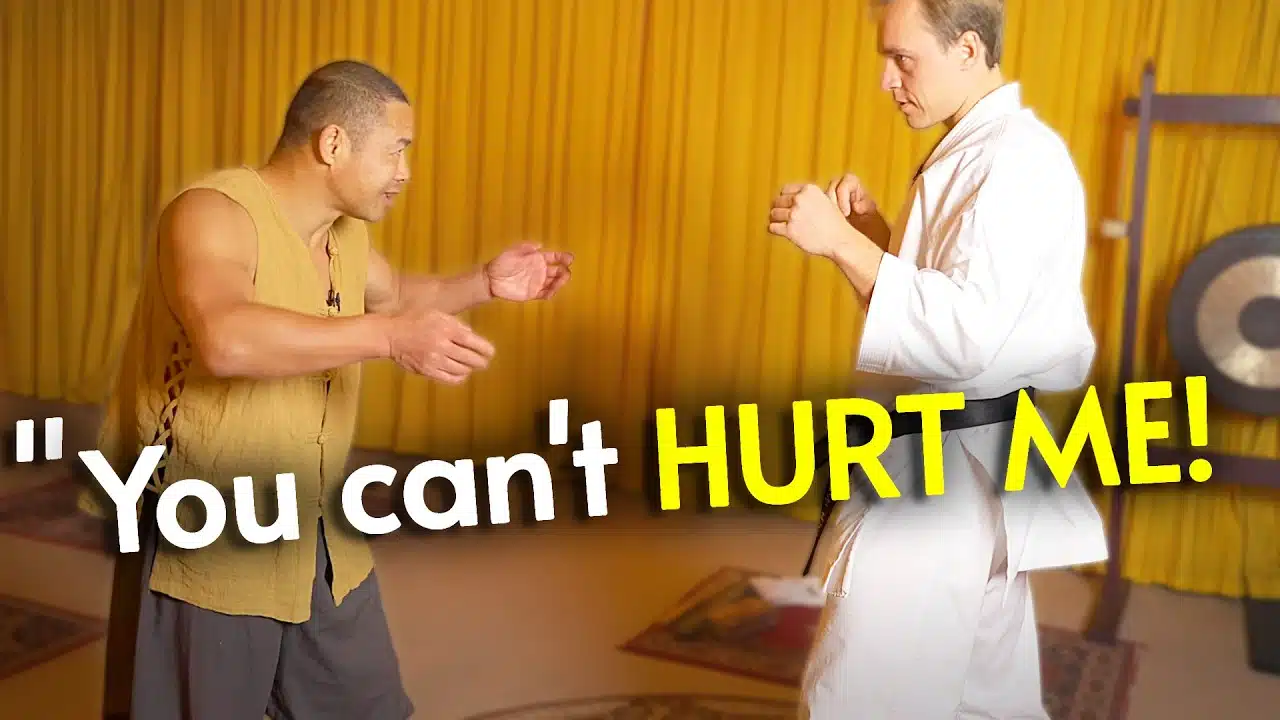
In a recent training session, martial artist and content creator experienced firsthand what happens when traditional Shaolin conditioning meets modern combat techniques.
The results? A body that doesn’t just absorb strikes—it bounces them back.
Jump to:
- The Philosophy Behind Iron Body Training
- Rubber Body, Not Stone Body
- Strategic Applications in Combat
- Deliberate Openings as Bait
- Training Equipment and Methods
- The Softness Paradox
- Performance Versus Combat Reality
- Qigong Foundation
- The Two-Car Collision Effect
- Health Benefits Beyond Combat
- Weapon Without Application Remains Useless
The Philosophy Behind Iron Body Training
Yan Le, a 34th generation Shaolin master, explained that iron body conditioning serves a purpose far beyond breaking sticks for demonstrations. Real combat application forms the foundation of authentic training.
For fighters we practice sometime they kick you one two three can take after they keep going 10 20 your body naturally to bouncing.
The goal isn’t merely withstanding punishment. Masters aim to create a physiological response where attacks get redirected through strategic body mechanics.
Rubber Body, Not Stone Body
Contrary to popular belief, iron body training doesn’t make practitioners rigid like concrete. Master Yan Le uses a different analogy entirely.
Make your body like a rubber you you can bouncing also when the disease come your body don’t like your body fight.
This elasticity creates tactical advantages in fighting. When opponents land strikes that feel ineffective, their confidence wavers. Psychological warfare through physical conditioning.
During the demonstration, the practitioner learned this lesson through direct experience—his kicks caused more pain to his own shin than to Master Yan Le’s conditioned leg.
Strategic Applications in Combat
Iron body conditioning enables a counterintuitive fighting strategy: attacking into attacks.
When kicks come toward a conditioned fighter, they absorb the impact while simultaneously closing distance. What looks like defensive failure becomes offensive opportunity.
You come, I come. You come, I come. I timing you.
Master Yan Le demonstrated how accepting a low kick allowed him to enter striking range immediately. Distance management transforms from defensive priority to offensive weapon.
Deliberate Openings as Bait
Advanced practitioners intentionally expose targets to manipulate opponent behavior. Ribs, legs, even the head become tactical lures.
When an opponent commits to attacking an apparently open target, the conditioned fighter absorbs the strike while launching simultaneous counters. The attacker’s commitment becomes their vulnerability.
I can make you open because I make you comfortable every martial art people they training I try to make the body become weapon.
Training Equipment and Methods
Shaolin iron body training employs specialized equipment, each serving distinct physiological purposes.
Brick Conditioning
Practitioners strike themselves with wrapped bricks while maintaining bouncing body mechanics. Wrapping prevents skin cuts while preserving impact.
During proper execution, the body moves forward into the strike rather than retreating. This replicates combat scenarios where advancing under fire provides tactical advantage.
Bundled Brush Training
Heavy bundles of bristles create different conditioning stimulus than solid objects. The brushes penetrate between ribs, targeting smaller surface areas with greater precision.
This focus makes small space too strong. Brick big pieces. The focus to make you area.
Weight provides additional benefit—two to three kilos build arm strength through repeated movement.
Bamboo Brush Circulation Work
Bamboo brushes serve recovery and circulation purposes. Practitioners strike themselves from shoulder to hand, promoting blood flow throughout trained areas.
Master Yan Le compared this technique to Finnish sauna practices and Russian banya traditions—all cultures discovered similar circulation-enhancing methods independently.
The Softness Paradox
Maximum power generation requires relaxation, not tension. This counterintuitive principle separates effective conditioning from performance demonstrations.
You need to be soft only softer. You can punch fast. You have to be really really relaxed. Then you can move speed. If you tense, you can’t.
During the training session, the practitioner experienced immediate results when applying this principle. Relaxed kicks generated significantly more power than tense, forced strikes.
Master Yan Le absorbed relaxed kicks without effort, then demonstrated “soft power”—devastating force delivered through completely loose body mechanics.
Performance Versus Combat Reality
Traditional demonstrations showing practitioners breaking sticks across their bodies serve entertainment purposes primarily.
We do the performance do the B stick is this is uh not useful no just for catch people’s eyes useful training and performance 100% different.
Combat-focused training emphasizes forward body movement, timing precision, and creating tactical opportunities. Real iron body training prepares fighters to advance through strikes while maintaining offensive capability.
Qigong Foundation
Basic qigong practice forms the foundation for advanced iron body techniques. Simple breathing and tension cycles build essential skills.
Practitioners stand relaxed, then inhale deeply through the nose. During exhalation, they clench fists, tense all muscles, lock ribs, and engage legs completely.
This creates full-body coordination under conscious control. Mental focus develops alongside physical conditioning.
This is good because the practice your um focus. Sometime we lost the focus we mind everywhere.
The Two-Car Collision Effect
When iron body practitioners advance into strikes rather than retreating, they create amplified impact on attackers.
Master Yan Le described this as resembling two cars colliding head-on. The attacker delivers force, but receives equal force returning through the conditioned body.
Balance disruption follows naturally. Attackers lose stability, creating openings for devastating counters. Pain combines with positional disadvantage—double psychological impact.
Health Benefits Beyond Combat
Iron body training offers advantages extending beyond fighting applications. Improved circulation throughout the body promotes overall wellness.
Master Yan Le connected physical vitality to happiness, explaining that children maintain joy partly through naturally fast circulation. Training replicates this physiological state.
The kids happy because circulation move fast the same your circulation move fast you will you know this when you do training you get endorphins.
Enhanced body awareness develops through consistent practice. Practitioners learn precise control over muscle tension, breathing patterns, and movement mechanics applicable throughout daily life.
Weapon Without Application Remains Useless
Developing conditioned body parts means nothing without understanding tactical deployment.
Many traditional martial artists condition hands and arms through repetitive striking but never learn combat-realistic applications. Form without function.
You only make your body become weapon but you don’t know how to use this still is no useful you have to practice the real way how to take attack.
Authentic Shaolin iron body training integrates conditioning with sparring, timing drills, and strategic study. Physical development and tactical understanding advance together, creating genuinely dangerous practitioners.










