Most gym-goers struggle with mobility issues that sabotage their workouts—yet they don’t even realize it.
Can’t squat deep enough? Struggling to press overhead without arching your back? Finding deadlifts uncomfortable no matter how much you practice form?
The problem isn’t your strength or technique—it’s likely your mobility holding you back.
In a recent video, physical therapist and strength coach Dr. Zach Long shared five simple mobility exercises that target the three most problematic areas: ankles, hips, and thoracic spine. Best part? This routine takes less than eight minutes and can transform how you move both in and out of the gym.
Jump to:
- Why Mobility Matters More Than You Think
- Exercise 1: Calf Stretch for Ankle Mobility
- Exercise 2: Goblet Squat Stretch
- Exercise 3: World’s Greatest Stretch (Enhanced Version)
- Exercise 4: Kneeling Thoracic Spine Rotation
- Exercise 5: Wall Slide and Liftoff
- Building Your 8-Minute Mobility Routine
- Real Results From Simple Movements
Why Mobility Matters More Than You Think
Poor mobility doesn’t just limit your range of motion—it creates compensations that increase injury risk. When ankles lack flexibility, squatters often let their heels rise, feet spin outward, or knees cave inward.
These compensations place unnecessary stress on joints and connective tissue. Over time, this leads to pain, plateaus, and potential injury.
The good news? Addressing mobility restrictions with targeted exercises can unlock immediate improvements in performance and comfort.
Exercise 1: Calf Stretch for Ankle Mobility
Tight ankles are surprisingly common and dramatically affect squat depth. Dr. Long recommends a loaded calf stretch performed on a bench or chair.
If you can’t easily squat down with your hamstrings touching your calf, chances are this is something you need to work on.
Place one foot on an elevated surface and drive your knee forward over your toes while keeping your heel planted. This targets the deep lower calf muscles that restrict ankle dorsiflexion.
Critical form point: Keep your knee tracking directly over the outside of your foot, not past your big toe. Improper tracking stretches in a compromised position.
Not feeling much stretch? Add load by holding a 30-40 pound weight on top of your knee or pull your chest into your thigh with your hands. Hold each rep for 10 seconds.
Try a bodyweight squat immediately after—most people notice deeper, more comfortable movement right away.
Exercise 2: Goblet Squat Stretch
This dynamic stretch uses a counterbalance to help you achieve deeper squat positions while improving hip mobility. Grab a light weight, kettlebell, or even a loaded backpack.
Stand with feet shoulder-width apart and squat as deep as possible. Keep your bodyweight distributed across your entire foot—no floating toes.
If your toes are moving, you’re too far back in your heels and your body is off balance.
Hold the bottom position for 20 seconds. Position your elbows between your knees and gently push them outward to create additional hip opening.
Struggling to maintain balance? Elevate your heels on a small wedge or weight plate initially. As mobility improves, gradually decrease heel elevation until you can perform these flat-footed.
Exercise 3: World’s Greatest Stretch (Enhanced Version)
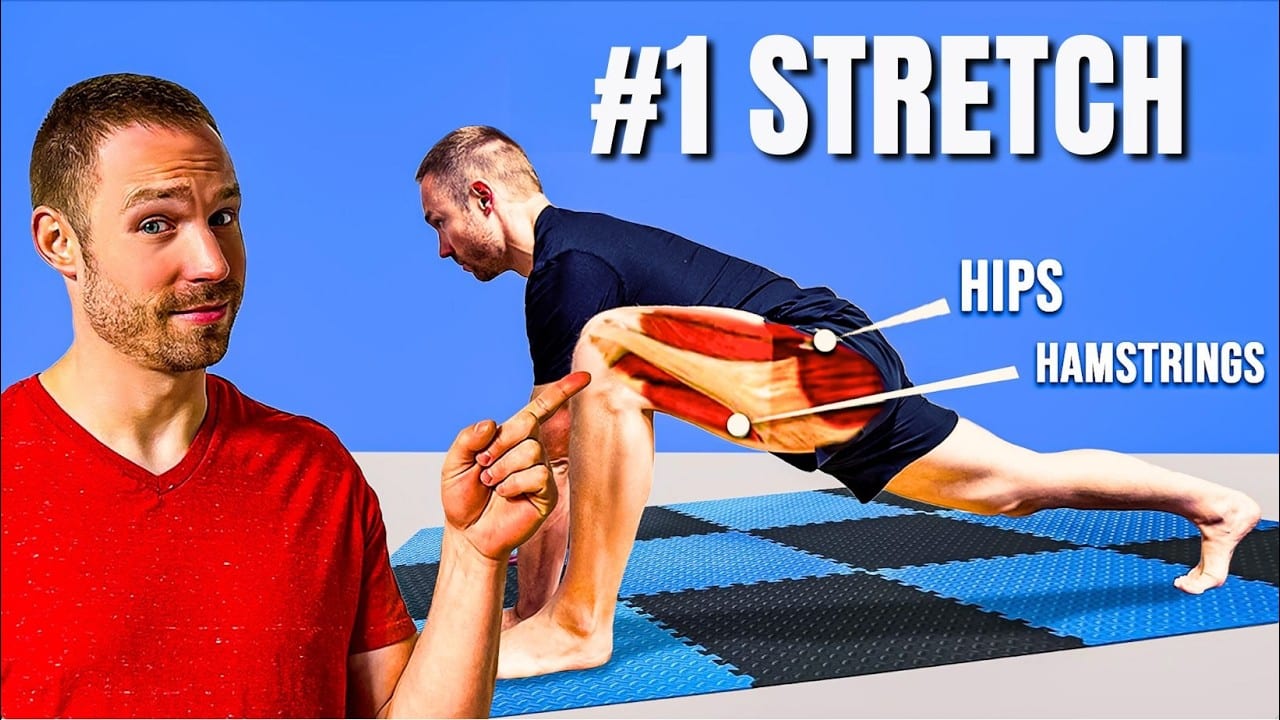
Despite its bold name, this dynamic movement truly deserves recognition. It simultaneously targets hip flexors, hamstrings, glutes, and thoracic spine mobility through multiple planes of motion.
Start in a kneeling lunge position with one hand on the floor opposite your front leg. Straighten your back leg completely and squeeze that glute—this activates hip flexor stretching.
Push your front knee outward while keeping your foot planted to stretch inner groin muscles. Then drop your elbow toward the ground as far as comfortable.
Next comes the thoracic rotation: rotate in the opposite direction while lifting your arm toward the ceiling. This targets midback mobility—crucial for overhead pressing and healthy shoulder function.
Complete the sequence on both sides for balanced mobility development.
Exercise 4: Kneeling Thoracic Spine Rotation
Modern life creates chronically stiff upper backs. Hours spent hunched over phones and computers lock thoracic spines into flexed, rounded positions.
Restrictions here make it difficult to raise our arms overhead, which can hinder optimal lifting technique in the gym and increase risk of injury.
Assume a half-kneeling position with one hand resting near your shoulder. Use your opposite hand to gently rotate your upper body open until reaching your current end range.
Here’s where this drill becomes powerful: take three deep breaths at end range. Breathing activates parasympathetic relaxation, allowing tissues to release tension.
After breathing, pull into rotation again—you’ll notice significantly greater range. Repeat this breathe-and-rotate sequence three times total per side.
Most people gain 20-30 degrees of additional rotation by the third repetition compared to their starting position.
Exercise 5: Wall Slide and Liftoff
Creating new mobility means nothing without strength to control it. Wall slides with liftoffs build crucial midback strength for maintaining overhead positions.
How often throughout the day do you spend with your arms overhead? For most, the answer is rarely, if ever.
This lack of overhead positioning weakens supporting muscles, particularly lower trapezius fibers responsible for upward scapular rotation.
Stand one foot-length from a wall with elbows in a “W” position. Slide arms upward into a “Y” position with elbows fully locked out.
Once extended, pull hands away from the wall as far as possible without arching your lower back. This engages lower trap muscles intensely—you should feel deep midback activation during the hold.
Too easy? Lie face-down on the floor with a small towel roll under your forehead. Perform the same movement pattern while fighting gravity—significantly harder and more effective for building strength.
Building Your 8-Minute Mobility Routine
Consistency trumps complexity with mobility work. Dr. Long recommends performing these five exercises as a pre-workout warm-up or standalone daily routine.
Suggested protocol:
- Calf stretch: 3-4 reps per side, 10-second holds
- Goblet squat stretch: 2-3 reps, 20-second holds
- World’s greatest stretch: 3 reps per side with full sequence
- Thoracic rotation: 3 rotations per side with breath holds
- Wall slides: 8-10 reps with 3-5 second liftoffs
Total time commitment? Less than eight minutes for complete body preparation.
Real Results From Simple Movements
These aren’t flashy exercises requiring advanced flexibility or specialized equipment. That’s precisely why they work for most people.
Many popular mobility programs fail because they’re too challenging for average gym-goers. Complex movements requiring significant existing flexibility discourage consistent practice.
Dr. Long’s approach prioritizes accessibility and effectiveness. Each exercise targets common restriction patterns using progressive loading and breathing techniques to create rapid improvements.
Expect better squat depth, more comfortable overhead pressing, and reduced daily aches within 2-3 weeks of consistent practice. Some benefits appear immediately after a single session.
The key? Actually doing the work. Eight minutes daily beats elaborate programs performed inconsistently.
For those dealing with persistent pain during movement, Dr. Long also authored Rebuilding Milo, detailing his physical therapy protocols used with elite athletes. The book provides systematic approaches for addressing common training injuries and movement dysfunction.
Mobility limitations don’t have to permanently cap your training potential. These five exercises provide practical, evidence-based solutions that fit into any schedule and deliver measurable results.