Building legs that move like an athlete’s requires more than just heavy squats and deadlifts in the gym.
Athletic leg strength means your body can stabilize on one leg, shift laterally, absorb impact, and explode in multiple directions with power and control.
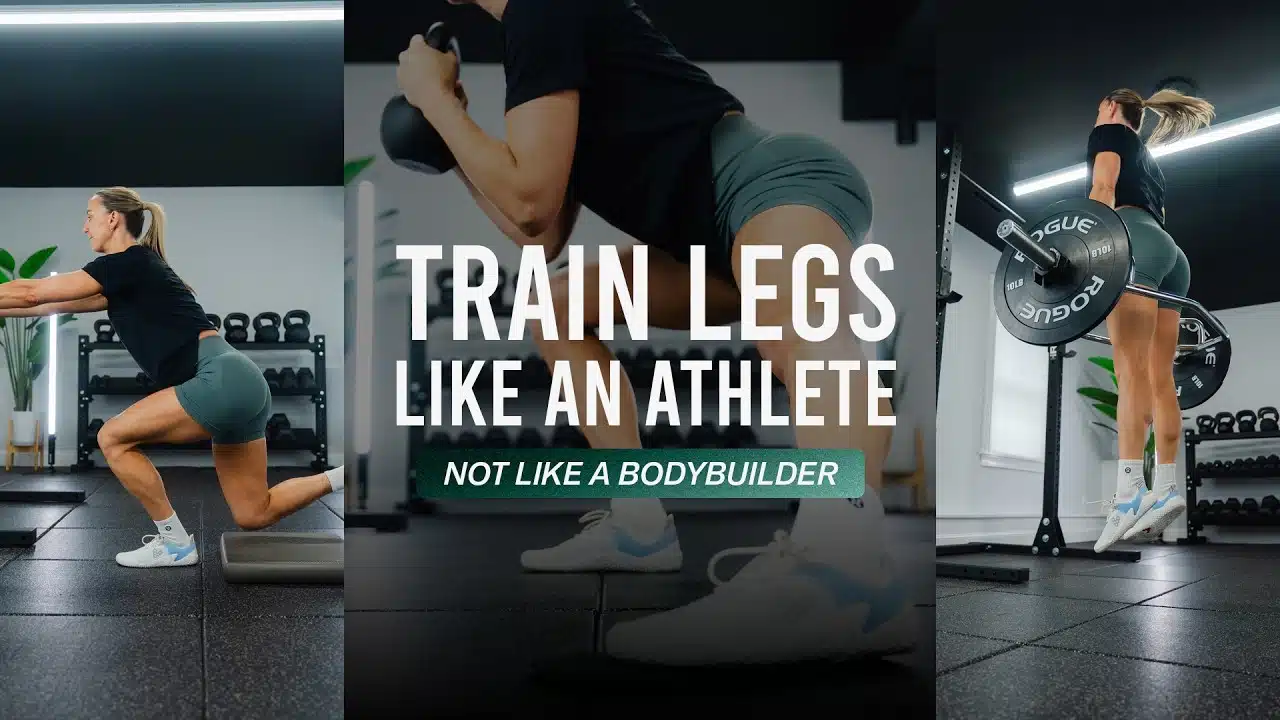
Most training programs miss these critical elements, focusing only on bilateral movements that build raw strength but don’t translate to real-world athletic performance.
Fitness experts emphasize three key training qualities that separate functional athletic legs from purely aesthetic development: single-leg strength, multi-planar movement, and loaded power.
Jump to:
Why Single-Leg Strength Changes Everything
Single-leg training represents the most overlooked component in most people’s leg routines. While bilateral exercises like squats and leg presses build impressive strength, they don’t address how bodies actually function during sports and daily activities.
Whether you’re walking, running, jogging, jumping, cutting, you’re doing things on one leg at a time. You’re very rarely performing any sort of sport with both feet planted on the ground.
Training on one leg exposes and corrects imbalances that bilateral movements can mask. These imbalances often develop from everyday habits or previous injuries, and single-leg work forces each side to pull its own weight.

If you want something simple that actually works, this is one of the most effective tools I’ve used to build strength, conditioning, and endurance without needing a full gym setup.
- Full-body training with one weight using swings, squats, and presses
- Solid cast iron build that feels stable and lasts for years
- Comfortable grip that makes high-rep workouts easier to handle
The Skater Squat: A Single-Leg Powerhouse
The skater squat stands out as an exceptional single-leg strength builder, particularly valuable for athletes or anyone recovering from lower-body injuries.
Unlike reverse lunges where the back foot touches down, skater squats keep the non-working leg floating throughout the movement. This seemingly minor difference dramatically increases balance and stability demands.
Here’s how to perform the movement correctly:
- Hold two light dumbbells extended forward as counterbalances
- Shift weight onto working leg completely
- Simultaneously reach arms forward while sending hips back
- Lower back knee to tap floor or pad behind you
- Drive through working foot to return to standing
The controlled lowering phase engages everything from foot stabilizers through ankle, quadriceps, hamstrings, and glutes. Nothing gets a free ride.
Scaling Options for Every Level
Beginners should start with TRX straps or rings for assistance. Hold the straps while performing the movement, gradually reducing arm involvement as strength improves.
Intermediate exercisers can use dumbbells held at arm’s length as counterbalances, which provide stability without direct support.
If you want something simple that actually works, this is one of the most effective tools I’ve used to build strength, conditioning, and endurance without needing a full gym setup.
- Full-body training with one weight using swings, squats, and presses
- Solid cast iron build that feels stable and lasts for years
- Comfortable grip that makes high-rep workouts easier to handle
Advanced athletes should progress to goblet-loaded variations, holding a kettlebell or dumbbell at chest height. This removes the counterbalance advantage while significantly increasing load on the working leg.
Other valuable single-leg exercises include single-leg deadlifts, rear-foot elevated split squats, and challenging step-up variations.
Multi-Planar Movement: Training Beyond Forward and Back
Traditional gym exercises predominantly occur in the sagittal plane—straight forward and backward motion. Squats, deadlifts, and standard lunges all follow this pattern.
But human movement happens in three dimensions. Athletes constantly shift laterally, rotate, and move diagonally. Training exclusively in one plane leaves massive gaps in functional strength.
Your body is meant to move in all directions. And so we want to train your legs to move in all directions.
Slider Lateral Lunges for Frontal Plane Strength
Slider lateral lunges effectively target adductors, glutes, hamstrings, and quadriceps while training lateral stability—a movement pattern absent from most programs.
Execution technique matters:
If you want something simple that actually works, this is one of the most effective tools I’ve used to build strength, conditioning, and endurance without needing a full gym setup.
- Full-body training with one weight using swings, squats, and presses
- Solid cast iron build that feels stable and lasts for years
- Comfortable grip that makes high-rep workouts easier to handle
- Place furniture slider under non-working foot
- Keep working foot planted without slider
- Slide non-working leg out to side
- Sit hips back and down over working leg
- Drive through planted foot while pulling slider leg back with adductor
Loading position dramatically affects which muscles work hardest. Holding weight at chest height (goblet style) keeps torso more upright, emphasizing quadriceps. Holding weight lower allows more forward lean, shifting emphasis toward hamstrings and glutes.
Choose your loading strategy based on which muscle groups need extra attention.
Additional multi-planar exercises worth incorporating include crossover step-ups, curtsy lunges, and Cossack squats—each challenging different movement planes.
Loaded Power: Building Explosive Strength
Moving heavy weight slowly builds maximum strength. But athleticism requires generating force rapidly—the quality of power.
Weighted power exercises bridge the gap between pure strength work and explosive bodyweight movements like box jumps. Training with added resistance makes athletes feel lighter and more explosive when performing without external load.
A lot of people can move a lot of weight slowly, but athleticism is also about being able to produce force quickly.
Trap Bar Deadlift Jumps for Lower Body Power
This exercise develops the ability to generate maximum force through full-body extension—the foundation of jumping, sprinting, and explosive athletic movements.
If you want something simple that actually works, this is one of the most effective tools I’ve used to build strength, conditioning, and endurance without needing a full gym setup.
- Full-body training with one weight using swings, squats, and presses
- Solid cast iron build that feels stable and lasts for years
- Comfortable grip that makes high-rep workouts easier to handle
Critical execution points:
- Load trap bar with approximately 35-40% of maximum deadlift weight
- Maintain neutral spine throughout movement
- Focus on triple extension (hips, knees, ankles fully extending)
- Jump explosively off ground
- Absorb landing by bending knees
- Reset completely between repetitions
The reset between reps proves crucial. Power training isn’t conditioning work—rushing through repetitions defeats the purpose. Each rep should express maximum explosiveness, which requires full recovery between efforts.
Weight selection matters enormously here. Loading too heavy transforms the exercise into slow strength work, eliminating the power development stimulus. If you can’t jump explosively with the weight, it’s too heavy.
Other loaded power exercises include barbell cleans, kettlebell swings, and loaded split squat jumps—each developing explosive strength through different movement patterns.
Integrating Athletic Training Into Your Program
Traditional bilateral strength exercises shouldn’t disappear from programs. Squats and deadlifts remain fundamental for building raw strength and muscle mass.
But layering in single-leg training, multi-planar movements, and loaded power work transforms strength that looks impressive into strength that performs impressively.
If you want something simple that actually works, this is one of the most effective tools I’ve used to build strength, conditioning, and endurance without needing a full gym setup.
- Full-body training with one weight using swings, squats, and presses
- Solid cast iron build that feels stable and lasts for years
- Comfortable grip that makes high-rep workouts easier to handle
Start by selecting one exercise from each category to add into existing routines. Focus on movement quality over load initially—these patterns require practice to execute properly.
As coordination improves and movement quality solidifies, gradually increase resistance while maintaining impeccable form and explosive intent on power movements.
Training like an athlete means building legs capable of more than just lifting heavy weight in controlled positions. It means developing strength that transfers to running faster, jumping higher, changing direction quickly, and moving confidently through whatever physical challenges life presents.