Pavel Tsatsouline trained Soviet special forces before introducing his revolutionary methods to America.
He spent decades developing strength and mobility protocols for hardened soldiers without compromising joint health.
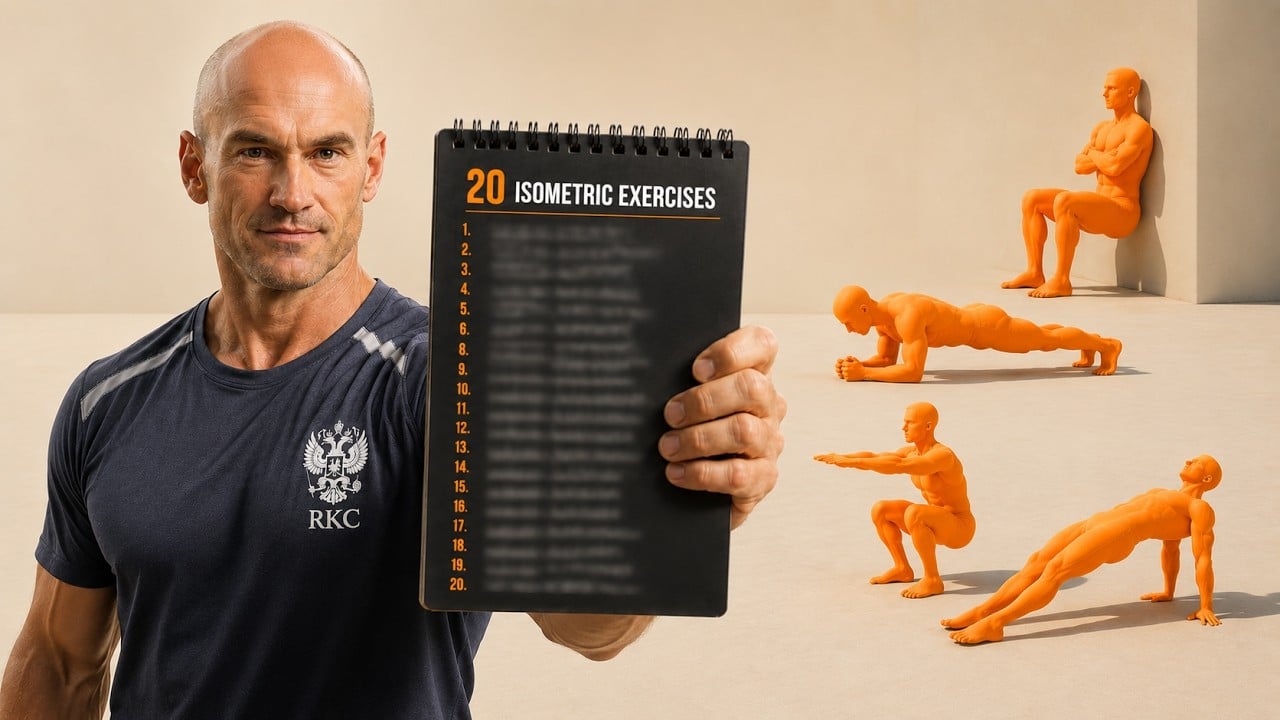
The five holds he perfected require just 15 minutes, no equipment, and address stiffness, aches, and nagging joint pain more effectively than stretching or medication.
These movements come straight from Soviet training methods that transformed how elite athletes and soldiers built unbreakable bodies.
Jump to:
The Hard Style Plank: Maximum Tension in Minimal Time
Most people perform planks completely wrong, turning what should be a powerful core exercise into a passive endurance test that leaves lower backs aching.
Pavel’s hard style plank lasts only 10 seconds, yet it generates more core activation than traditional planks held for minutes.
No products found.
Start by positioning forearms on the ground with elbows directly beneath shoulders. Squeeze glutes hard enough to crack a walnut. Tuck the pelvis under to flatten the lower back completely.
Contract quads forcefully while driving elbows into the floor as if trying to push through it. Brace abdominals as though anticipating a punch to the stomach.
Breathe shallowly but steadily for the full 10 seconds. Rest one minute between three total rounds.
Common Mistakes That Sabotage Results
Allowing hips to sag crushes the lower spine and creates the back pain people mistakenly attribute to planks themselves. Sticking the butt upward transforms the exercise into a passive rest position.
If you can hold this position longer than 15 seconds, you’re not generating sufficient tension.
For those not ready for full planks, drop to knees while maintaining identical tension patterns—same glute squeeze, same pelvic tuck, same maximum effort. Progress by lifting one foot at a time.
No products found.
This single hold teaches spinal stabilization that eliminates lower back pain at its source. Research on bracing for back pain confirms what Soviet trainers knew decades ago.
The Prying Squat: Opening Hips and Ankles Simultaneously
Soviet weightlifters called this movement “prying” because it systematically opens tight joints that restrict every step taken throughout the day.
Inability to achieve a deep squat without heels lifting, knees caving, or lower back rounding signals a mobility problem affecting daily movement patterns.
Drop into the deepest squat achievable with feet shoulder-width apart and toes pointed slightly outward. Get hips below knees if possible.
Place elbows inside knees and gently push knees outward. Keep chest elevated and heels glued to the floor for 60 seconds initially, working toward 2-3 minutes over subsequent weeks.
Why Tight Ankles and Hips Destroy Your Body
When ankles and hips don’t function properly, knees compensate for ankles while the lower back compensates for hips.
No products found.
This compensation cascade causes systemic breakdown because two stuck joints force everything else to work incorrectly.
The biggest error involves letting the butt drift backward off the heels, creating a half-squat with weight shifted forward. Drive heels into the ground hard, as if leaving footprints in concrete.
Rounding the lower back typically occurs when hips and ankles lack mobility to sink properly. Hold a doorframe or sturdy furniture for support while joints gradually adapt.
The prying squat fixes root causes rather than symptoms—the defining characteristic separating Soviet methods from conventional approaches.
The Cossack Hold: Bulletproofing Hips and Groins
Soviet wrestlers and dancers relied on this position to maintain hip, groin, and ankle durability that allowed them to perform at elite levels for decades.
Most people struggle significantly with this movement initially, revealing just how compromised their lower body mobility has become.
No products found.
Take a stance much wider than shoulder-width. Sink down onto one leg while keeping the opposite leg completely straight with toes pointed toward the ceiling.
The bent leg’s heel remains flat on the floor. Maintain an upright chest position. Hold for 30 seconds per side, completing two rounds per leg.
Loading Tissues Under Tension Creates Lasting Change
Rounding the back forward indicates excessively tight hips. Press hands together at chest level as a counterweight to maintain upright positioning.
Allowing the extended leg’s heel to lift defeats the purpose. That straight leg performs critical work—keep toes pulled toward shins with heels pressing downward.
Dropping the squatting leg’s heel violates the same rule as the prying squat: heel down, no exceptions.
For those finding full Cossacks too aggressive, hold a doorframe with the hand opposite the bent leg. Support partial bodyweight through the arm until hip and groin mobility improves sufficiently.
No products found.
This hold simultaneously targets inner thigh, groin, lateral hip, and ankle in a position forcing coordinated function rather than isolated stretching.
Months of groin stretching without progress occurs because stretching alone doesn’t work. The Cossack hold loads tissues under tension, producing the lasting adaptations stretching cannot deliver.
The Active Dead Hang: Decompressing Spine and Shoulders
Pavel identified hanging as one of the most underutilized tools for shoulder and spinal health, a position modern lifestyles have almost entirely eliminated.
Find a pull-up bar, sturdy doorframe, tree branch, or verified-solid door opening. Grab on and hang with full bodyweight suspended from arms.
The active component involves gently pulling shoulder blades down and back, as if tucking them into back pockets. This engagement activates muscles surrounding the shoulder joint without bending arms.
Feet remain off the ground for 30 seconds. Rest, then repeat for three total rounds.
No products found.
When you hang, you decompress every disc in your spine.
Hanging Builds Longevity Markers
Hanging stretches lats, chest, and entire back musculature while building grip strength—one of the strongest predictors of overall longevity in research literature.
It trains shoulders in an overhead, full-bodyweight-loaded position that modern environments rarely require, addressing a critical movement gap.
Passive hanging misses most benefits. The shoulder blade engagement transforms the exercise from simple decompression into active shoulder stabilization training.
Grip fatigue causes most people to quit prematurely. That burning sensation is the adaptation signal. Hands strengthen rapidly when consistently challenged.
Those unable to support full bodyweight should use a doorway, gripping the top edge while allowing knees to sink toward the floor with feet planted. Adjust loading by varying knee depth. Progress to single-foot support before attempting full hangs.
The Couch Stretch: Eliminating Hip Flexor Restriction
Desk work, driving, and evening television systematically shorten hip flexors year after year. This single restriction explains lower back pain when standing, shortened walking stride, and glute inactivation during squats.
No products found.
Soviet weightlifters used this position for decades as essential preparation, understanding that hip flexor mobility determines lower back health.
Position near a couch, bed, or wall. Assume a kneeling lunge position, but place the back foot’s top surface against the elevated surface with shin vertical.
The front leg maintains normal lunge positioning with foot flat and knee at 90 degrees.
Squeeze the back leg’s glute maximally while pushing hips forward. A stretch ranging from intense to brutal should radiate through the back hip and thigh front. Maintain upright chest for 60 seconds, then switch sides.
Tight Hip Flexors Are the Hidden Source of Back Pain
Arching the lower back to reduce discomfort eliminates hip flexor tension entirely. The glute squeeze automatically tucks the pelvis and prevents lower back compensation.
Collapsing the chest forward represents another compensation pattern. Stay tall, imagining a string pulling the head’s crown toward the ceiling.
No products found.
For those finding the wall version too aggressive, start with a standard kneeling lunge with back foot flat and front foot positioned further forward. Apply identical glute squeeze and forward hip drive with less hip flexor stretch intensity.
This single hold accomplished more for lower backs than a thousand crunches. Tight hip flexors pull the pelvis’s front edge downward, forcing unnatural lumbar arching throughout the day—where most chronic back pain originates.
Freeing hip flexors eliminates the compensation forcing backs to work incorrectly. Without the restriction, pain has no mechanical source.
The Complete 15-Minute Protocol
Combining these five holds creates a comprehensive routine requiring three weekly sessions for transformative results.
- Hard Style Plank: Three rounds of 10 seconds with maximum tension, one-minute rest between rounds
- Prying Squat: 60 seconds immediately following planks, no rest required
- Cossack Hold: 30 seconds per side, two rounds per leg, alternating sides
- Active Dead Hang: 30 seconds, three rounds with one-minute rest intervals
- Couch Stretch: 60 seconds per side, one round each leg
Total session duration: approximately 15 minutes. Three weekly sessions represent the optimal frequency, though additional sessions work well for responsive bodies.
Within the first week, morning stiffness decreases noticeably. Squat depth improves slightly. Shoulders feel less restricted.
No products found.
Within one month, movement patterns fundamentally change. Getting off couches no longer requires groaning. Picking up objects involves unconscious squatting. Posture improves without conscious effort.
The Soviet method rebuilds bodies from the inside out using nothing but bodyweight and minutes daily—how the world’s strongest people have trained for the last century.
No equipment, no gym, no supplements. Just five holds, 15 minutes, three weekly sessions. These movements represent decades of refinement by coaches who trained elite performers under the harshest conditions imaginable.