For athletes crossing into their 30s and beyond, one truth becomes increasingly difficult to ignore: the body doesn’t recover, adapt, or perform the same way it did at 22.
That’s not a limitation—it’s an opportunity.
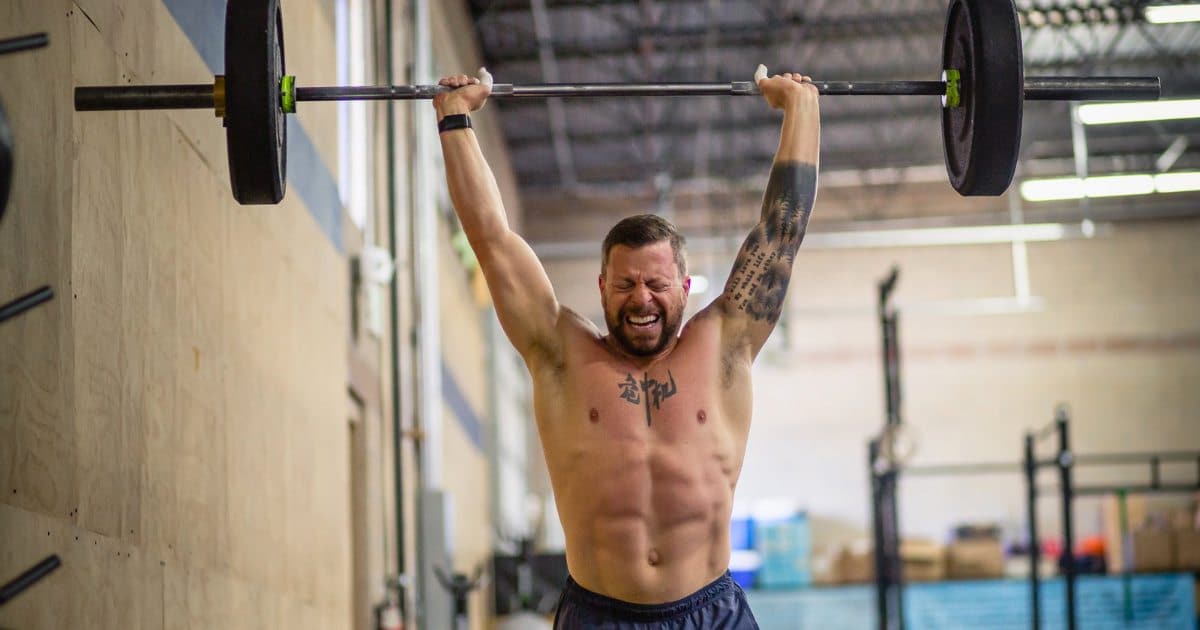
According to Jason Grubb, a five-time CrossFit Games champion and lifelong fitness learner, the path to peak performance in the Master’s category starts by dropping the fantasy of youth.
“You can’t train like a 20-year-old and expect to thrive as a 40-year-old,” Grubb says. “Once you hit 35, it’s time to rework your approach—how you move, eat, rest, and compete.”
After years of chasing elite-level volume and burning out in the process, Grubb discovered that less can truly be more—especially when every training decision is intentional. Now at 46, he’s not just competing—he’s dominating.
Jump to:
- Stop Training Like You’re 25
- Overtraining Was Holding Him Back
- Less Volume, More Intention
- The Golf Ball Analogy: Quality Beats Quantity
- Dialing in Nutrition and Recovery
- Understanding Intensity: The Color-Coded Boulder Method
- Strategic Recovery: The Hidden Superpower
- Proof in Results: From Local Competitor to World Champion
- Act Your Age—and Win Like It
Stop Training Like You’re 25
One of the biggest mistakes Master’s athletes make is assuming that more volume equals more gains.
Grubb made that mistake himself.
He entered CrossFit at 38 with no competitive background. A former jogger trying to stay in shape despite a diet heavy in pizza and ice cream, Grubb admits, “I literally jogged so I wouldn’t get too fat.”
Once he discovered CrossFit, he dove in with obsessive commitment—six days a week, often for hours at a time. That enthusiasm paid off early: just eight months into training, he entered his first local competition and landed sixth place.
That fire pushed him to go all in. But with his sights set on the CrossFit Games, he started mimicking the training of elite 20-something athletes—long sessions, multiple WODs, and very little recovery.
“I was trying to be Matt Fraser or Rich Froning,” he recalls. “I was doing 3–4 hours a day, grinding through workouts without warm-ups, without a plan, just pure volume.”
Despite his work ethic, his results plateaued. Each Open season left him outside the top 20. The breakthrough wouldn’t come until he let go of the younger athlete mindset.
Overtraining Was Holding Him Back
Grubb realized that overtraining, not underperforming, was his biggest problem.
The training volume was brutal—and his body couldn’t keep up. He describes sessions that felt like “walking through thick mud,” doing one strength component after another, MetCons stacked on MetCons, with no clarity or intent.
Worse, he wasn’t fueling appropriately for that workload. “I wasn’t eating enough, and I wasn’t recovering,” he says. “I’d go into competition already drained. I was never the fittest guy when it counted.”
At 41, after failing to qualify yet again for the Games, he reached a breaking point.
“I remember sitting on the gym floor with my eyes closed and just saying, ‘Fine. I’ll buy a Master’s program.’ It was begrudging—like I was giving up on being elite.”
What he didn’t realize then was that this mindset shift would unlock the best version of himself.
Less Volume, More Intention
Switching to a Master’s-focused program slashed his daily workload—but it amplified his results.
Instead of chasing exhaustion, Grubb focused on precision.
Strength days became deliberate: “Instead of 30 random snatches, I had nine working reps. Every single one had to be perfect.”
Conditioning workouts were no longer about survival—they became tactical, with pacing strategies and targeted intensity. His sleep improved. He recovered faster. Performance skyrocketed.
“I was finally training the right amount, and I had energy to focus. I wasn’t just getting through workouts—I was getting better.”
The Golf Ball Analogy: Quality Beats Quantity
To explain the shift, Grubb uses a simple metaphor: golf practice.
When he used to buy the giant $7 bucket of golf balls, he rushed through them, swinging away without form or focus. But with the $5 small bucket, he paid attention. Every shot mattered.
“With fewer reps, you concentrate. Same thing in the gym—when you have less volume, you dial in your technique, your form, your movement patterns.”
It’s a mindset shift: train to improve, not just to complete. Every movement—snatch, pull-up, burpee—has purpose.
Dialing in Nutrition and Recovery
Volume wasn’t the only issue. Nutrition was lagging too.
“I was burning thousands of calories and barely fueling,” Grubb admits. “No wonder I was tanking.”
Fixing that meant tracking meals, optimizing macronutrient intake, and supplementing with electrolytes to prevent muscle cramps, fatigue, and dehydration.
His go-to? Element, an electrolyte mix with 1,000 mg sodium, 200 mg potassium, and 60 mg magnesium.
“It’s clean, no junk, and it works. Whether I’m recovering or going hard, Element keeps me fueled and hydrated.”
That small change had a huge impact. Alongside improved sleep and reduced training load, hydration and fueling finally supported—not sabotaged—his efforts.
Understanding Intensity: The Color-Coded Boulder Method
Now as the creator of Boulder Athlete, a program built for Master’s athletes, Grubb applies all these lessons directly into how he trains others.
Every workout is color-coded by intensity using heart rate zones:
- Blue = Recovery pace. Easy, controlled movement for warm-ups or cool-downs.
- Green = Zone 2. Steady, conversational pace that builds endurance.
- Yellow = Zone 3. Moderate effort, sustainable but challenging. “If I walk into the gym and ask, ‘Can we add a round?’—you should be able to say yes.”
- Orange = Zone 4. Uncomfortable, short-duration intensity that challenges aerobic efficiency.
- Red = Max effort. Full throttle. Grubb only prescribes 2–3 red sessions per week, scheduled before rest days to allow for full recovery.
This system builds smart, adaptable fitness—not reckless exhaustion.
Strategic Recovery: The Hidden Superpower
What most athletes ignore, Boulder Athlete builds in.
Recovery isn’t optional—it’s scheduled.
- Wednesdays end with red-line efforts, followed by a lighter Thursday.
- Saturdays finish hard, with Sundays off for full recovery.
“You can’t keep doing max efforts and expect to improve. You need strategy. Rest is part of the plan.”
By aligning training zones, nutrition, and rest, Master’s athletes can push their limits without breaking their bodies.
Proof in Results: From Local Competitor to World Champion
Grubb’s transformation wasn’t theoretical—it was measurable.
After switching to smarter training at age 42, he qualified for the CrossFit Games. In 2018, he placed third. In 2019, he won.
He’s won five consecutive titles since then—and he credits it all to intentional programming.
“Yesterday, I had four snatches off blocks. That’s it. But I focused on every rep. Then I sold my soul on the Assault bike. Not random. Not rushed. Intentional.”
That word—intentional—sums up everything.
It’s not about doing less for the sake of laziness. It’s doing exactly enough to drive progress. Not more. Not less. The right load, the right effort, the right recovery—every time.
Act Your Age—and Win Like It
There’s no shame in training like a 35-, 40-, or 50-year-old athlete. In fact, it’s the only way to keep progressing long-term.
Grubb urges others to do what he wishes he had done sooner:
“I wish I had learned this at 38. If you’re 35+, stop pretending your body recovers like it used to. Be smart. Respect your age. You’ll get stronger, not weaker.”
Every rep matters. Every bite matters. Every rest day matters.
That’s how champions are built—one intentional day at a time.
“Your best days are ahead of you. Fortune favors the bold.”