Ever feel like your knees are just one awkward move away from giving out? You’re not alone.
Whether it’s lingering pain from past injuries, discomfort during daily activities, or the strain from high-impact sports like Crossfit or hybrid training, knee vulnerability is a common issue.
But there’s good news: you can build stronger, more resilient knees with smart and specific training.
In this guide, we’ll break down why knee resilience matters and provide a powerful lineup of seven exercises that target exactly what your knees need — mobility, strength, and control.
Let’s dive in and give your knees the support they’ve been missing.
Jump to:
Why You Should Care About Knee Resilience
Knee injuries often occur when the stress placed on the joint exceeds the tissue’s ability to handle that load. This could be something as simple as a slight twist during a walk — especially if your knees are never trained for rotational movements.
“You get injured not because the knee is useless, but because it’s underprepared,” explains movement specialist and mobility coach [Author Name].
Regular strength training targets major muscle groups — but when it comes to the knees, most people neglect rotational forces and extreme flexion angles. By training these often-ignored capacities, you give your knees the ability to tolerate awkward loads, reduce injury risk, and move more freely through life and sport.
How to Strengthen Knee Resilience
In short: you need to focus on two things — moving your knees over your toes, and improving your knee’s ability to rotate.
Yes, moving knees over the toes has long been misunderstood as risky. But most modern movement experts now agree: avoiding that motion entirely actually weakens the joint and increases injury risk. Instead, training forward motion and deep flexion safely adds strength and tissue tolerance.
Start with bodyweight and low resistance. Once you’ve nailed proper movement patterns, you can gradually add weight and intensity.
7 Powerful Exercises to Strengthen and Protect Your Knees
1. Walking (Especially Backwards)
- Walking is a foundational, low-impact activity that enhances blood flow and joint lubrication.
- Backwards walking adds reverse tension and activates neglected muscle chains around the knees.
- Want to challenge it further? Try walking uphill backwards — or use a sled in the gym for extra resistance.
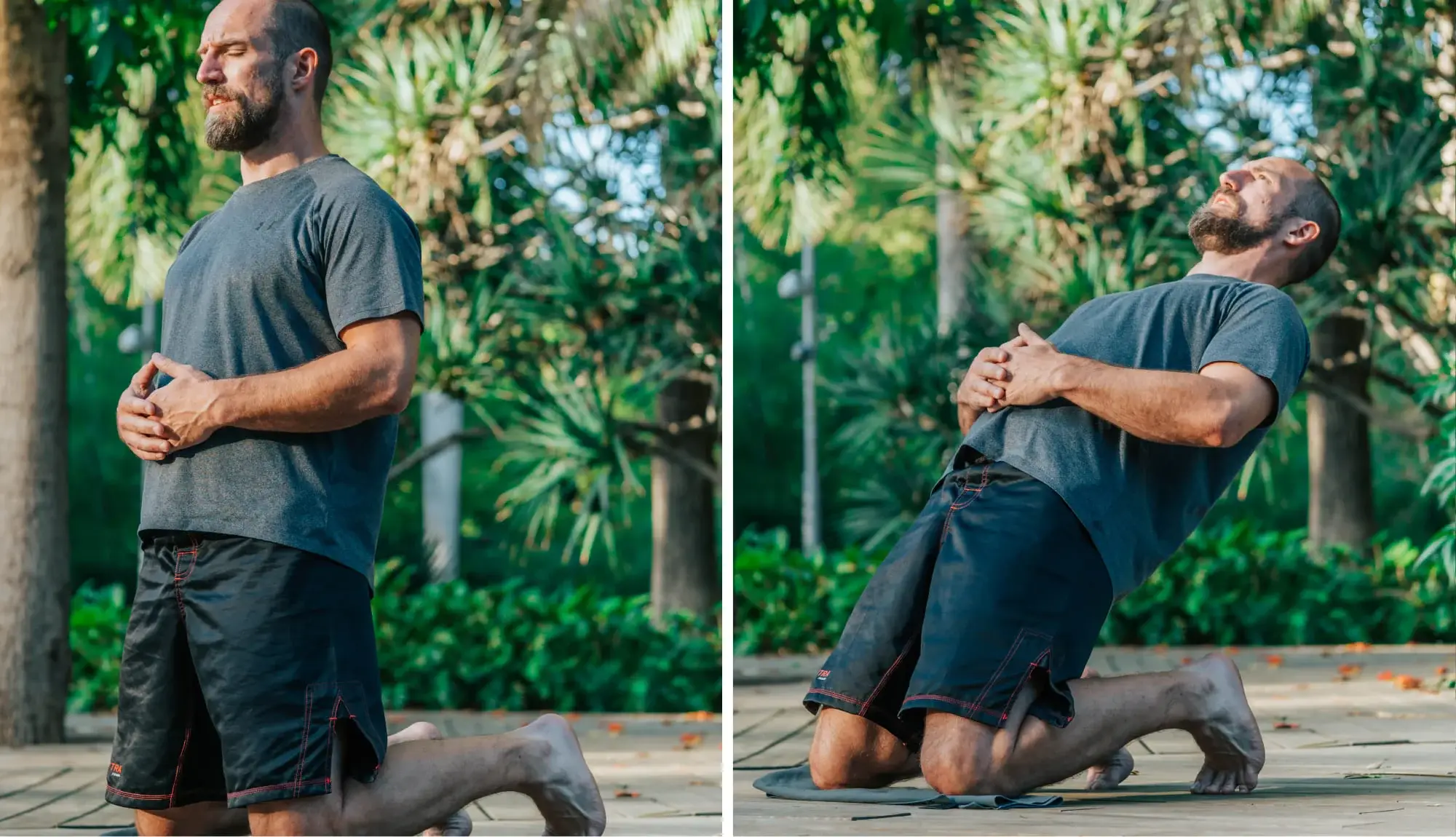
2. Kneeling Lean Backs
- Kneel on the tops of your feet.
- Engage your entire body and slowly lean back, then return to upright position.
- This targets the superficial front line — the fascia and muscles along the quads down to the shins.
- Do 10–20 slow, controlled reps for 1–2 sets. Quality is key.
3. Teardrop Squats
- Start in a narrow squat stance, lift your heels, and let your knees move far forward over your toes.
- You’ll reach deep flexion of the knee — ideal for real-world movement prep.
- Try 10–25 bodyweight reps for 1–2 sets.
4. Split Squats (Crescent Lunge Style)
- Step into a split position (like a yoga lunge). Keep your front heel down.
- Lower your knee forward until it’s past your toes, then push back up.
- Want to amplify it? Add dumbbells, a medicine ball, or a weighted vest.
- Start with 8–15 reps per leg, focusing on control and depth.
5. Inward Chair Pose Holds (Knees Forward and In)
- Stand with feet hip-width or wider. Squat down deeply into chair pose.
- Move your knees forward over your toes, then gently press them inward.
- This mimics a common injury risk angle — training it boosts resilience.
- Hold for 1 minute, rest for 1 minute. Repeat 3 rounds.
Pro Tip: “Don’t force the depth or angle. Move in a range that feels unconventional — but safe. Embrace the weird while respecting your body’s feedback,” says [Author Name].
6. 90/90 Performance Push-Ups
- Sit with one leg in front and one behind, forming 90-degree angles in both knees.
- Lean forward over your front leg. Use minimal hand support as you control the lowering and the rise.
- Advanced: Try it hands-free, or with arms behind your head for increased difficulty.
- Do 10–30 reps per side, for 2–3 sets. Use drop sets to reduce intensity gradually.
7. Resistance Band Knee Rotations
- Attach a resistance band to a stable anchor and loop around your foot.
- With the knee bent, rotate the shin inward or outward against the band’s pull.
- This directly targets ligament control and rotational capacity — often the missing link in knee strength.
- Start with 20–40 reps per direction, one leg at a time. Keep the movement small and precise.
If you’re new to rotational training, start with Knee CARs (Controlled Articular Rotations) and gradually introduce resistance once you find your baseline ROM (range of motion).
How Often to Train Your Knees
Building knee resilience doesn’t mean training them every day.
“I personally dedicate one day a week to my knee-specific routine,” says [Author Name].
This allows for adequate recovery while still providing frequent enough stimulus for adaptation. Aim to integrate 3–4 of these exercises into your weekly routine — even just 1–2 sets per session can yield big results over time.
Final Takeaway
Your knees aren’t fragile — they’re just undertrained in the ways you need them most. Rotation, deep flexion, awkward movement — that’s life. That’s sport. That’s play.
By training your knees to move better under load in the ranges you least encounter, you’re not only protecting yourself from future injury — you’re unlocking a stronger, more capable body.
Start slow. Go light. Focus on range. Progress from there. Small inputs, repeated consistently, can have a massive long-term payoff.
So walk backwards, squat deep, and give your knees the kind of love they’ve been waiting for.