At nearly 50 years old, Devon Larratt’s arms are still getting stronger.
A decorated Canadian Special Forces veteran and arm wrestling legend, Larratt isn’t just defying age—he’s redefining what’s physically possible. His iconic arms, carved from decades of focused training, aren’t just a product of brute strength. They’re the result of meticulous technique, years of injury-hardened resilience, and a level of discipline honed on and off the battlefield.
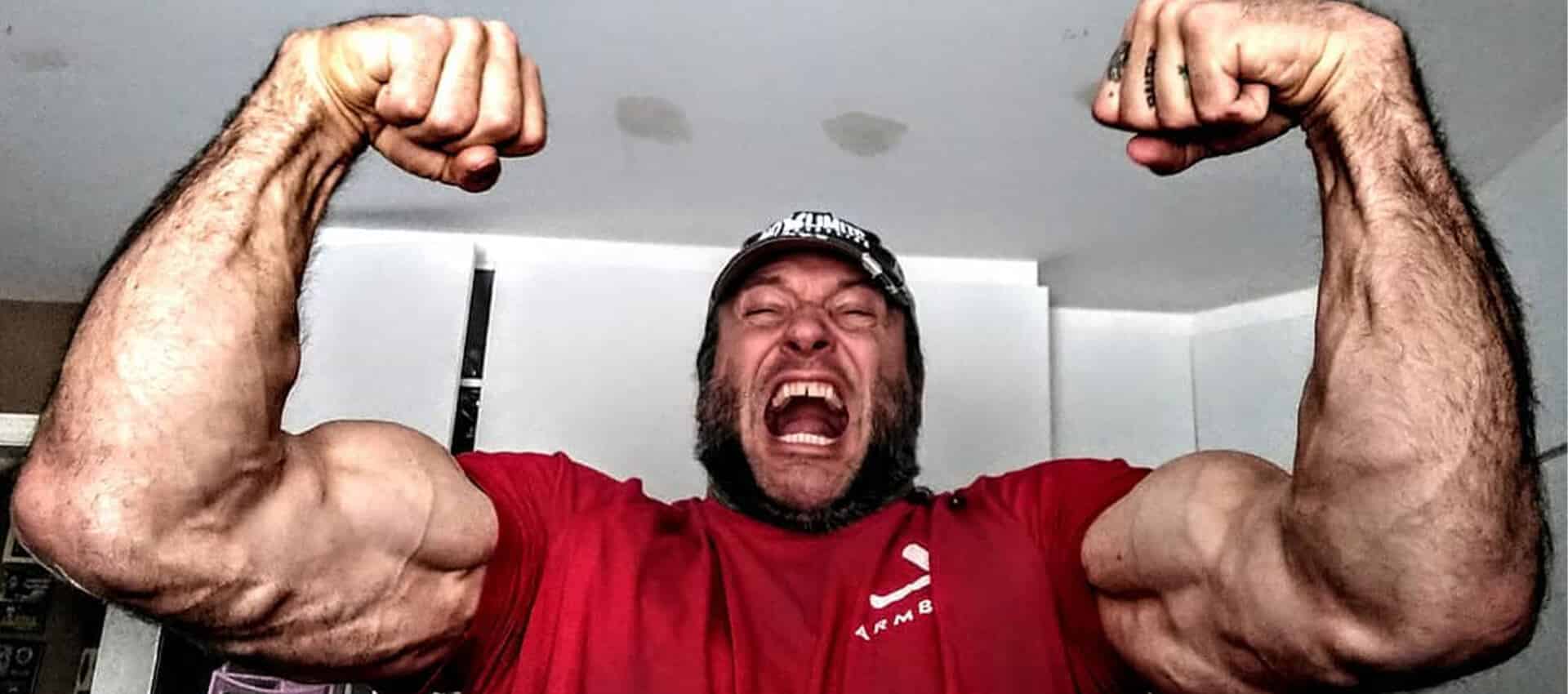
So how exactly does someone build the strongest arms in the world? Larratt opened the doors to his home gym to show exactly how.
Jump to:
- From Chores to Champion: An Unusual Start
- A Home Gym Built for War
- The Four Pillars of Arm Wrestling Strength
- Grip Training: Thumb Domination and Micro-Control
- Strength Alone Isn’t Enough
- Still Getting Stronger at 50
- The Toll of Battle—And Recovery
- Built Different: The Larratt Family Legacy
- What It Really Takes to Build the World’s Strongest Arms
From Chores to Champion: An Unusual Start
Larratt’s journey began in the most unexpected place—his grandmother’s kitchen table.
“I started arm wrestling with my grandmother when I was five or six,” he recalled. “It was a reward for doing chores.”
That innocent start led to a lifelong obsession. By 18, Larratt met a professional arm wrestler—and everything changed. He committed fully to the sport, even as his path led him into the Canadian military’s elite Special Forces unit.
During multiple tours in Afghanistan, he found ways to train under the harshest conditions, sometimes lifting makeshift weights in secret between missions. His military years would test not only his mental grit but also his physical limits—getting shot, surviving a helicopter crash, and still returning to the sport stronger than ever.
A Home Gym Built for War
Larratt trains out of his home in Ottawa, Canada—what he calls “Arm Wrestling Central.”
His gym isn’t fancy. There are no mirrors or designer equipment. Instead, the centerpiece is a custom-built arm wrestling table, retrofitted with a cable system and resistance bands. The table itself has history—it once belonged to Andrienne, a former world champion female arm wrestler. Larratt has used it for more than two decades.
“I do most of my work right here,” he said, gesturing to the table surrounded by floor weights and grip tools. “Everything I need is in this room.”
The setup is minimal by design. Each piece of equipment targets a specific aspect of arm wrestling mechanics, refined over years of experimentation. The gym isn’t just where Larratt trains himself—it’s where he’s preparing the next generation, including his two sons and even his daughter, who’s set to compete in a high school championship.
The Four Pillars of Arm Wrestling Strength
While many assume arm wrestling is all about bicep size, Larratt’s approach is highly specialized. His strength is built around four core movements, each training a different part of his arm and grip to dominate the table.
1. Rising
Rising refers to lifting the knuckles while gripping, increasing leverage and shifting pressure into the opponent’s fingers.
“This is what gives you hand control,” Larratt explained. “If you can rise while gripping, it’s like putting your opponent on a slope.”
2. Pronation
This motion—rotating the forearm outward—attacks an opponent’s wrist stability.
“When I pronate, I’m trying to roll you out and open your grip. It’s a small move, but it’s massive on the table.”
3. Back Pressure (Posting)
This is the pulling motion toward the body, helping maintain tight angles and avoid being extended.
“It’s the foundation of most techniques—if you can post and keep your elbow tight, you control the fight.”
4. Cupping
Cupping involves flexing the wrist inward, closing down on the opponent’s hand.
“This is where the crushing power comes from,” Larratt said. “It’s not just grip strength—it’s how you close the entire wrist around the hand.”
Grip Training: Thumb Domination and Micro-Control
Larratt spends hours working his thumb and finger strength using resistance bands, wraps, and tension-based holds.
One of his favorite drills: thumb compression. He wraps a band around his thumb and hand, then repeatedly closes and opens his grip while under tension.
“You do a few sets of these and your thumb just explodes in size and power,” he said.
He also uses a pinch-grip bar—a thick metal bar that’s notoriously difficult to lift with one hand. His sons began lifting it before they were even teenagers.
“I offered them $100 if they could lift it with one hand,” he said with a laugh. “They both got it by around 12 years old.”
Strength Alone Isn’t Enough
Despite being one of the strongest arm wrestlers in history, Larratt constantly emphasizes that strength alone isn’t what wins.
“Arm wrestling is like miniature martial arts,” he explained. “It’s not just about who’s stronger. It’s about who’s smarter, more precise, and better with timing.”
He demonstrated how tiny grip changes before the match even starts—like how high the thumb rests or how much “posting” pressure is applied—can make the difference between control and collapse.
In his words: “The match is halfway decided before they say ‘go.’”
Still Getting Stronger at 50
As most athletes wind down with age, Larratt feels like he’s still on the rise.
“I think I’m still getting stronger,” he said. “It takes a long time to build up the connective tissue in your hands, elbows, and wrists. Most people never get there.”
Instead of lifting heavier, Larratt trains smarter. He focuses on precision movement, neurological adaptation, and injury prevention. At this point in his career, every workout is designed with surgical intent.
He refers to it simply as “old man strength.”
The Toll of Battle—And Recovery
Larratt’s arms have endured a lifetime of trauma—on and off the table.
He’s suffered multiple injuries, including a torn bicep courtesy of Levan Saginashvili, the Georgian super-heavyweight widely considered the strongest arm wrestler on Earth.
Instead of hiding the injury, Larratt tattooed it with the words “Levan was here” and a tiny cat logo labeled “415,” referencing Levan’s weight at the time.
“War and sport—both leave marks,” Larratt said. “You either break, or you rebuild stronger.”
Built Different: The Larratt Family Legacy
Devon isn’t just building his arms—he’s building a dynasty.
Both of his sons, Milo and Myles, train with him regularly and already have the kind of hand strength most adults lack. His daughter, though less intense about the sport, still competes and is gearing up for a local high school championship.
“My hope is that these guys don’t make the same mistakes I did,” he said. “They’re starting with 30 years of knowledge I had to learn the hard way.”
It’s not just about titles or medals. “Even if there’s no belt, I’d still arm wrestle,” Larratt said. “It’s just what we do.”
What It Really Takes to Build the World’s Strongest Arms
Devon Larratt didn’t get to the top through size or hype. His arms were engineered over decades—built with discipline, refined with science, and tested in both combat and competition.
His advice to anyone chasing strength: “Focus on longevity. Build your hands and arms slowly, intelligently. Technique will take you where raw power can’t.”
At 50, Larratt stands as a living testament that strength isn’t born—it’s earned. And in his world, there’s always room to keep climbing.