In their latest deep-dive video, the team at Wod Science has done what no one else in the functional fitness world has managed to do: quantify mechanical power output in elite CrossFit athletes during a real workout.
Using cutting-edge wearable technology and biomechanics modeling, they’ve pulled back the curtain on what actually happens—scientifically—during a CrossFit Open workout. And the findings might shift how fitness is measured, programmed, and understood across the board.
“CrossFit defines fitness as increased work capacity across broad time and modal domains,” explains Koma, senior scientist at ETH Zurich and host of the Wod Science channel. “That sounds great, but until now, we’ve had no actual way to measure that work capacity in watts.”
That’s all changed.
(Full video below)
Jump to:
- A New Era: Tracking Power in Functional Fitness
- Elite Athletes Push 500+ Watts in 15-Minute AMRAPs
- Shorter vs. Taller: How Body Type Impacts Performance
- CrossFit vs. Cycling: Who Produces More Power?
- Elite Women in CrossFit Outpace Cycling Peers
- Burpees Generate More Power Than Dumbbell Movements
- The Average Joe vs. The Elite Machine
- Programming Bias? Taller Athletes at a Disadvantage
- Beyond VO₂ Max: Anaerobic Power as the New Metric
- Next Steps: Data-Driven Functional Fitness
- Final Thoughts: Redefining Fitness in Watts
A New Era: Tracking Power in Functional Fitness
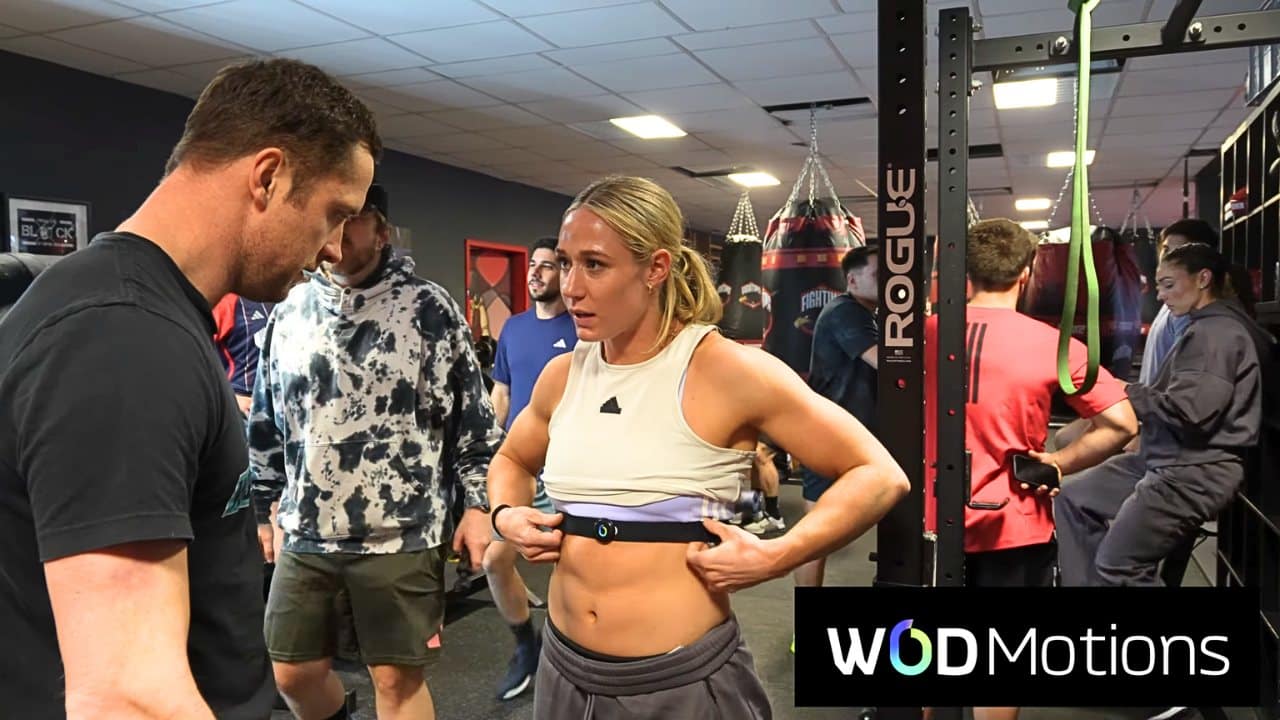
The experiment took place during CrossFit Open workout 25.1, a 15-minute AMRAP consisting of burpees over dumbbell, hang clean and jerks, and walking lunges. At Adidas HQ, a group of newly signed elite athletes were fitted with a small chest-worn device from What Motion, developed by Mariah Sabioni.
The device uses biomechanics-based modeling to calculate mechanical power, breaking down rep pacing, movement efficiency, and power output—all in real time.
No products found.
“This sensor is a game changer,” says Koma. “You just strap it on like a heart rate monitor, and suddenly you know your watts per rep, reps per minute, total work performed—all the things that have always been a black box in CrossFit.”
Elite Athletes Push 500+ Watts in 15-Minute AMRAPs
According to the What Motion data, male elite athletes were producing 450 to 500 watts on average during the full 15-minute workout. Female athletes came in between 320 and 360 watts.
To put that in perspective, that’s the kind of output typically seen in elite endurance athletes during high-effort intervals.
“We’ve never seen hard numbers on power in functional fitness before,” Koma says. “The fact that these athletes are putting up numbers similar to elite cyclists during time trials is mind-blowing.”
These aren’t peak numbers, either—they’re sustained averages. And the analysis gets even more compelling when comparing two top-tier athletes with different body types.
Shorter vs. Taller: How Body Type Impacts Performance
The Wod Science team compared two elite male athletes—one shorter, one significantly taller (by ~14 cm). During the first few rounds of the workout, both moved at nearly identical paces: 2.0–2.1 seconds per rep.
But the taller athlete had to produce significantly more power to keep up—630 watts compared to the shorter athlete’s 570 watts in round one.
No products found.
As the workout progressed and the rep schemes increased, the taller athlete’s pace slowed to 2.9 seconds per rep, while the shorter athlete maintained 2.4–2.5 seconds per rep.
That difference translated into 30 more reps for the shorter athlete—and a win on the leaderboard.
“This is a great illustration of how mechanical efficiency, not just raw power, determines success in these workouts,” says Koma. “The shorter range of motion allowed the athlete to cycle movements faster and with less energy cost per rep.”
CrossFit vs. Cycling: Who Produces More Power?
To better understand how elite CrossFit athletes stack up against other endurance athletes, Wod Science turned to cycling data from the Giro d’Italia, one of the world’s most grueling races.
- Pro cyclists (~64 kg average) sustain 370 watts over 10 minutes
- That’s 5.78 watts per kilogram
In comparison:
- The shorter elite CrossFit athlete hit 5.84 watts per kilogram
- The taller athlete came in at 4.94 watts per kilogram
While top cyclists like Jonas Vingegaard and Tadej Pogačar can reach 6.7–6.8 W/kg on short hill climbs, the CrossFit numbers still impress—especially considering the full-body, mixed-modal nature of the movements.
Elite Women in CrossFit Outpace Cycling Peers
Wod Science also evaluated power data in elite female athletes and compared it to published cycling performance metrics.
No products found.
- Female cyclists (~59 kg average) average 248 watts over 10 minutes
- That’s around 4.2 W/kg
- Elite CrossFit female: 356 watts, with a higher W/kg score
Kristen Faulkner, an Olympic-level cyclist, reportedly averages 338 watts—but weighs considerably less, meaning her relative power output is still higher.
Still, the narrow gap between elite CrossFitters and Olympic cyclists surprised even the researchers.
Burpees Generate More Power Than Dumbbell Movements
One of the more unexpected findings from the analysis: burpees over the dumbbell generated higher average wattage than the hang clean and jerk.
Despite being a bodyweight movement, burpees required rapid full-body coordination, explosiveness, and constant pacing—leading to power outputs of 650+ watts in sprint rounds.
The dumbbell movement, while adding resistance, involved shorter vertical displacement and primarily upper-body effort, leading to slightly lower average power outputs.
“People hate burpees for a reason,” Koma laughs. “They’re absolutely brutal—not just metabolically, but mechanically too.”
The Average Joe vs. The Elite Machine
Koma also ran the workout himself—strapped into the same sensor—to compare how an average, trained athlete stacks up against the pros.
No products found.
- Elite pacing: 2.5–2.7 sec/rep
- Koma’s pacing: 4.0–5.1 sec/rep
- Elite power: 450–500W
- Koma: 300W average
Interestingly, a shorter recreational athlete beat Koma in reps (by 12.8%) despite producing 6% less power overall, showing how anthropometrics and rep efficiency can significantly affect performance.
“If the workout had involved weighted movements with greater range, I’m confident I would have pulled ahead,” says Koma. “But it shows how movement selection affects leaderboard outcomes—something worth considering in programming.”
Programming Bias? Taller Athletes at a Disadvantage
The data makes a strong case for revisiting movement selection in programming, especially for tests like the CrossFit Open.
The taller elite athlete in the study had to output more power per rep yet still lost on reps due to slower cycle speed and longer movement paths.
“This is something Dave Castro should think about,” Koma notes. “If the Open workouts disproportionately penalize taller athletes, maybe it’s time to balance that out.”
Beyond VO₂ Max: Anaerobic Power as the New Metric
Another takeaway? These CrossFit athletes aren’t just aerobically fit—they’re anaerobic machines.
Many sustained power levels above their estimated lactate threshold, suggesting that anaerobic capacity and buffering ability are major performance drivers in functional fitness.
“Their VO₂ max might not be elite-endurance high, but their ability to sustain output above threshold is exceptional,” Koma says.
This insight could influence how CrossFit athletes train—shifting more focus to anaerobic conditioning, lactate clearance, and movement economy over just long aerobic base work.
No products found.
Next Steps: Data-Driven Functional Fitness
The Wod Science team plans to continue exploring performance through a data lens, with upcoming seminars, workshops, and real-time testing in cities like Berlin.
Athletes and coaches will get hands-on exposure to:
- Lactate threshold testing
- Biomechanical power analysis
- Polarized training strategies
- Interference effects in hybrid training
“We’re trying to bridge the gap between exercise science and real-world CrossFit,” says Koma. “For the first time, we can take lab-grade data into the gym—and back it up with performance results.”
Final Thoughts: Redefining Fitness in Watts
CrossFit’s original definition of fitness—work capacity across broad time and modal domains—was philosophical. Now, it’s measurable.
And based on the data, elite CrossFit athletes are some of the most powerful performers in sports. Not just because of how much they lift, or how many reps they do—but because of how efficiently they can produce and sustain real mechanical power.
“This is just the beginning,” says Koma. “We finally have the tools to measure the invisible. And the more we look, the more we’ll understand what true fitness really is.”
If you’re into CrossFit, sports science, or performance data, this is a moment to pay attention.
The era of data-driven functional fitness is here.
No products found.