Running destroys knees—or so the old wives’ tale goes.
Physical therapists hear it constantly from worried patients limping into clinics, convinced their favorite sport is grinding their joints into dust.

But here’s what science actually says: running makes knees stronger, not weaker.
Kate Mihevc Edwards, a physical therapist specializing in running injuries, recently debunked this persistent myth in an article for Outside Run—and shared exactly how runners can bulletproof their knees against actual causes of pain.
Jump to:
Research Flips the Script on Running and Joint Health
Multiple studies over recent years have demolished the notion that running wears out knees. A 2017 meta-analysis revealed that runners actually had lower rates of knee and hip osteoarthritis compared to non-runners.
Even more compelling? Research from 2023 found no difference in knee osteoarthritis prevalence among runners logging vastly different weekly mileages versus sedentary controls.
Edwards explains that running creates beneficial stress on joints. Each footstrike improves circulation of synovial fluid—the slippery substance that lubricates and nourishes cartilage.
Every time you run, you are loading your bones and using your muscles and tendons, making them stronger.
Loading builds resilience in bones, muscles, and connective tissue. Rather than breaking down knees, running actually fortifies them.
If Running Doesn’t Hurt Knees, Why Does Knee Pain Happen?
Here’s the paradox: while running strengthens knees, roughly 50% of all running injuries involve knee pain. IT band syndrome, patellofemoral pain, meniscus issues—runners experience them all.
According to Edwards, nearly every case traces back to three culprits: poor movement control, questionable training decisions, and inadequate strength.
The knee becomes the victim of problems originating elsewhere in the kinetic chain—weak hips, unstable cores, undertrained quadriceps.
Detective Work: Finding Your Pain Trigger
Before panicking about permanent damage, Edwards recommends investigating training history over the previous three months. She suggests asking yourself these revealing questions:
- Did weekly mileage suddenly spike?
- Was a new workout type introduced—hills, speedwork, trails?
- Has life or training stress intensified recently?
- Is caloric intake sufficient for current training volume?
- Are sleep hours adequate for recovery?
- Does strength training exist in the routine?
Often, honest answers reveal obvious culprits. Training errors cause most knee complaints, not structural deficiencies in the joint itself.
Dial back volume, address life stressors, prioritize sleep, or add calories—sometimes solutions are simpler than expected.
For persistent issues where squatting feels agonizing, consulting a running-focused physical therapist becomes essential. They’ll analyze gait mechanics and build comprehensive plans addressing strength, mobility, and training habits.
Strength Training: Not Optional Equipment
Edwards emphasizes that protecting knees requires legitimate strength work—not just bodyweight exercises or resistance bands (though both have value).
Progressive loading with actual weights is non-negotiable. No single magic exercise fixes everything either.
Comprehensive knee protection demands addressing hip strength, rotational control, quadriceps power, and core stability simultaneously.
The 7-Minute Knee-Bulletproofing Routine
Edwards designed a time-efficient routine targeting all critical areas. Each exercise serves specific purposes while building overall resilience.
Standing Clam: The Multi-Tasker
3 sets of 15 reps per side
This deceptively simple move activates the gluteus medius—critical for quadriceps function and safe knee control. It simultaneously builds single-leg strength, rotational stability, pelvic control, and proper foot positioning.
Loop resistance band above knees. Stand on one leg with slight bend, place opposite foot against wall with knee at same height. Pull knees apart while maintaining balance and foot arch.
Both hips should fire intensely. Hold onto something if balance wavers, but only separate knees as far as pelvic control allows.
Elevated Heel Squats: Quad Power
3 sets of 8-12 reps
Elevating heels eliminates ankle mobility limitations that compromise squat form. This variation hammers quadriceps while improving hip depth and power output.
Place weight plates, dumbbells, towels, or wedges under heels. Hold kettlebell at chest height, knees pointing forward. Inhale deeply, then exhale while descending slowly—no rushing allowed.
Lower until knees align with hips at approximately 90 degrees. Start with zero weight and progressively increase load over weeks.
Single-Leg Romanian Deadlifts: Hamstring Gold Standard
3 sets of 10 reps per side
Running happens on one leg at a time, making unilateral exercises essential. Recent research identifies RDLs as the premier exercise for building unilateral hamstring strength in runners.
Balance on one leg, pressing into all four foot corners while maintaining arch with slight knee bend. Hold kettlebell in opposite hand.
Hinge forward slowly, extending non-standing leg backward with toes pointing down. Keep hips level and facing floor. Reach kettlebell toward standing foot.
Entire standing leg should engage—if lower back feels it instead, hip hinge needs adjustment.
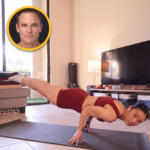
Side Plank With Leg Lift: Core and Hip Fusion
3 sets of 5 reps per side with 5 rotations each
This modified side plank builds core and hip stability while introducing rotational control—critical for maintaining form when fatigued.
Bend bottom knee into modified side plank position, elbow directly under shoulder. Straighten top leg and lift while reaching through heel.
Press into bottom knee, elevate hips high, avoid sticking butt out. Raise top arm skyward, then rotate down by threading arm between hip and elbow. Return to starting position.
Trunk position should remain rock-solid throughout rotations.
Consistency Trumps Intensity
Edwards stresses that true strength gains require consistency and progressive overload—not sporadic heroic efforts. TheraBands and bodyweight exercises provide value, but actual weights must enter the equation for meaningful adaptation.
This seven-minute routine addresses every critical component: hip strength, rotational control, quadriceps power, and core stability. Performed regularly with gradually increasing loads, it transforms knees from vulnerable joints into resilient powerhouses.
Running doesn’t destroy knees—inadequate preparation does. Armed with evidence-based training strategies and targeted strength work, runners can log miles for decades without fear of grinding their joints into oblivion.
The myth deserves retirement. Knees were built to run.