
For years, medical dogma held that testosterone accelerated prostate cancer growth—a belief so entrenched that doctors refused to prescribe it to men with the disease.
The logic seemed bulletproof: prostate cells depend on androgens, so more testosterone should mean more cancer.
But when researchers actually measured what happens at the cellular level as testosterone rises, they discovered something that upended decades of assumptions.
What they found reveals not just a major shift in prostate cancer treatment—but exposes why the entire wellness industry’s “optimize your testosterone” pitch might be built on a fundamental misunderstanding of human biology.
Jump to:
- The Saturation Model: Why More Testosterone Doesn’t Always Mean More Effect
- Libido Plateaus Far Below “Optimal” Levels
- Muscle Growth: Where the Data Gets Complicated
- The Patient Every Clinic Sees: 480 ng/dL and Convinced He Needs 900
- The “Optimize Your Testosterone” Marketing Hook
- When Higher Testosterone Reflects Better Health—Not Causes It
- The Bottom Line: Normal Range Means You’re Probably Fine
The Saturation Model: Why More Testosterone Doesn’t Always Mean More Effect
Scientists expected prostate signaling to climb steadily with rising testosterone levels. Instead, they hit a ceiling.
Above roughly 250 ng/dL, pushing testosterone higher produced no additional PSA rise and no detectable increase in prostate cancer incidence over decades of follow-up.
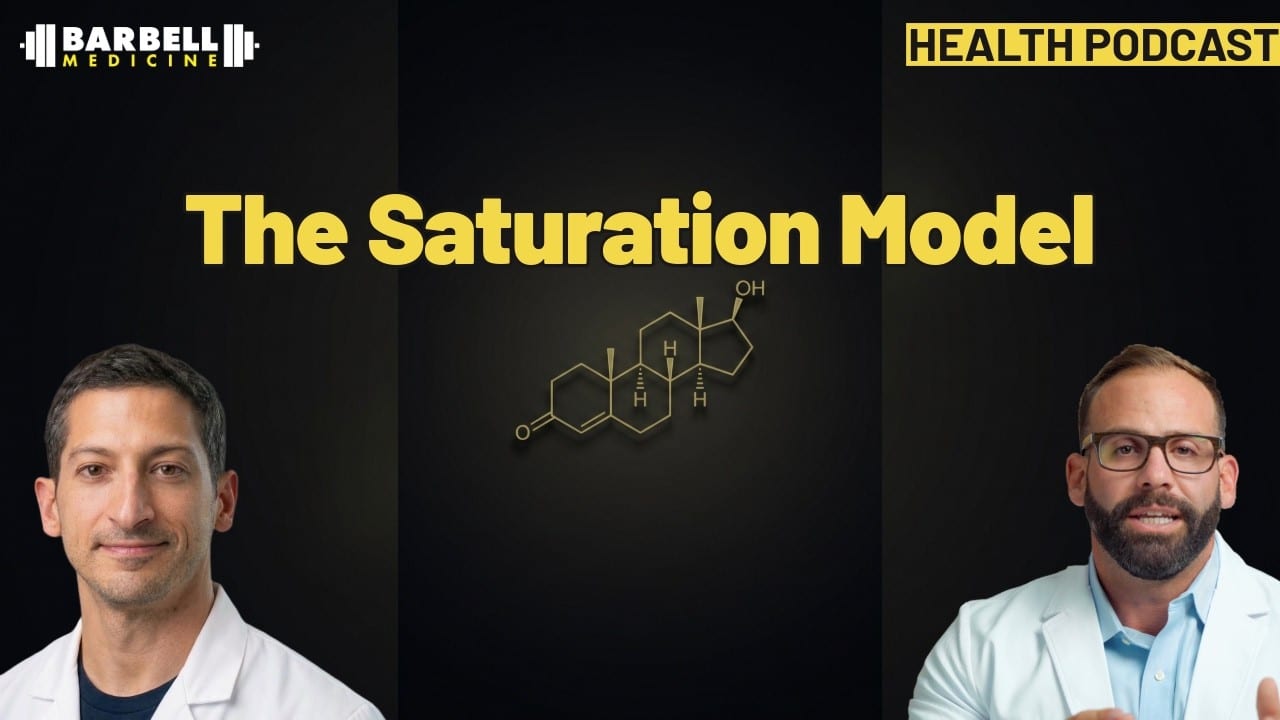
This phenomenon is called the saturation model. Below the threshold, testosterone drives cellular activity. Once you cross it, androgen receptors are already occupied—adding more testosterone to the bloodstream produces no additional response.
Prostate tissue isn’t unique. Researchers wanted to know: which other androgen-dependent tissues behave the same way?
Libido Plateaus Far Below “Optimal” Levels
When scientists examined libido using large datasets like Framingham and HIM, they found the same plateau effect.
Sexual desire increases with testosterone up to approximately the bottom of the reference range—then it flattens.
That means a guy with a testosterone level of 600 is not more libidinous than a guy at 400.
Translation: a man at 800 ng/dL doesn’t get better erections than someone at 500.
Within normal physiological ranges, higher testosterone doesn’t translate to enhanced sexual function. The receptor saturation model applies here just as it does in prostate tissue.
Muscle Growth: Where the Data Gets Complicated
Dose-response trials dating back to the late 1990s gave young men graded testosterone doses—up to 600 mg per week.
Lean mass and strength climbed across the entire range tested. Higher dose equaled more muscle.
But there’s a critical catch: those are supraphysiological doses that cannot be achieved naturally. 600 mg weekly is roughly three to six times what standard TRT prescriptions deliver.
Within normal physiological ranges—the target good clinicians aim for when treating testosterone deficiency—the additive effect on muscle is small to nonexistent.
Exercise Alone vs. Testosterone Plus Exercise
A 12-week trial tested standard transdermal testosterone in men with low-to-low-normal levels.
Adding testosterone to structured exercise didn’t produce more lean mass or strength gain than exercise alone.
Why? Direct measurements reveal that intramuscular androgen exposure doesn’t scale with blood testosterone the way most assume.
Muscle fibers regulate their own local androgen environment. This explains why men and women see similar relative improvements in strength and muscle mass from exercise—despite men having 10 to 20 times higher circulating testosterone.
Intramuscular androgen exposure between sexes is much closer than serum levels suggest. Muscle tissue can produce androgens locally from precursors like DHEA.
Testosterone Levels Don’t Predict Strength
A 2025 NHANES analysis of adult men found no correlation between serum testosterone and measured strength.
There was a cross-sectional association with muscle mass, but that relationship runs both directions. Men with more muscle tend to have less fat, better metabolic health, and higher SHBG—all of which raise testosterone readings independent of any causal effect on muscle.
The finding that holds up: strength dissociation. Pushing testosterone higher doesn’t push strength higher.
The Patient Every Clinic Sees: 480 ng/dL and Convinced He Needs 900
Imagine a man walks into a clinic. His total testosterone is 480 ng/dL—right in the middle of the reference range.
But he’s convinced 900 is the target to “optimize.”
How should a clinician respond without sounding condescending?
Hey, tell me the context here. Why was this checked in the first place? Did you have any symptoms that were concerning to you? Like, what’s the goal here that we’re trying to achieve?
Most patients don’t need a deep dive into the saturation model. Instead, clinicians focus on belief change—understanding what’s driving the conviction that a higher number equals better health.
Questions That Reframe the Conversation
- What symptoms prompted testing? Many men have no complaints—just a number they’re chasing.
- What’s the ultimate goal? Better gym performance? Improved libido? More energy?
- Could other factors be at play? Fatigue might stem from iron deficiency, sleep apnea, or even undiagnosed colon cancer causing anemia—not low testosterone.
Testosterone levels represent a person’s natural equilibrium based on production rate, receptor sensitivity, and SHBG levels. A reading of 480 might be exactly where that individual’s biology settles.
If the person has no signs or symptoms whatsoever and has a testosterone level of 480, then they under no circumstance do they meet criteria for testosterone deficiency that would merit hormone therapy. If the person is adamant and they really want to get that level of 900, then they’re basically saying, ‘I would like to use anabolic steroids.’
The “Optimize Your Testosterone” Marketing Hook
Wellness clinics often advertise testosterone optimization as if there’s a magic number everyone should hit.
Some explicitly target 800 to 900 ng/dL. Others use vaguer language: “We’ll find your optimal level where you feel best.”
Both approaches miss critical nuance. There’s no single best level. Experiences attributed to testosterone—fatigue, gym performance, sexual health—are multifactorial.
The less specific the symptom, the less a single number reflects it.
The Glucose Analogy
Imagine substituting testosterone with glucose in optimization marketing. What’s the “optimal” glucose level?
Obviously, glucose fluctuates based on fasting status, food intake, activity, sleep, and dozens of other variables.
Yeah, turns out it’s the same thing here.
Testosterone varies minute-to-minute, hour-to-hour, day-to-day. A single blood draw is just a snapshot—not a comprehensive picture of androgen exposure over time.
If continuous testosterone monitors existed (like CGMs for glucose), people might recognize how much natural variability occurs and place less stock in hitting arbitrary targets.
When Higher Testosterone Reflects Better Health—Not Causes It
Within normal physiological ranges, there’s little correlation between higher testosterone and better outcomes for nonspecific symptoms.
However, achieving higher levels often reflects improved health habits:
- Reduced visceral fat
- Increased physical activity
- Better sleep quality
- Strong interpersonal relationships
- Health-promoting diet
These behaviors improve metabolic health, lower body fat, and raise SHBG—all of which can elevate testosterone readings.
Rather, getting to a higher level generally reflects better health, and so, you don’t need a testosterone lab value to get you to do that stuff.
You should pursue those habits regardless of your testosterone number. A lab test isn’t necessary motivation—though if it functions as a behavior change tool, testing is inexpensive.
The real concern? People get abnormal readings, spiral into unnecessary workups, and potentially receive inappropriate treatment.
The Bottom Line: Normal Range Means You’re Probably Fine
Testosterone replacement therapy has legitimate medical uses for men with true deficiency and corresponding symptoms.
But chasing arbitrary “optimal” levels within or above normal ranges doesn’t deliver promised benefits for libido, strength, or overall vitality.
The saturation model demonstrates that androgen-dependent tissues hit a ceiling. Beyond that threshold, more testosterone in the bloodstream doesn’t translate to enhanced cellular signaling.
If you’re in the normal physiological range with no specific symptoms, you likely don’t have testosterone deficiency. Focus energy on evidence-based health behaviors instead of medicalizing a number that reflects natural biological variation.
And if wellness marketing promises to “optimize” your testosterone? Ask what outcome you’re actually trying to achieve—and whether the science supports testosterone as the lever to get you there.