Struggling to focus? Finding yourself endlessly scrolling without even realizing it?
You’re not alone—and it’s not just sophisticated algorithms hijacking your attention.
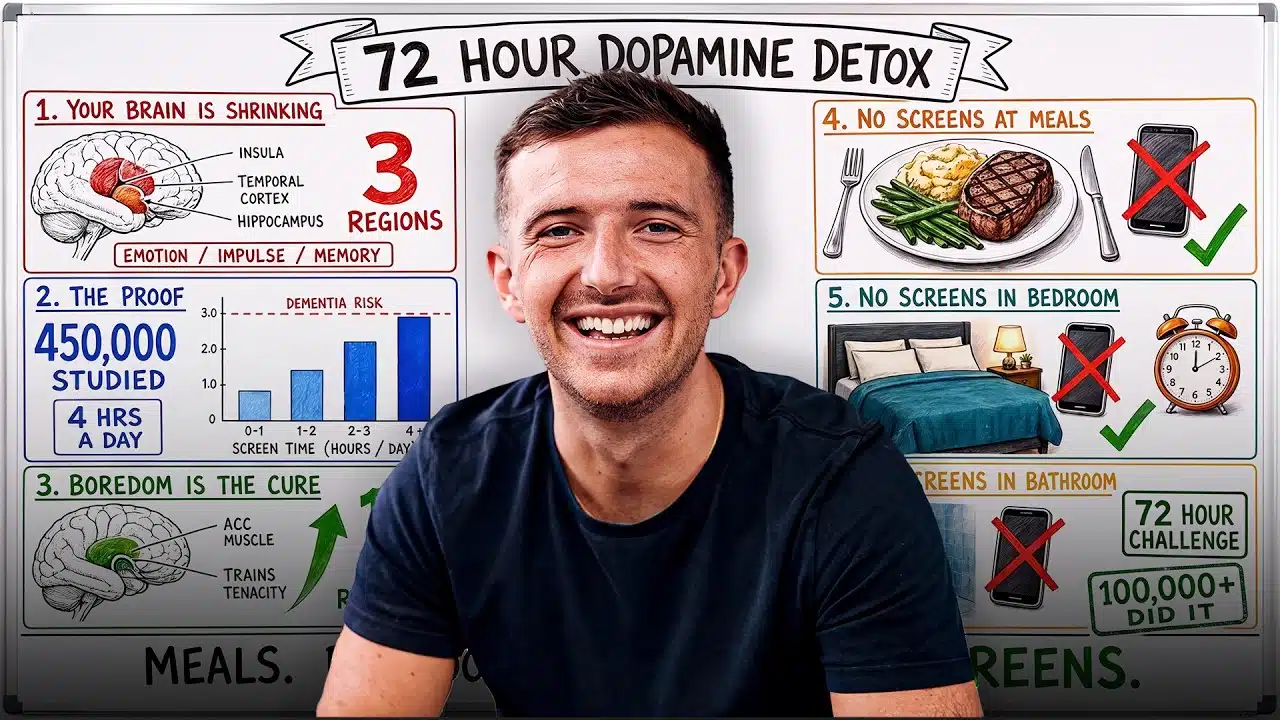
According to neuroscientist and best-selling author TJ Power, this phenomenon was predicted nearly 200 years ago, and modern neuroscience now confirms what’s really happening inside your brain.
In a recent video, Power breaks down the science of “brain rot” and offers a surprisingly simple 72-hour challenge that could reverse years of cognitive decline.
Jump to:
A 200-Year-Old Prediction Coming True
In 1854, Henry David Thoreau retreated to a cabin in the woods and made a startling prediction. He observed that society was beginning to prefer fast-moving, trivial ideas over deep thought.
Thoreau believed this shift, if left unchecked, would lead to what he called “a collective cognitive decline.” Nearly two centuries later, neuroscience is proving him right.
A major new study has found that people with smartphone addiction are experiencing accelerated decline in gray matter across three critical brain regions: the left insula, temporal cortex, and hippocampus. These areas control emotion regulation, impulse control, and memory processing.
This is what brain rot really is. It’s your brain losing the ability, losing the strength to do hard things because it’s no longer being challenged in the correct way.
What Brain Rot Actually Does to You
Power, who received his first iPhone at age 11, spent over a decade trapped in what he describes as constant phone distraction. As technology became increasingly sophisticated at triggering dopamine responses, the addiction only intensified.
The impact goes far beyond occasional distraction. Research involving over 450,000 people found that four hours per day of leisure-based screen time is directly connected to premature cognitive decline—including increased dementia risk.
But there’s encouraging news. Another major study discovered that a specific digital detox can effectively erase 10 years of age-related cognitive decline, specifically in sustained attention.
The Missing Ingredient: Sustained Attention
Sustained attention is the opposite of brain rot. It’s your ability to keep focus on one task without constantly seeking the next dopamine hit.
Right now, while reading this, you might feel urges to check WhatsApp, email, Instagram, or watch short-form videos. That impulse isn’t weakness—it’s your brain responding to years of conditioning.
Through his research lab, Dose Lab, Power has guided over 108,000 people through experiments designed to rebuild brain strength and capacity. One particular challenge has shown remarkably powerful effects.
The 72-Hour “Meals, Bedroom, Bathroom” Challenge
Power’s solution is deceptively simple but undeniably challenging: avoid screens in three specific contexts for 72 hours.
- Meals: No screens while eating
- Bedroom: No screens in your sleeping space
- Bathroom: No screens during bathroom breaks
This is going to be hard. That’s the whole point. The only way to create a brain that isn’t rotting is to do hard things.
Why Meals Matter
Power admits he reached a point where he physically couldn’t eat food unless YouTube was playing simultaneously. Sound familiar?
Eating without screens forces your attention back to a single activity. The boredom you’ll feel isn’t a problem—it’s the cure. Boredom is where recovery happens.
Just like muscle growth requires pushing through discomfort at the gym, building sustained attention requires resisting that urge to seek distraction.
The Bedroom Battle
Most people have elaborate justifications for keeping screens in their bedroom: emergency calls, alarm clocks, sleep sounds. Power has heard them all—and experienced them himself.
After guiding over 100,000 people to remove phones from their bedrooms, he’s never received a single email about a genuine emergency that was missed. Emergency services handle true emergencies. We create illusions to justify our screen dependency.
Practical solutions exist for every excuse:
- Place your phone outside the room to use as an alarm
- Purchase an inexpensive alarm clock
- Adjust your sleep schedule to wake naturally
For those dependent on sound to fall asleep, Power recommends a 9:30 PM shower routine—ideally in near-darkness to begin “input fasting.” After a hot shower, your body naturally cools down, which promotes sleep. Then simply lie in bed, thinking grateful thoughts, patiently training your brain.
Breaking the Bathroom Habit
Power describes his own bathroom-phone relationship with refreshing honesty: toilet time became an excuse to scroll mindlessly, often spending 10 minutes consuming content he couldn’t even remember afterward.
Without screens, you’re forced back to the experience of childhood—looking around, reading soap bottles, actually being present. These moments reset your brain.
Why Boredom Is Actually the Solution
Modern culture treats boredom as a signal to seek stimulation. Power argues we should see it differently—as a training ground for attention.
Every time you sit with boredom instead of reaching for distraction, you strengthen your anterior mid-cingulate cortex (AMCC). This brain region, located deep in the center of your brain, is often called the “tenacious part” that wills you to do difficult things.
When your AMCC grows stronger, that determination spreads to every area of life where you need willpower and focus.
The Stakes Are Higher Than You Think
Beyond immediate focus problems, chronic screen overuse affects three fundamental capacities:
Emotion regulation: Instead of stable moods, you experience constant ups and downs—happy, then depressed, then happy again as dopamine crashes and spikes.
Impulse control: Any meaningful goal—career advancement, financial stability, health improvements—requires sustained attention and determination. Short-form content trains you to be the opposite: unable to watch even a 14-second video without skipping ahead.
Memory: The connection between excessive screen time and premature dementia risk is now documented in large-scale studies. Power watched his grandmother suffer through dementia and emphasizes this isn’t a minor concern.
Why Now Is the Time to Act
Perhaps most urgently, Power warns that today is the easiest it will ever be to break screen addiction.
As artificial intelligence becomes increasingly sophisticated at delivering perfectly personalized content, breaking free will only get harder. Five years from now, the difficulty will be exponentially greater.
Can you be the person that takes on the 72-hour meals, bedroom, bathroom challenge, and teach yourself that you have control over your machine, and empower yourself with the freedom that these machines are amazing tools, but they can either imprison you or liberate you.
How to Actually Do This Challenge
Power recommends enlisting support—a partner, roommate, or friend who can take the challenge alongside you. Accountability increases success rates dramatically.
Remember, this isn’t a lifetime commitment. It’s a 72-hour experiment to see if you experience measurable improvements in focus, mood stability, and mental clarity.
Every time difficulty arises—sitting at a meal without distraction, lying in bed without a screen, being alone with your thoughts—remind yourself that you’re actively strengthening neural pathways. You’re choosing liberation over imprisonment.
Many people watch videos about improving focus and attention, think “I should really do that,” then continue scrolling. Power himself admits he did the same for a decade.
The question isn’t whether this challenge sounds appealing or convenient. The question is whether you’re willing to actually do something different—to choose the harder path that leads somewhere better.