Drop sets have long been touted as a time-saving shortcut to muscle growth, but can they really deliver the same hypertrophy as traditional straight sets?
A groundbreaking new study involving trained lifters puts this popular technique to the test—and the results might surprise you.
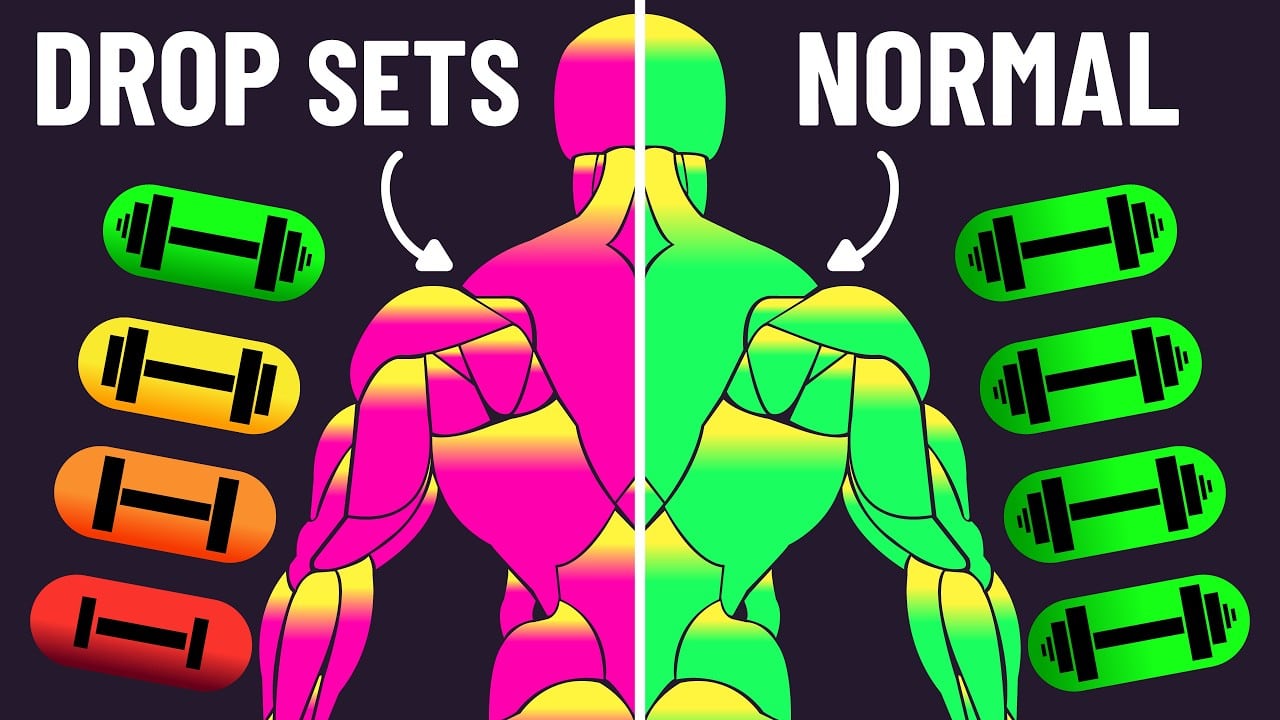
The research explores whether strategic load reductions can match conventional training for biceps and lat development, all while slashing gym time by more than half.
For anyone juggling a busy schedule but refusing to compromise on gains, these findings offer a practical roadmap.
Jump to:
The Study Design: Drop Sets vs. Normal Sets
Researchers recruited 29 trained individuals averaging 7.6 years of lifting experience for a 10-week experiment. Each participant had one arm randomly assigned to drop sets and the other to traditional straight sets—a clever within-subject design that controls for individual variation.
The exercises? Preacher curls and kneeling lat pulldowns, both performed on an electromagnetic cable machine two to three times weekly.
The normal set arm completed four sets of 8-12 reps to momentary failure on preacher curls and two sets on pulldowns. Every rep featured maximal intended velocity on the concentric phase with controlled eccentrics. Loads adjusted across sessions to maintain the target rep range.
The Drop Set Protocol Explained
The drop set arm performed two “drop series” on preacher curls and one on pulldowns. Subjects started with their 8-12 rep max load, then the machine automatically reduced weight by 8% whenever concentric velocity dropped 20% from the fastest rep.
This ingenious design ensured most repetitions occurred within two reps of failure—maximizing the proportion of hard, growth-stimulating work.
Typically, participants performed one to three reps between load reductions, with total reps per drop series ranging from 16 to 24. The load dropped approximately four times per series, creating extended mechanical tension without traditional inter-set rest.
The Results: Practically Identical Growth in 60% Less Time
Elbow flexor muscle thickness—encompassing both biceps and brachialis—increased in both conditions. Normal sets showed slightly greater gains, but the difference was minuscule and fell within measurement error.
The researchers concluded the results were practically equivalent.
Here’s where it gets interesting: drop set sessions lasted 10 fewer minutes—a 60% reduction in training time. When calculating hypertrophy per training minute, drop sets emerged as the clear winner for efficiency.
Overall, these results indicate that drop sets can be an excellent time-efficient method for muscle hypertrophy.
Important Study Limitations
Training was only semi-supervised, with participants keeping logs and receiving periodic check-ins. Subjects reported significant discomfort during drop sets, which could have led to submaximal effort—potentially explaining the numerical difference in growth.
Additionally, Tonal Systems funded the research and provided devices for participants to keep. While this doesn’t necessarily compromise results, transparency demands acknowledgment.
That said, the study design and statistical analysis remain sound. The authors have contributed to multiple respected meta-analyses on training volume, frequency, and proximity to failure.
What the Broader Research Shows
Two meta-analyses have compared drop sets to normal sets for hypertrophy, each combining five studies. Both found fairly similar muscle growth between approaches, aligning with the new findings.
Unlike the recent study, all five papers in these meta-analyses used conventional equipment—making their conclusions more directly applicable to typical gym-goers. One analysis reported drop sets generally decrease training time by 30-70%, though protocols varied considerably.
The Most Time-Efficient Drop Set Style
Research by Fink and colleagues demonstrates the power of single-set, multiple-drop protocols. They recruited 16 untrained men for triceps pushdowns over six weeks.
One group performed three straight sets to failure with a 12-rep max load. The drop set group performed one set to failure, immediately dropped load by 20%, continued to failure, then repeated once more.
Triceps cross-sectional area increases didn’t differ significantly—though interestingly, they favored drop sets. Training time plummeted dramatically.
Similarly, Ozaki and colleagues had nine untrained individuals train dumbbell curls with one arm doing high-load sets, another low-load sets, and a third arm doing drop sets. The drop set protocol involved starting at 80% one-rep max, then reducing load by 15% four consecutive times, training to failure each round.
Elbow flexor growth was practically identical across all three conditions, yet drop sets required substantially less time.
Less Efficient Drop Set Variations
Some studies used drop set protocols that save less time. One example involved trained individuals performing three lower-body exercises with drop sets structured as multiple sets with single load reductions per set—rather than one extended set with multiple drops.
While still effective, this approach doesn’t maximize time savings like the Fink and Ozaki protocols.
What About Strength and Endurance?
The newest study didn’t examine strength or endurance adaptations, but meta-analytic data provides insights.
Strength Gains: The Nuanced Picture
Fascinatingly, one meta-analysis found no significant difference in strength increases between drop sets and normal sets. However, context matters enormously.
Maximizing one-rep max strength benefits from heavier loads. In several studies, normal set conditions used slightly lighter peak loads than optimal—potentially suppressing strength gains. Had they trained heavier, results might have differed.
Additionally, within-subject designs (training opposite limbs differently) may confound results through cross-education effects, where strength gains transfer between limbs. Notably, muscle growth doesn’t transfer, making this design perfect for hypertrophy research but potentially problematic for strength studies.
While drop sets clearly build strength effectively, normal sets likely hold an edge for maximizing one-rep max performance.
Muscular Endurance: Drop Sets Shine
Though meta-analytic data doesn’t exist, individual studies measuring rep performance at given percentages of one-rep max show drop sets typically produce larger endurance increases.
One exception: Ozaki’s study found normal sets with lighter loads actually produced greater endurance gains than drop sets. However, this represents just one small investigation.
Practical Training Recommendations
All existing drop set research involves training one or just a few exercises. Performing drop sets for every movement in your program is debatable due to their intensity and systemic fatigue.
Consider implementing drop sets selectively on a handful of exercises rather than program-wide.
Strategic Applications
- Time-crunched sessions: When life limits gym time, switching select exercises to drop sets preserves training stimulus
- Finisher sets: Perform normal sets as planned, then add load reductions on the final set for extra volume
- Isolation and machine exercises: Drop sets suit these movements particularly well, though experimentation with compound lifts isn’t prohibited
- Hybrid approaches: You don’t have to choose exclusively—blend both methods based on schedule and recovery
Exercise Selection Considerations
Isolation and machine exercises present the strongest case for drop sets. Cable curls, triceps pushdowns, leg extensions, and machine rows allow quick load adjustments without compromising form under fatigue.
Compound barbell movements require more caution. Strip-setting a deadlift or back squat demands rapid plate removal and creates greater technical breakdown risk when exhausted.
The Rest Period Paradox
Previous research demonstrates that resting longer than 60 seconds between sets tends to produce more muscle hypertrophy than shorter rests. Yet drop sets—particularly single-set, multiple-drop protocols—involve virtually zero rest between load reductions.
How do drop sets match normal sets for growth despite this apparent contradiction?
Possible Explanations
Much evidence favoring longer rests used exercises training large muscle masses—squats, deadlifts, rows. Possibly, movements involving smaller muscle groups tolerate shorter rests without compromising hypertrophy.
Papers by Fink and Ozaki exclusively used arm isolation exercises, supporting this theory. However, conclusive evidence that drop sets fail for larger muscle groups doesn’t exist.
Another explanation: drop set protocols often accumulate more hard reps close to failure. The recent study deliberately designed drop sets to maximize the proportion of reps within two of failure. This greater stimulus might compensate for minimal rest.
If you wanted to err on the side of caution when implementing drop sets, I would go for the style of drop sets used by Ozaki, where you essentially perform more sets than you otherwise would with normal sets.
As research expands, these mechanisms will become clearer. For now, don’t overthink it excessively.
The Bottom Line on Drop Sets
Drop sets deliver comparable muscle growth to traditional straight sets while dramatically reducing training time—potentially by 60% or more. This makes them an exceptional tool for busy lifters who refuse to sacrifice progress.
The most time-efficient approach involves single sets with multiple load reductions (typically 8-20% drops) performed to complete failure. This maximizes hard reps near failure while minimizing rest.
For maximal one-rep max strength development, normal sets with heavier loads likely maintain an advantage. But for muscular endurance and hypertrophy—especially when time is limited—drop sets prove remarkably effective.
Implement them strategically on isolation and machine exercises where load changes happen quickly and safely. Consider hybrid programming: normal sets when time allows, drop sets when schedules tighten, or traditional sets finished with drop set finishers.
The evidence is clear: drop sets aren’t just a intensity technique—they’re a scientifically-validated method for building muscle efficiently. Your gains don’t have to wait for more free time.