Ukrainian weightlifter Arena Drovska just rewrote what’s possible in Olympic lifting.
In a jaw-dropping performance that left commentators speechless, Drovska executed not one, but three successful squat jerks—culminating in a massive 7-kilogram personal record at 131 kilograms.
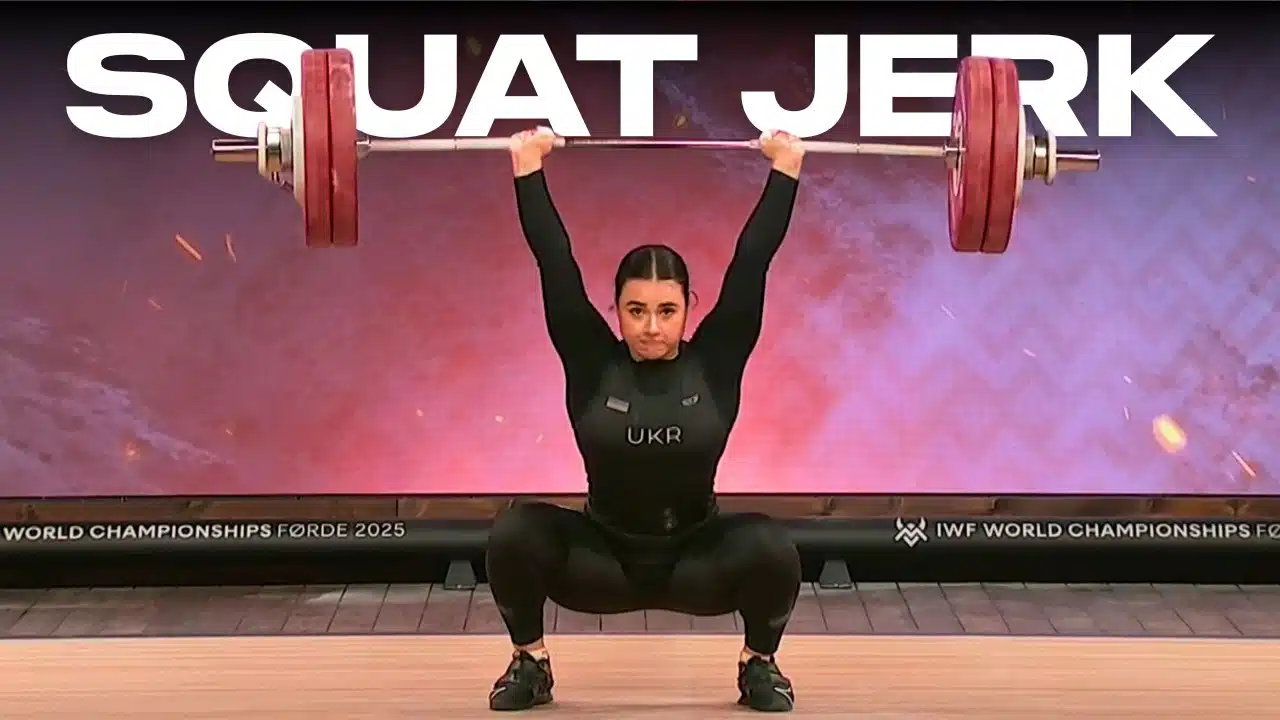
What makes this even more remarkable? She did something rarely seen in competitive weightlifting during her final attempt.
And it’s sparking conversation about technique, adaptation, and the sheer mental fortitude required at elite levels.
Jump to:
- Mastering One of Weightlifting’s Rarest Techniques
- Building Momentum: From 124kg to Personal Best Territory
- The 131kg Attempt: Breaking Barriers With Unconventional Adaptation
- Lessons From Elite Performance
- Squat Jerk vs. Split Jerk: Understanding the Tradeoffs
- The Coaching Connection
- What Makes Performances Like This Inspirational
Mastering One of Weightlifting’s Rarest Techniques
Drovska specializes in squat jerking—an uncommon variation where lifters drop into a full squat position rather than splitting their legs or performing a power jerk.
Commentary during the event highlighted just how special this technique is to witness live. One commentator noted the electric atmosphere when newcomers see it for the first time.
It’s always one of my favorite things is seeing new fans of the sport turn up and they watch and they see that and they just the room just goes.
The squat jerk requires extraordinary mobility, timing, and courage. Unlike split jerking—where lifters create a stable base by stepping forward and backward—squat jerkers must catch massive weights while dropping straight down into a deep squat.
It’s technically demanding and leaves virtually no margin for error. One miscalculation and the barbell crashes down.
Building Momentum: From 124kg to Personal Best Territory
Drovska opened strong with 124 kilograms—already impressive weight for her category.
Commentators praised her clean execution and textbook squat jerk form. But this was just warming up.
Her second attempt jumped to 128 kilograms—a 4-kilogram personal record. Tension filled the arena as she approached the loaded barbell.
Can he hold it? Yes. What a beautiful lift.
The successful lift demonstrated not just physical strength but mental resilience. Setting personal records under competition pressure separates good lifters from great ones.
But Drovska wasn’t finished. Personal connections added emotional weight to her performance—one commentator revealed that Drovska trains under coach Vitalia Rashor, who had also coached them.
I’m like crossing fingers on both of my hands.
The 131kg Attempt: Breaking Barriers With Unconventional Adaptation
Drovska’s final attempt loaded 131 kilograms onto the bar—a staggering 7-kilogram personal record beyond her previous best of 124kg.
This wasn’t incremental progress. This was explosive breakthrough territory.
As she set up for the lift, anticipation reached fever pitch. Then something extraordinary happened.
Did she take a step? Did she take a small step when she was at the bottom? I’ve never seen that in a squad.
Replay footage confirmed what seemed impossible—while locked in the bottom squat position with 131 kilograms overhead, Drovska adjusted her foot placement by taking a small step.
This adaptation is virtually unheard of in squat jerking. Lifters occasionally adjust footing during split jerks, but doing so from a deep squat with maximal weight overhead requires unbelievable balance and body control.
Why This Matters for Technique and Training
Drovska’s mid-lift adjustment highlights crucial principles for lifters at any level:
- Adaptability under pressure: Perfect conditions rarely exist in competition—athletes must problem-solve in real-time
- Core stability mastery: Making positional adjustments while supporting maximum loads requires exceptional trunk control
- Proprioceptive awareness: Understanding exact body position in space allows micro-corrections that save lifts
- Mental composure: Maintaining focus during unexpected challenges separates successful attempts from failures
Most lifters would panic if their positioning felt off mid-lift. Drovska made a calculated adjustment and completed the lift successfully.
Lessons From Elite Performance
Recreational lifters and athletes can extract valuable insights from Drovska’s performance—even if squat jerking isn’t part of their programming.
Progressive Overload With Strategic Jumps
Drovska didn’t attempt 131 kilograms immediately. She built confidence with 124kg, pushed boundaries with 128kg, then went for broke at 131kg.
This approach allows neuromuscular adaptation and psychological preparation. Each successful lift reinforces belief that heavier weights are achievable.
Technical Proficiency Under Fatigue
Maintaining proper form during maximal efforts requires thousands of practice repetitions at submaximal weights.
Drovska’s ability to execute three technically complex squat jerks—including one requiring mid-lift correction—demonstrates mastery developed through consistent, deliberate practice.
Mental Toughness Development
Setting a 4kg personal record, then immediately attempting another 3kg increase requires supreme confidence.
Athletes can cultivate this mentality by regularly pushing beyond comfort zones in training—not recklessly, but with calculated risk-taking that builds resilience.
Squat Jerk vs. Split Jerk: Understanding the Tradeoffs
Approximately 95% of Olympic weightlifters use split jerking rather than squat jerking. Why does Drovska buck this trend?
Squat jerk advantages:
- Shorter bar path—less distance to move weight overhead
- No forward/backward stepping—maintaining vertical bar trajectory
- Potential for faster recovery from bottom position for athletes with exceptional leg strength
Split jerk advantages:
- Wider, more stable base of support
- Less extreme mobility requirements
- Easier to save slightly off-balance lifts
- More forgiving timing windows
Elite lifters choose techniques matching their physical attributes and training backgrounds. Drovska’s success proves that unconventional approaches can work when executed with world-class precision.
The Coaching Connection
The emotional investment from commentators added human dimension to technical excellence. Sharing a coach creates bonds within weightlifting communities.
Coach Vitalia Rashor has clearly developed methodology producing exceptional squat jerkers—a specialized skill requiring specific programming most coaches don’t emphasize.
Finding coaches who understand individual strengths and build programs around them—rather than forcing athletes into standard templates—makes enormous difference in reaching potential.
What Makes Performances Like This Inspirational
Drovska’s lifts transcend mere numbers on barbells. They represent dedication, courage, and willingness to attempt what seems impossible.
That final 131-kilogram lift—complete with mid-squat footwork adjustment—will be studied and discussed in weightlifting circles for years.
It demonstrates that perfect technique matters less than effective technique. Adaptation and problem-solving under extreme stress define champions.
Whether training for Olympic platforms or personal fitness goals, Drovska’s performance offers timeless lessons: believe in progressive improvement, master fundamentals through relentless practice, stay composed when challenges arise, and never stop pushing boundaries.
Arena Drovska just showed exactly what human potential looks like when talent meets preparation.