Learning proper squat technique can feel overwhelming with so many conflicting cues and coaching styles floating around the internet.
But what if there was a systematic approach that addressed every common mistake you’re likely making?
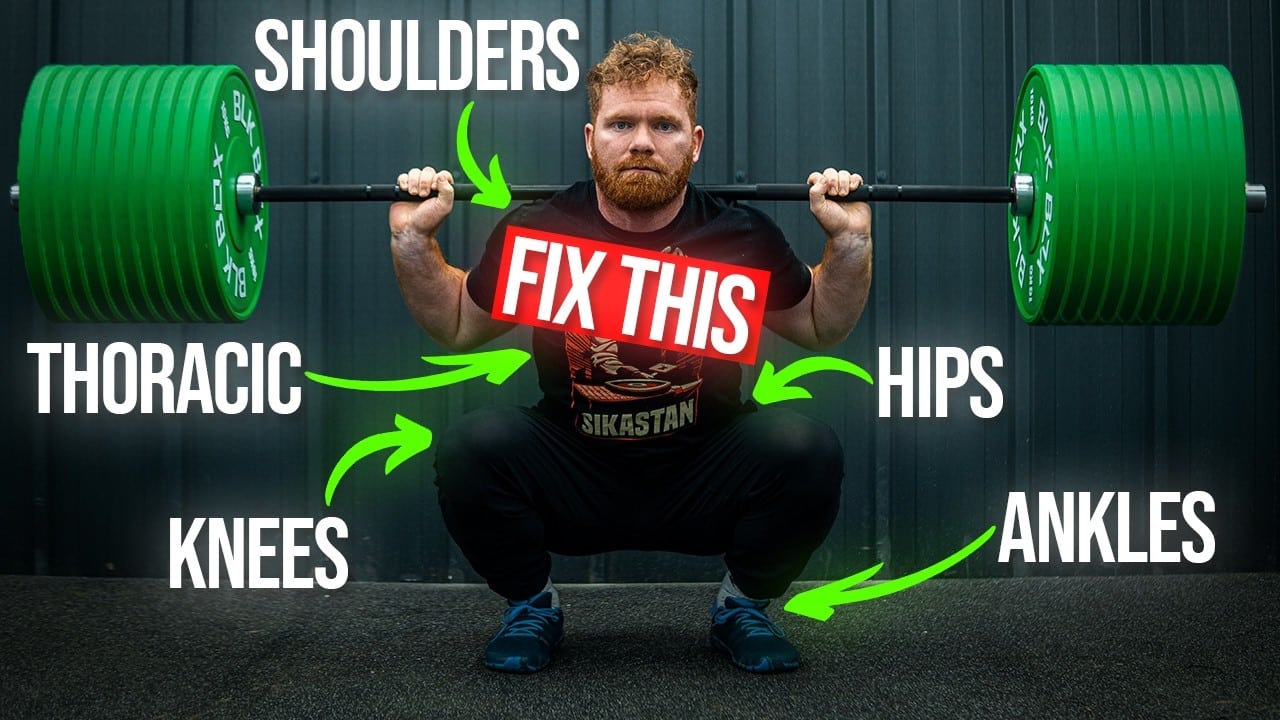
Strength coaches have broken down the back squat into a comprehensive blueprint that works for non-competitive lifters of all body types.
From bar position to stance width, bracing mechanics to mobility fixes, this guide covers the technical details that separate mediocre squatters from those who build serious strength safely.
Jump to:
- The Foundation: Bar Position Matters More Than You Think
- Stance Width and Foot Positioning
- Mastering the Brace Position
- Two Effective Descent Strategies
- Fixing Back Rounding During Squats
- Addressing Butt Wink
- Comprehensive Mobility Solutions
- Correcting Knee Valgus
- Preventing Heel Lift
- Understanding Sticking Points
The Foundation: Bar Position Matters More Than You Think
Most lifters don’t realize that bar placement can make or break their squat performance. The choice between high bar and mid bar positioning depends entirely on individual body proportions.
Lifters with longer torsos relative to femur length typically handle both positions well. Those less naturally built for squatting benefit dramatically from mid bar placement.
Just note that the difference between high bar and mid bar when you’re looking at it visually is actually quite small, but the difference it makes to your squat and how it feels on your back will feel drastic.
High bar placement sits directly on top of the traps, following the classic weightlifting position. Mid bar targets the widest part of the shoulder while remaining distinctly different from low bar positioning, which sits much lower on the back.
Stance Width and Foot Positioning
A shoulder-width stance with toes turned out approximately 30 degrees works best for most people. However, individual variations exist.
Some lifters need slightly narrower or wider stances depending on hip structure and mobility limitations. Experimentation with both weighted and unweighted squats helps identify optimal positioning.
Mastering the Brace Position
Proper bracing separates amateur squatters from technical masters. The key distinction involves pulling the chest up without forcing ribs forward.
I breathe up into my chest and I allow my lower back to sit in its natural lumbar extension.
Elbow position should remain approximately 45 degrees relative to the torso—not too low, not too high. Wrists should stay relatively straight rather than excessively extended.
Natural lumbar extension with chest up and ribs down creates stability. Overextending the ribs or tucking excessively both compromise lower back position and increase injury risk.
Two Effective Descent Strategies
Coaches teach two distinct approaches to the squat descent, both equally valid depending on individual needs.
Strategy One: Focus exclusively on pushing knees forward throughout the entire movement, maintaining this forward knee drive from descent through ascent.
Strategy Two: Break simultaneously at hips and knees, pushing knees forward while sending hips back, maintaining tension throughout the full range of motion.
Contrary to popular belief, the choice between these strategies depends more on strength weaknesses and mobility than body proportions. Some long-femured lifters benefit from keeping heels and hips closer together during the movement.
Fixing Back Rounding During Squats
Back rounding represents one of the most common and problematic squat errors. Multiple causes require different solutions.
Solution #1: Adjust Bar Position
When the barbell sits too high on the back, it pushes forward during descent. Moving to mid bar position keeps the bar closer to center of balance, reducing pressure on the back.
Solution #2: Correct Rack Position
Excessively vertical elbows open up the upper back, making extension harder to maintain. Positioning elbows at 45 degrees contracts shoulder blades together, facilitating better positioning throughout the movement.
Elbows positioned too high drive even higher during the squat, pushing the barbell forward and increasing back rounding.
Solution #3: Synchronize Hip and Knee Movement
Sending hips back before knees break adds forward momentum to torso and barbell, predisposing lifters to excessive rounding.
Never let your hips move unless your knees have moved as well.
Solution #4: Fix Ascent Mechanics
Many lifters descend correctly but immediately send hips backward when standing from the bottom position. Instead, drive knees aggressively forward during ascent, consciously preventing hips from traveling backward prematurely.
Solution #5: Strengthen Posterior Chain
Weak back muscles simply cannot maintain contracted positions under heavy loads. High-volume assistance work addresses this fundamental weakness.
- Seal rows for upper back development
- Chin-ups for lat strength
- Barbell rows for overall back thickness
- Back extensions for lower back endurance
Execute these exercises with high volume and intensity using various set structures—EMOM, supersets, or tri-sets all work effectively.
Addressing Butt Wink
Excessive butt wink often signals underlying technical or mobility issues that limit performance, regardless of injury concerns.
Develop Positional Awareness
Some lifters lack proprioceptive awareness of lower back position during squats. Slowing descent until natural lumbar extension becomes second nature resolves this issue.
Optimize Starting Position
Pulling ribs down and taking the lower back out of extension automatically predisposes lifters to butt wink. Conversely, overextending ribs eliminates mobility needed to maintain extension throughout the movement.
The solution remains consistent: pull chest up, allow lower back to sit in neutral extension without overextending.
Address Mobility Limitations
Poor ankle mobility prevents knees from traveling forward adequately, causing lower back bunching. Systematic mobility testing identifies specific deficits requiring attention.
Essential mobility tests include:
- Hip internal and external rotation
- Hip flexion range
- Ankle dorsiflexion distance from wall
- Shoulder rotation capacity
- Thoracic spine mobility
These tests need not be perfect measurements—they simply provide baseline comparisons between limbs and progress markers for reassessment.
Comprehensive Mobility Solutions
Most mobility programs fail because lifters don’t stretch frequently enough, long enough, or intensely enough to produce results.
Hip Extension
Banded couch stretches with neutral torso positioning target hip extension effectively. Combine with foam rolling for enhanced results, holding stretches minimum 45 seconds.
External Hip Rotation
Standing pigeon stretches at various heights address external rotation limitations. Find uncomfortable positions and maintain them, pairing with soft tissue work on glutes and hamstrings.
Internal Hip Rotation
Passive stretches allowing knees to drift inward as tissues soften work well. Combine with VMO and adductor soft tissue work, despite the significant discomfort involved.
Hip Flexion
Supported bodyweight squats at multiple stance widths and toe angles accumulated for five-plus minutes per session improve hip flexion dramatically.
Ankle Mobility
Address ankles from two positions—straight leg heel drops and weighted knee-over-toe stretches with hip flexion. Build intensity gradually to avoid tendon irritation. Tibialis anterior rolling helps eliminate blocking sensations.
Overhead Mobility
Foam roller overhead stretches with various hand positions benefit squatting, pressing, and weightlifting movements. Perform for reps or static holds.
Correcting Knee Valgus
Inward knee movement during squats stems from three primary causes requiring distinct approaches.
General Weakness in Beginners
New lifters experience technical breakdown somewhere—often manifesting as knee valgus. Without immediate pain or significant side-to-side discrepancies, continued training typically resolves the issue naturally through increased strength and practice.
Specific Glute Weakness
External rotation requirements throughout full range squats demand strong glutes. Weakness relative to other involved muscles prevents proper knee tracking.
Effective assistance exercises include:
- Pauses at parallel with hip circle holds for time
- Side steps or monster walks to failure
- Bulgarian split squats performed correctly (straight down, not sitting back)
- Heels-elevated zombie squats
Choose the most difficult exercise and perform it consistently for eight weeks with high volume, lighter weights, and excellent technique before progressing to heavier loads.
Hip Mobility Restrictions
Insufficient hip external rotation mobility forces knees inward throughout the movement. Refer to mobility testing and correction protocols outlined previously.
Preventing Heel Lift
Heels lifting during squats reduces stability and force output significantly. Three solutions address this common problem.
Slow practice develops awareness of even foot pressure distribution—neither excessive heel nor toe loading. Master this feel with lighter weights before progressing to heavier, more explosive lifting.
Poor ankle mobility prevents adequate knee-over-toe travel, forcing heel elevation. Test ankle mobility and implement appropriate stretching protocols.
Weightlifting shoes with raised heels and stable platforms improve squatting dramatically for most lifters. Even inexpensive options provide transformative benefits worth the investment.
Understanding Sticking Points
Most lifters miss heavy squats just above parallel—the most mechanically disadvantageous position with hips driven back. This represents where failure occurs at maximum loads, not necessarily a specific weakness requiring targeted work.
The real solution to this is just getting stronger. When you get stronger, you will overcome these sticking points.
Specific overloading through pin squats, box squats, or paused variations rarely produces the promised results. Progressive overload through consistent training remains the most reliable path forward.
Addressing these common squat errors systematically transforms performance and reduces injury risk. Technical mastery combined with appropriate mobility work and assistance exercises builds sustainable strength gains that compound over training years.