Forearm training might seem straightforward, but most people are doing it wrong.
That’s according to fitness experts who’ve cracked the code on building serious forearm size and strength.
The secret isn’t just doing more farmer’s carries or using fat grips on your bicep curls.
It’s about understanding the 20 individual muscles in each forearm and training them with proper movements that match their specific functions.
Jump to:
Why Most Forearm Training Falls Short
Many lifters assume isometric holds will build impressive forearms. They’re mistaken.
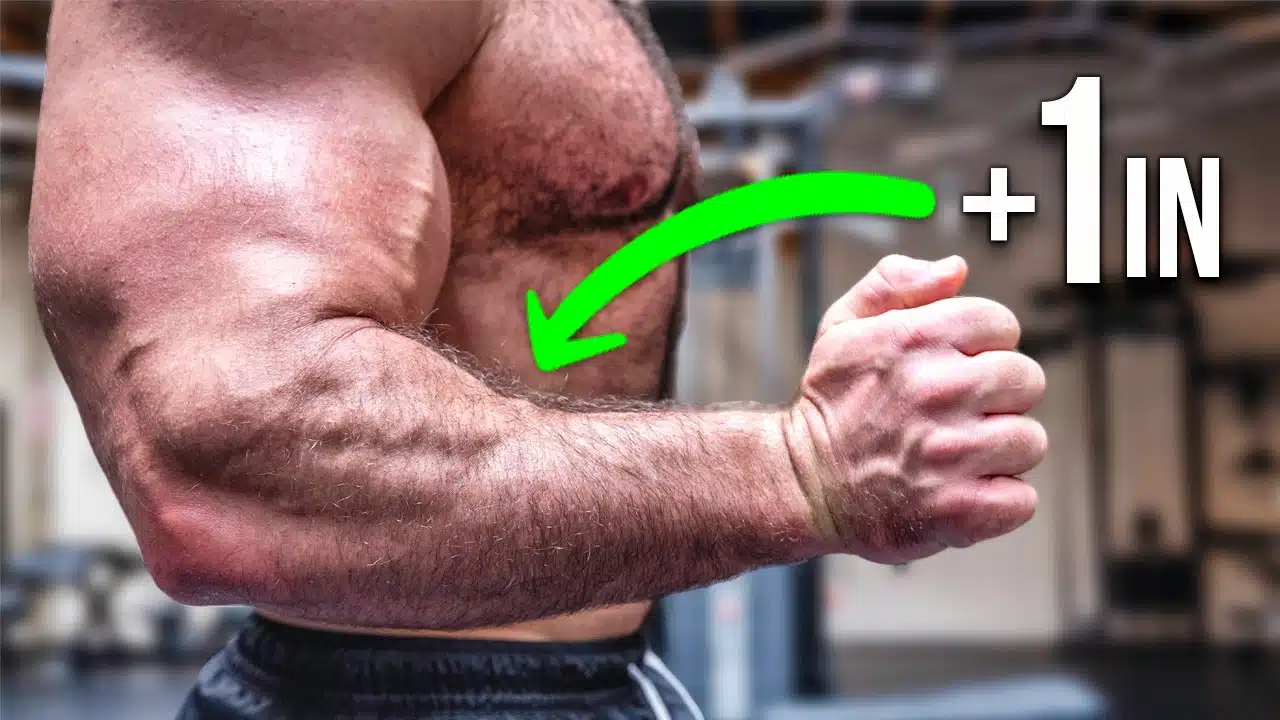
While static exercises like farmer’s carries increase neural adaptations quickly, they have serious limitations for muscle growth. One trainer who added an inch to his forearms explained his past mistakes:
I neglected the finger extensors and flexors because I assume isometric holds would get the job done. I was wrong. Over time I developed tennis elbow in my right arm and golfer’s elbow in my left.
The result? He couldn’t even pick up objects with his right hand or perform standard curls with his left.
Isometric holds create small amounts of hypertrophy, but dynamic movements with full extension and flexion build significantly more muscle mass. Forearms show the greatest correlation between size and strength of any muscle group, making targeted training essential.
Understanding Forearm Anatomy
Each forearm contains 20 individual muscles responsible for distinct functions:
- Wrist flexion and extension
- Radial and ulnar deviation
- Pronation and supination
- Finger flexion and extension
- Elbow stabilization
Breaking these down into functional groups makes training far simpler than memorizing anatomy charts.
Training The Finger Flexors
The flexor digitorum superficialis and profundus control grip strength for fingers two through five. These muscles insert at different points on your finger bones, which determines optimal training methods.
Wrist curls with finger rolls remain the gold standard. Allow the weight to roll into your fingers at the bottom for maximum stretch, then curl both your fingers and wrist.
Hand grippers offer an alternative with easier progressive overload, though they emphasize grip strength over pure hypertrophy. Prioritizing muscle growth first creates the foundation for stronger grip later.
The Truth About Fat Grips
Fat grips serve a specific purpose, but it’s not what most people think.
Research shows they actually decrease bicep activation during curls. They’re designed for wrist flexion and extension exercises, not arm training.
The increased diameter starts finger flexors at greater length, making them excellent for wrist curls. Using them on bicep movements? That’s just marketing hype.
Targeting Primary Wrist Flexors
Wrist flexor muscles originate on the medial epicondyle near your elbow. Their natural line of action follows an angle involving flexion, pronation, and slight ulnar deviation.
Standard wrist curls cut range of motion in half by ignoring this natural movement pattern.
Cable wrist curls with dual handles solve this problem perfectly. Lean forward for deep stretch, then pronate with slight ulnar deviation as you curl. This follows the muscles’ actual fiber direction.
Advanced lifters can use mechanical drop sets: start with finger flexion until failure, then continue with pure wrist flexion.
Pronator Training
Pronator muscles respond best to rotational resistance. Loop a strap attachment around your hand and pronate against cable resistance, letting the strap roll under your knuckles.
Bringing your elbow slightly forward improves mind-muscle connection. Traditional dumbbell pronation works but lacks an ideal strength curve.
Posterior Forearm Development
The posterior compartment houses 12 muscles, but grouping them by function simplifies programming dramatically.
Finger Extensors: The Missing Link
Neglecting finger extensors creates serious problems. Medial epicondylitis (golfer’s elbow) and lateral epicondylitis (tennis elbow) stem from imbalances between flexor and extensor strength.
Rubber band exercises seem gimmicky but allow progressive overload through different resistance levels. They’re essential for injury prevention.
Training these muscles helped one lifter completely rehabilitate both golfer’s and tennis elbow:
I started out by just not wearing straps during back day whatsoever, which sucked at first. Then I added in heavier eccentrics because it helps you retrain any sort of protective movement patterns you might be doing.
Wrist Extensors
Three primary wrist extensors cross the elbow joint, creating programming decisions. Keeping your arm straight maximizes length, but two muscles assist radial deviation while one aids ulnar deviation.
Single-handle cable extensions allow natural abduction or adduction despite slight elbow flexion. Experiment to find what creates the strongest contraction for your anatomy.
Building The Brachioradialis
This muscle originates on the lateral humerus, wraps around the forearm, and inserts on the lateral radius. It’s an elbow flexor with zero wrist involvement.
Hammer curls theoretically maximize brachioradialis activation with neutral wrist position. Reality proves more complex.
Research reveals significant individual variation in strongest elbow flexors. People with dominant biceps need pronated movements to limit bicep involvement and force brachioradialis work.
Two standout exercises:
- Reverse grip Smith machine drag curls: Lean slightly back, drag the bar up your torso with reverse grip
- Rotating strap curls: Start with thumbs pointing in, rotate outward as you curl
Drag-style pinwheel curls across the body create exceptional brachioradialis activation by pulling outward simultaneously.
Preventing Overuse Injuries
Golfer’s elbow and tennis elbow represent inflammation where multiple muscles share common tendons at the elbow.
Training every forearm function prevents muscular imbalances that create chronic tendon stress. Small muscles matter just as much as large ones.
Rehabilitation follows a progressive sequence:
- Remove straps from all pulling exercises
- Add controlled eccentric training
- Progress to full range dynamic movements
- Incorporate dedicated finger extensor and flexor work
This approach addresses protective movement patterns while rebuilding balanced strength.
Complete Forearm Training Strategy
Effective forearm development requires hitting multiple movement patterns:
- Finger flexion: Wrist curls with finger rolls, hand grippers
- Finger extension: Rubber band exercises
- Wrist flexion: Cable curls with dual handles, incline bench wrist curls
- Wrist extension: Cable or dumbbell reverse wrist curls
- Pronation: Cable or dumbbell pronation
- Supination: Cable or dumbbell supination
- Brachioradialis: Reverse grip drag curls, rotating cable curls
Forearms recover quickly, allowing training 2-3 times weekly. Combining isometric holds with dynamic movements creates comprehensive development.
Most importantly, consistent progressive overload on all movement patterns prevents imbalances while building impressive size and functional strength. The lifter who transformed his forearms summed it up perfectly: train every single muscle, no matter how small, because neglecting any creates dysfunction down the line.