Retirement doesn’t mean staying on the couch forever—at least not for Jason Kelce.
The former Philadelphia Eagles center recently returned to his old training facility to test whether he could still hang with an NFL-level workout.
Spoiler: it wasn’t pretty, but it was revealing.
Working alongside Fernando Noriega, director of player performance and sports science for the Eagles, Kelce tackled everything from speed drills to heavy squats—pushing his post-retirement body to limits he hadn’t touched in over a year.
Jump to:
Warming Up: Coordination Takes a Hit
Kelce started with dynamic stretching and movement drills, immediately revealing what a year away from structured training does to an elite athlete.
Feels very tight in there.
His shoulders were already betraying him during shoulder activation exercises. But things got worse during coordination drills—specifically ladder work.
This is where I wonder if my coordination is still here.
After fumbling through footwork patterns that used to be second nature, Kelce was brutally honest.
That’s not a quickness issue, though. That’s a coordination issue, which it’s even more embarrassing.
Coordination declines faster than strength or speed when training stops. Neural pathways that fire rapidly during specific movements weaken without consistent use, making familiar drills feel foreign.
Speed Test: Faster Than Ever?
Despite coordination struggles, Kelce’s max speed test delivered a shocking result.
His fastest recorded speed during his playing career was 19.2 miles per hour. On his first attempt post-retirement, he clocked 19.64 mph.
Are you kidding me? LET’S GO.
On his second attempt, he hit 19.72 mph—his fastest speed ever recorded.
Some of the guys that are playing now probably can’t hit that. Like, that’s crazy.
How does someone run faster after retirement? Weight loss likely played a role. Kelce mentioned he’d dropped weight since leaving the game, reducing mass without sacrificing power output temporarily boosts top-end speed.
Plus, he wasn’t carrying game-day fatigue, chronic injuries, or mental stress from an NFL season.
Power Output: Reality Sets In
Power testing brought Kelce back down to earth.
Using trap bar deadlifts measured on force plates, Noriega set benchmarks: 2,600 watts at 200 pounds and 3,612 watts at 300 pounds. Kelce fell short on both attempts, hitting only 2,200 watts initially.
To help, Noriega suggested using a weightlifting belt, which improves intra-abdominal pressure and allows lifters to generate more force.
Even with assistance, Kelce managed only 3,700 watts—below his target but respectable given his time away.
Force Plate Jump Test: A Steep Decline
Force plate testing measures explosive power during vertical jumps by capturing force generated during takeoff and landing.
Kelce’s peak force during his playing days? 9,362 Newtons in 2023.
His first jump post-retirement: 7,000 Newtons.
It’s embarrassing. It’s really bad.
His second attempt wasn’t much better—6,900 Newtons.
Fatigue from previous drills likely contributed, but explosive power declines rapidly without consistent plyometric training. Fast-twitch muscle fibers atrophy quicker than slow-twitch fibers when unused, directly impacting jump performance.
Squat Test: Chasing 500 Pounds
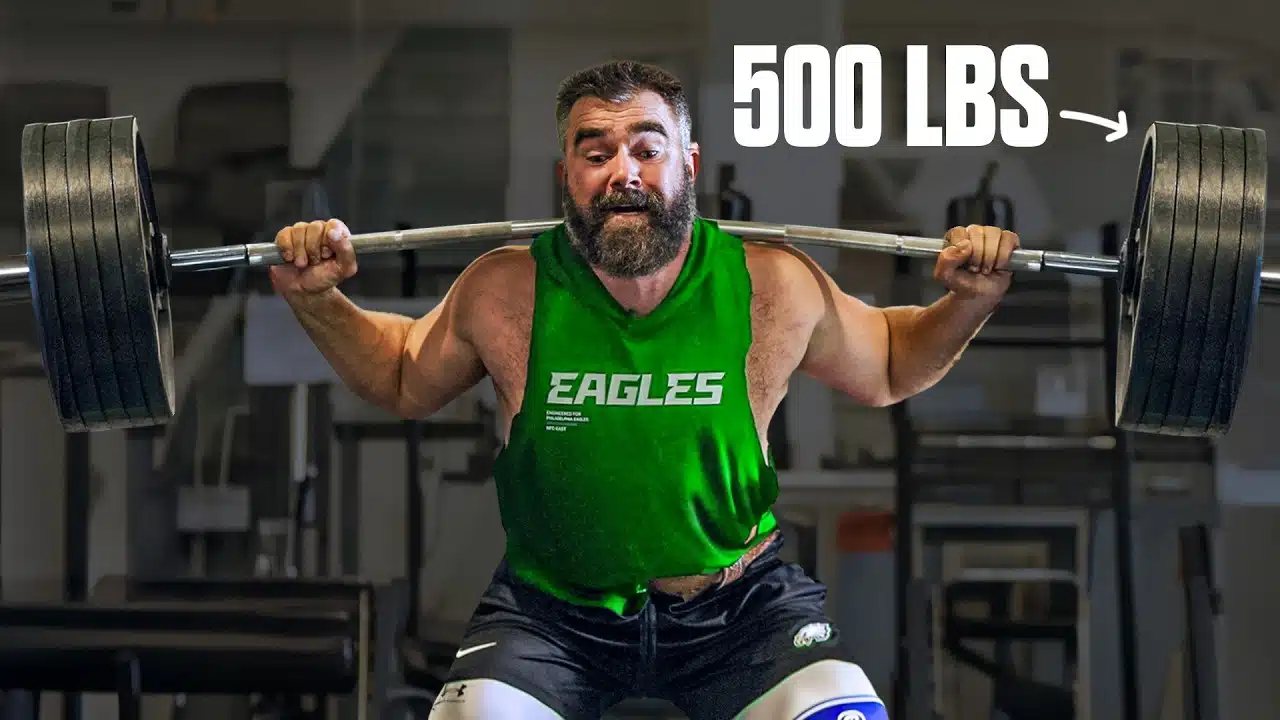
Kelce’s ultimate goal was hitting 500 pounds on the back squat—a weight he routinely lifted during his playing career.
In season a number that I would routinely try and hit once every month or once every two months. I would try and hit 500 lb for me. And this is where like the psychological thing is like just knowing that I could do that. I felt strong.
After warming up progressively, Kelce attempted three reps at lighter weight to gauge readiness.
I don’t think it’s going to happen today, guys. I can just feel it. That was way harder than it should be.
He dropped to doubles, working up cautiously. At 455 pounds, form looked solid but effort was maximal.
Noriega suggested a psychological trick: load 550 pounds on the bar so 500 feels lighter by comparison.
Oh, I guess I’ll do 500 now that I’m not doing 550.
Instead, Kelce loaded 505 pounds and attempted one rep. He descended under control but couldn’t complete the lift, grinding halfway up before stalling out.
It was a good try. It was a good try. I suck. I’m a little tired.
Accessory Work: Fatigue Wins
Finishing exercises included lat pulldowns and grip endurance holds—both revealing cumulative fatigue.
I am so tired. I’m fading quick. Fading quick.
Even grip strength showed asymmetry. Years of hand-fighting offensive linemen left Kelce’s thumbs weaker than expected.
Years of punching people and grabbing them have made my thumbs very weak.
What This Reveals About Detraining
Kelce’s workout demonstrates detraining effects—physiological changes that occur when structured training stops.
Key observations:
- Coordination declines fastest: Complex movement patterns degrade within weeks without practice
- Speed can temporarily improve: Reduced bodyweight and recovery from chronic fatigue may boost top speed short-term
- Explosive power drops significantly: Fast-twitch muscle fibers and neural drive diminish rapidly without plyometric work
- Maximal strength holds better: Though down from peak, Kelce retained considerable strength despite a year off
- Cumulative fatigue matters: Without training conditioning, workout volume becomes overwhelming quickly
Research shows strength athletes can maintain 70-80% of strength for several months post-retirement, but power and speed qualities decline faster. Kelce’s experience aligns perfectly with this pattern.
Practical Takeaways for Everyday Athletes
Even elite athletes lose fitness quickly when training stops—but foundational strength endures longer than expected.
Key lessons:
- Maintain movement patterns: Keep practicing complex exercises even at lower intensity to preserve coordination
- Explosive power needs consistent work: Plyometrics and power exercises require regular training to maintain
- Strength is resilient: Maximal strength fades slower than other qualities, making it worth building
- Manage expectations after breaks: Performance drops are normal—progressive reintroduction prevents injury
- Psychological benchmarks motivate: Having performance standards keeps training focused and meaningful
Kelce’s honest assessment of his performance shows that staying humble and realistic prevents injury during comeback attempts.
Final Verdict
Could Jason Kelce complete an NFL workout? Technically yes—but not at his playing-level intensity.
His speed test shocked everyone, proving some qualities can temporarily improve post-retirement. But power, coordination, and work capacity all showed significant decline.
When asked how post-retirement Kelce compared to playing-days Kelce, Noriega wisely kept comparisons internal rather than embarrassing his former athlete publicly.
For anyone stepping away from structured training—whether professional athlete or weekend warrior—Kelce’s experience offers valuable perspective: fitness fades faster than expected, but foundational strength remains surprisingly resilient with proper reintroduction.